Summary
- ACMA's draft Albury radio plan withholds the proposed 2AY commercial FM specification on 107.3 MHz until five transmission events occur: 2REM leaves that frequency, starts its Albury replacement and Culcairn infill, and 2AAA starts infill transmitters in Ladysmith and Uranquinty under the Wagga Wagga plan.
- The consultation paper predicts that 2AY's new signal would put 1,519–2,651 people within potential interference to 2AAA's existing coverage. The two proposed Wagga Wagga infills reduce the modelled range to 1,009–1,446; some potential interference remains.
- The Albury draft names Uranquinty's transmitter TS120001546 in its fifth condition. The Wagga Wagga draft names the same planned 97.5 MHz transmitter TS12001546. ACMA's consultation closes at 5 pm AEDT on 30 November 2026.
The largest piece of hardware in this story is not the first one allowed to turn on. ACMA proposes moving Albury commercial station 2AY from 1494 kHz AM to a new 107.3 MHz FM transmitter at Mt Baranduda. Its draft specification allows a directional pattern reaching 100 kW maximum effective radiated power in some sectors. That is an impressive transmitter. The document governing its start is a checklist for other broadcasters.
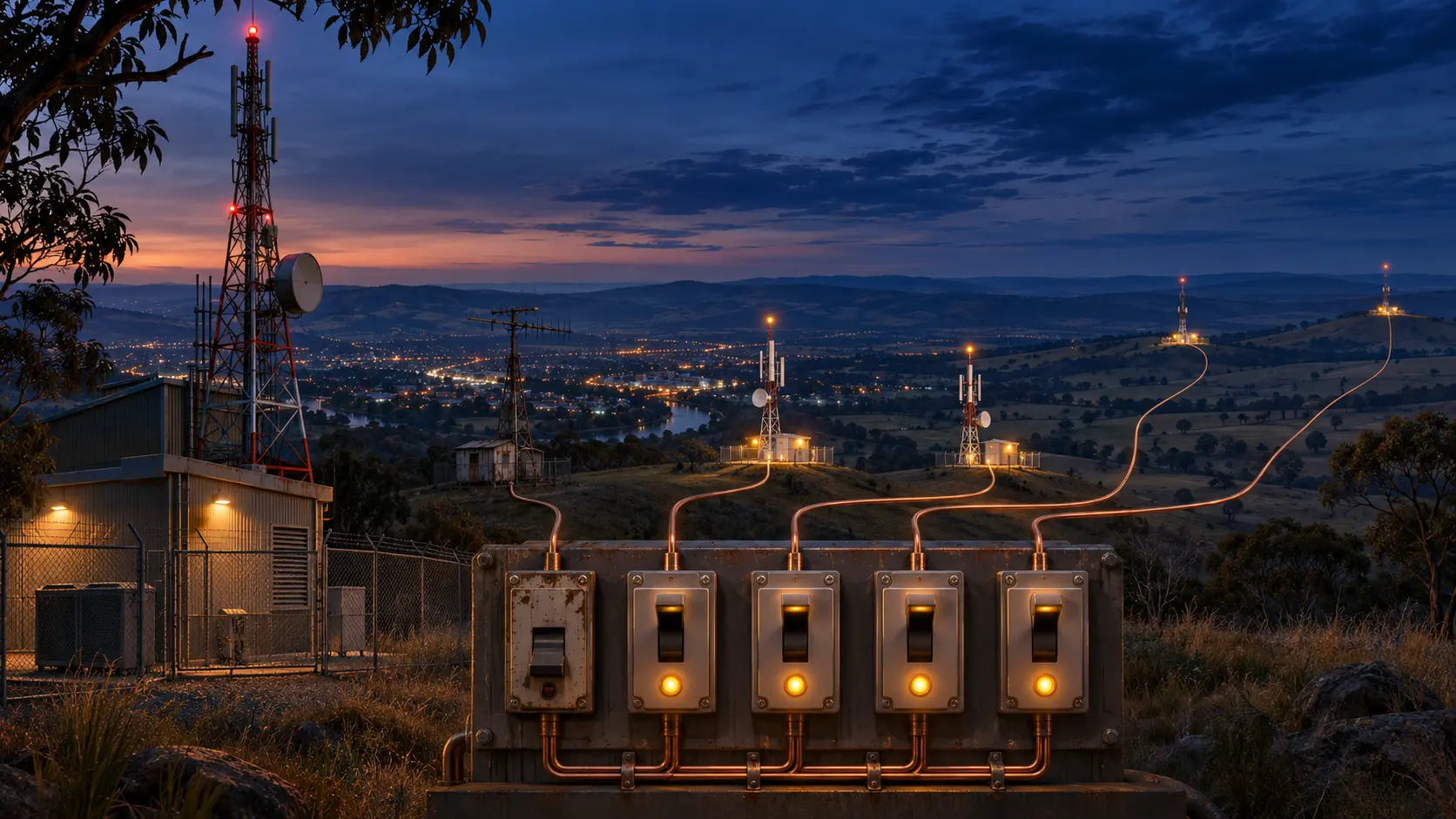
Read Attachment 1.12A of the draft Albury licence-area plan variation. The proposed 2AY FM specification, TS12001372, becomes available only on the first day all five listed events have occurred. First, community station 2REM must stop using the 107.3 MHz transmitter that occupies 2AY's proposed channel. Second, 2REM must actually transmit on its replacement 90.5 MHz Albury specification. Third, it must transmit from a new 96.3 MHz infill site at Culcairn. Fourth and fifth, a different community broadcaster, 2AAA in the Wagga Wagga area, must transmit from two new 97.5 MHz infill sites at Ladysmith and Uranquinty. The last two sit under another licence-area plan.
That is a chain, not a permission slip. A paper frequency assignment for 2REM does not satisfy the condition that its replacement transmitter carry a service. A planned Culcairn infill does not satisfy the requirement that it transmit. And clearing 107.3 MHz in Albury leaves two Wagga Wagga conditions untouched. The draft binds the commercial launch to actual transmissions by community operators, including one whose main station stays on its existing 107.1 MHz frequency.
Why Wagga Wagga is on Albury's switchboard
The Wagga Wagga conditions are the price of 2AY's proposed signal reaching beyond Albury. ACMA's consultation paper models potential interference from the new 107.3 MHz commercial service into 2AAA's 107.1 MHz community service. It puts 1,519–2,651 people in the potentially affected area before the two new infills. Existing services without the proposed 2AY FM signal produce a modelled 50–156. The difference is substantial enough that ACMA proposes a mitigation bargain rather than treating Wagga Wagga as an irrelevant neighbour on a map.
2AAA preferred to keep its main frequency. The proposed answer is two small transmitters on 97.5 MHz: up to 10 W at Ladysmith and 25 W at Uranquinty. ACMA says these reduce the potentially affected population to 1,009–1,446. The remaining range matters. The infills mitigate the predicted interference; they do not erase it. The paper says 2AAA is willing to accept potential interference in outer areas and agrees to the proposed infill measures, with 2AY licensee Ace Radio supporting the changeover. Those numbers are propagation-model estimates, not a count of listeners who have lost a station.
The regulator could have described this as a commercial technology upgrade and left the community consequences in an appendix. Instead, the draft turns both community infill transmissions into conditions for the commercial transmitter itself. That decision puts operating evidence where the bargain lives. The smaller broadcaster's promised protection must be on air before the larger broadcaster takes its new channel.
The same logic explains the nearby Albury and Culcairn requirements. 2REM currently uses 107.3 MHz. ACMA proposes moving it to 90.5 MHz in Albury, with up to 2 kW, and adding a 96.3 MHz, 50 W infill at Culcairn. Neither the replacement frequency nor the infill is an administrative footnote for the broadcaster that has to carry its audience across the move. The old 107.3 MHz signal must stop before 2AY can start there; the other two 2REM signals must run. This is a more exacting handoff than simply drawing two stations into different boxes on a plan.
The one extra zero
The five-condition lock also contains a small problem with a large target. The Albury draft's fifth condition refers to Uranquinty's transmitter as TS120001546. The companion draft Wagga Wagga variation lists the 97.5 MHz Uranquinty service, licence SL3039, as TS12001546 in Schedule Four and Attachment 4.8. The Albury reference has an extra zero. Both documents are ACMA's own consultation texts. The mismatch is visible without a rival account or a guess about anyone's intent.
The natural fix is a corrected cross-reference before the instrument is made. Until then, a person planning the handoff has to ask which exact specification satisfies the fifth condition as drafted. A condition that names the wrong technical record is poor engineering even when everybody understands the intended tower. ACMA's published consultation invites submissions until 30 November; that is a concrete item to settle in the final text.
Two separate 28-day clocks sit behind the activation gate. The Albury draft would end availability of 2REM's old 107.3 MHz specification 28 days after its 90.5 MHz service first transmits. It would end availability of 2AY's old 1494 kHz AM specification 28 days after 2AY's FM service first transmits. These are different triggers. The first 28-day allowance does not open a period for 2REM and 2AY to share 107.3 MHz: the 2AY FM condition separately requires 2REM's old transmission to have stopped. The second clock begins only after the commercial FM service itself starts.
Nothing in the 30 October consultation gives the dates on which those five prerequisite events occur. The plan is still a draft. The record needed to change the operational conclusion is the final registered instrument, followed by the old-frequency stop date, the four new community-service start dates and the first 2AY FM transmission. Until those are on the record, a timetable that starts with “2AY gets FM” skips the stations that have to make it possible.
Member Briefing
Deeper Profile Context
Sign in with the right membership level to unlock the full briefing and source notes.
Only for Strategic Circle
Strategic Circle
Open to all readers. Unlock profile briefings after joining and signing in.
Join Strategic CircleOnly for Leadership Alliance
Leadership Alliance
For qualified IP-asset owners and management; sign in to unlock alliance briefings.
Join Leadership Alliance