Summary
- ACMA proposes moving Albury community station 2REM from 107.3 to 90.5 MHz, freeing 107.3 MHz for commercial AM station 2AY's FM conversion. The proposed 2AY transmitter could operate at up to 100 kW maximum effective radiated power.
- The draft plan gives the old 2REM transmitter specification 28 days after 90.5 MHz starts, and the old 2AY AM specification 28 days after 2AY's FM service starts. Each clock has its own trigger.
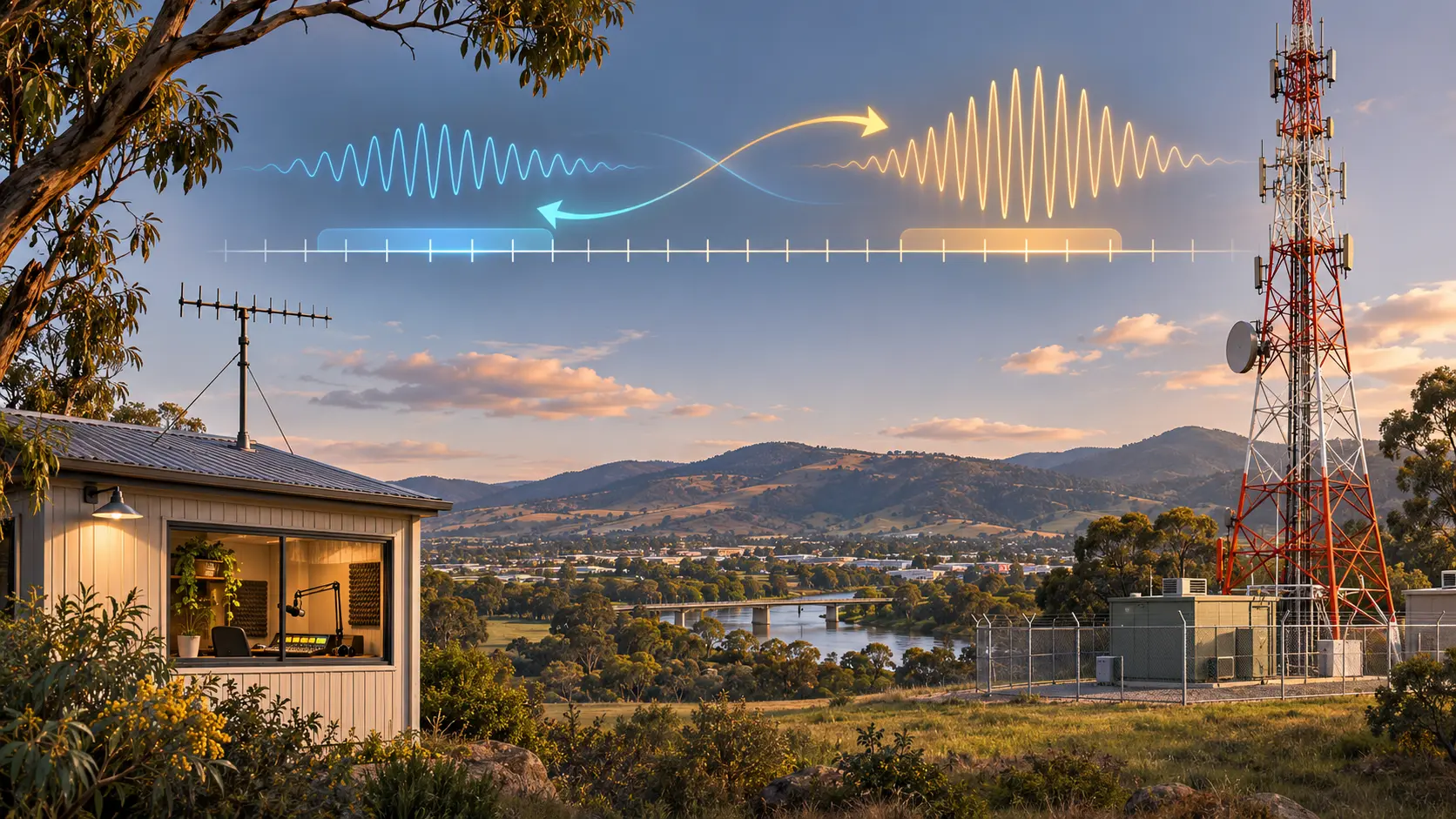
The commercial station's promised FM channel is occupied. That is the first line of the Australian Communications and Media Authority's Albury proposal, once the cheerful phrase “AM–FM conversion” is translated into a timetable. 2AY wants the 107.3 MHz slot. Community broadcaster 2REM uses it now. ACMA proposes moving 2REM to 90.5 MHz, then making 107.3 MHz available for 2AY. The smaller station is the first mover in the larger station's upgrade.
The consultation paper describes a proposed 2AY FM transmitter at the Mt Baranduda site: 107.3 MHz, a directional antenna, a maximum antenna height of 60 metres and up to 100 kW maximum effective radiated power. Those are draft technical specifications, not a record that the tower is on air. ACMA also proposes a new 2REM FM infill transmitter at Culcairn. The community station therefore faces a frequency move and a coverage-planning task, not a mere label change on a schedule.
Two 28-day windows follow the two starts. Once 2REM begins transmitting on 90.5 MHz, its existing transmitter specification would cease to be available 28 days later. Once 2AY begins FM transmission, its old AM transmitter specification would cease to be available after 28 days. The clocks are separate because the services are separate. The draft Albury plan variation would encode the handoff; it cannot by itself confirm the actual start dates or that listeners retained reception.
The same consultation also changes radio plans for Wagga Wagga, but its 2WG AM/FM simulcast and 2AAA infill proposals have different frequency and coverage mechanics. Albury's dependency is sharper: a community broadcaster must vacate a specific FM frequency to make the commercial conversion possible. Submissions close on 30 November 2026. The next records worth reading are the final plan, both stations' actual start dates and measured reception after the retune. Until then, a “conversion” is a sequence of permissions and transmitters, not one switch.
Member Briefing
Deeper Profile Context
Sign in with the right membership level to unlock the full briefing and source notes.
Only for Strategic Circle
Strategic Circle
Open to all readers. Unlock profile briefings after joining and signing in.
Join Strategic CircleOnly for Leadership Alliance
Leadership Alliance
For qualified IP-asset owners and management; sign in to unlock alliance briefings.
Join Leadership Alliance