
Summary
- AEP’s disclosed purchase is 190MW for delivery beginning in 2027. Bloomberg reports options for further annual tranches of up to 200MW through 2034, with each tranche priced separately.
- AEP has not selected locations or decided whether the generators will connect to a regional grid or serve data centres. A 200MW annual tranche would require about 800 nominal 250kW units, against a proposed Pennsylvania factory target of 1,000 units a year.
The most consequential detail in AEP’s agreement with Mainspring Energy is still an open question: where will the generators go? AEP Chief Commercial Officer Greg Hall told Bloomberg that the utility had not decided whether the units would connect to a regional grid or sit at data centres. That leaves the deal with a clear supply ambition and an unfinished delivery map.
Mainspring’s 13 October announcement says AEP has purchased an initial 190 megawatts, with deliveries beginning in 2027, under an agreement for up to 1.6 gigawatts through 2034. The company calls it the largest procurement of linear generators to date. The distinction between the first purchase and the maximum matters. Bloomberg’s interviews with Mainspring chief executive Tom Linebarger and Hall describe additional options of up to 200MW a year, priced tranche by tranche, and a possible value above $4 billion if the programme reaches its ceiling. That is a route to future sales, not a fixed $4 billion order placed on signing day.
The initial 190MW is about 11.9% of the 1.6GW ceiling. The remaining 1.41GW is potential volume, not an order that AEP has already made public. AEP can use the annual options as it learns where demand appears and what can be installed. Mainspring, in turn, gets a chance to scale production against a utility customer, but its revenue depends on option exercise, tranche pricing and equipment delivery. Neither the release nor the interview publishes a price per megawatt, minimum take, cancellation terms or margin.
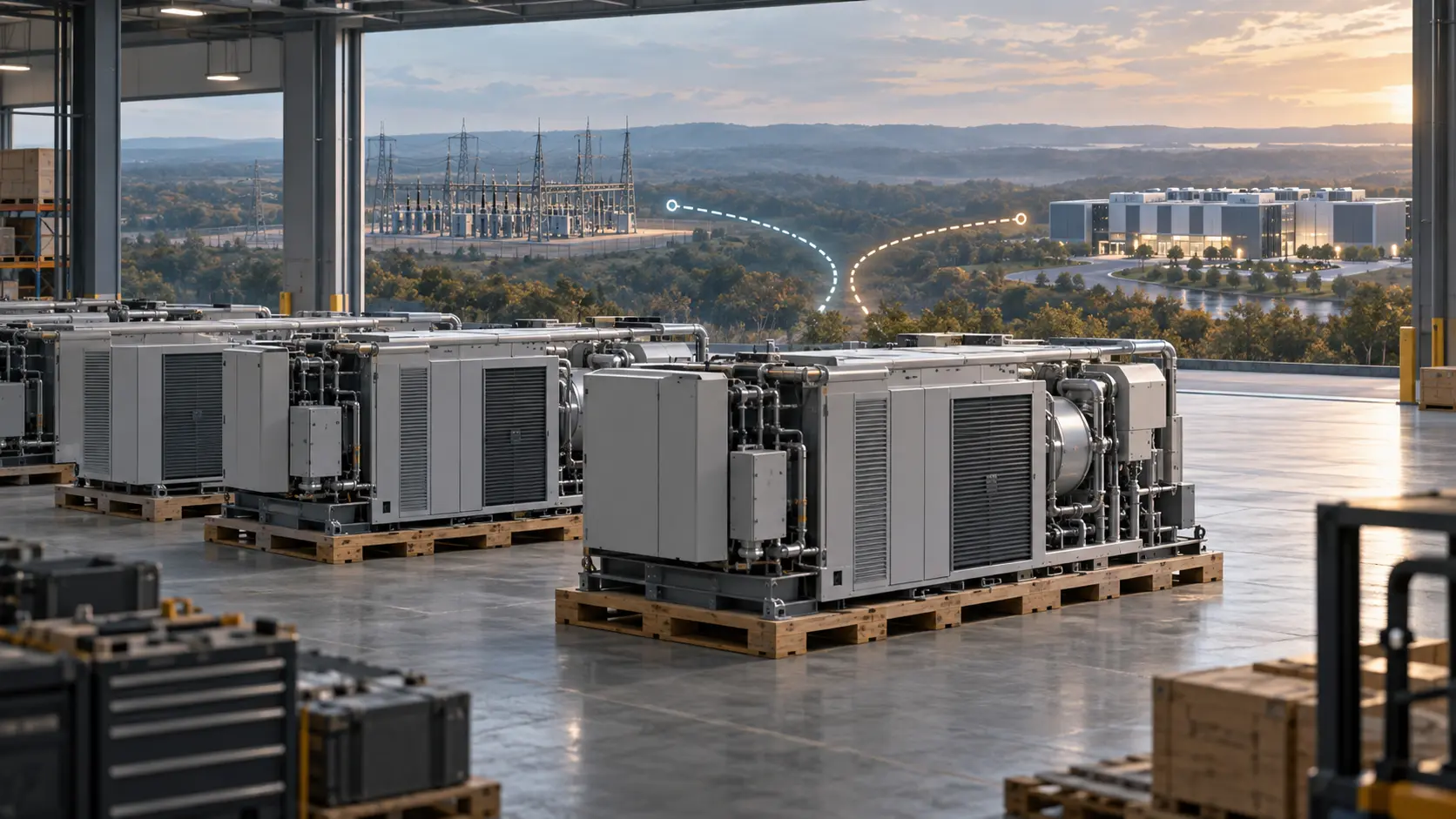
The product is modular, which can make the order easier to stage than a single large generating plant. Mainspring’s current specifications describe a standard 2.5MW configuration built from ten 250kW generators. On that nominal basis, the first 190MW represents 760 units, or 76 standard configurations; a 200MW annual option represents 800 units, or 80 configurations. These are arithmetic translations of the published ratings, not a disclosed bill of materials for AEP.
The location question changes what “capacity” means. A generator beside a data centre may serve one customer behind the meter; a unit connected into a regional network becomes part of utility-side supply. The two arrangements have different grid connections, fuel access, permitting, operating control and cost-allocation questions. Mainspring lists natural gas, biogas, hydrogen and propane among the possible gaseous fuels. Its published 46% net AC efficiency applies under specified natural-gas or biogas test conditions and varies by fuel and site configuration. Fuel flexibility is a product attribute; it does not establish which fuel AEP will use or make the output zero-carbon by itself. The company’s product specifications are manufacturer data, not measured performance at an AEP site.
The same gap appears on the manufacturing side. In 2024 Mainspring said it had been selected for an $87 million US Department of Energy manufacturing award and proposed a Pennsylvania plant capable of producing up to 1,000 generators a year; the company then expected to break ground in 2025. Pennsylvania’s July 2026 development announcement lists $3 million to support the new facility. Those releases establish a planned plant and public support, but they do not disclose its commissioning date or current production rate.
A full 200MW annual tranche would equal 80% of the proposed 1,000-unit capacity if all units came from that line and each carried the nominal 250kW rating. That is a useful scale test, not evidence of a bottleneck: the company could expand, source from elsewhere or deliver a different mix.
AEP and Mainspring have a longer relationship. Their 2022 memorandum of understanding proposed an Oklahoma pilot and listed possible grid uses. That announcement did not report a completed trial or measured results. The new purchase is a commercial step beyond an exploratory MOU, but the public record still leaves the operating proof in the future. The first installations, rather than the agreement’s maximum, will show whether the units can be sited and commissioned at the pace the option schedule implies.
For now, the $4 billion figure is best read as a ceiling on possible programme value. AEP has secured a first tranche and the right to choose further volumes; the price is set separately as those tranches are taken. The market should watch four milestones: named sites, the chosen grid or behind-the-meter configuration, evidence that the Pennsylvania line is producing, and commissioning data from the 2027 tranche. Until those appear, 1.6GW describes the size of the path, not the amount of power already placed at a customer’s meter.
Sources: Mainspring’s 13 October announcement; Bloomberg’s reporting on the annual options, pricing and siting; Mainspring’s 2024 manufacturing announcement; Pennsylvania’s July 2026 award list.
Member Briefing
Deeper Profile Context
Sign in with the right membership level to unlock the full briefing and source notes.
Only for Strategic Circle
Strategic Circle
Open to all readers. Unlock profile briefings after joining and signing in.
Join Strategic CircleOnly for Leadership Alliance
Leadership Alliance
For qualified IP-asset owners and management; sign in to unlock alliance briefings.
Join Leadership Alliance