Summary
- State rail 1800 MHz spectrum licences expire on 17 June 2028. ACMA's current consultation prefers to replace them with apparatus licences from the following day, although incumbent holders may still apply individually for spectrum-licence renewal.
- The June consultation paper records rail requests for 20-year tenure, and in some submissions indefinite access. ACMA proposes at most five years per apparatus licence, renewable generally until 1 January 2037.
- The proposal carries existing rail frequencies, areas and registered transmitters across, restricts use to rail safety and control communications, and prepares 1900–1910 MHz as the longer-term rail band. The consultation closed on 22 July and ACMA still lists it as under review.
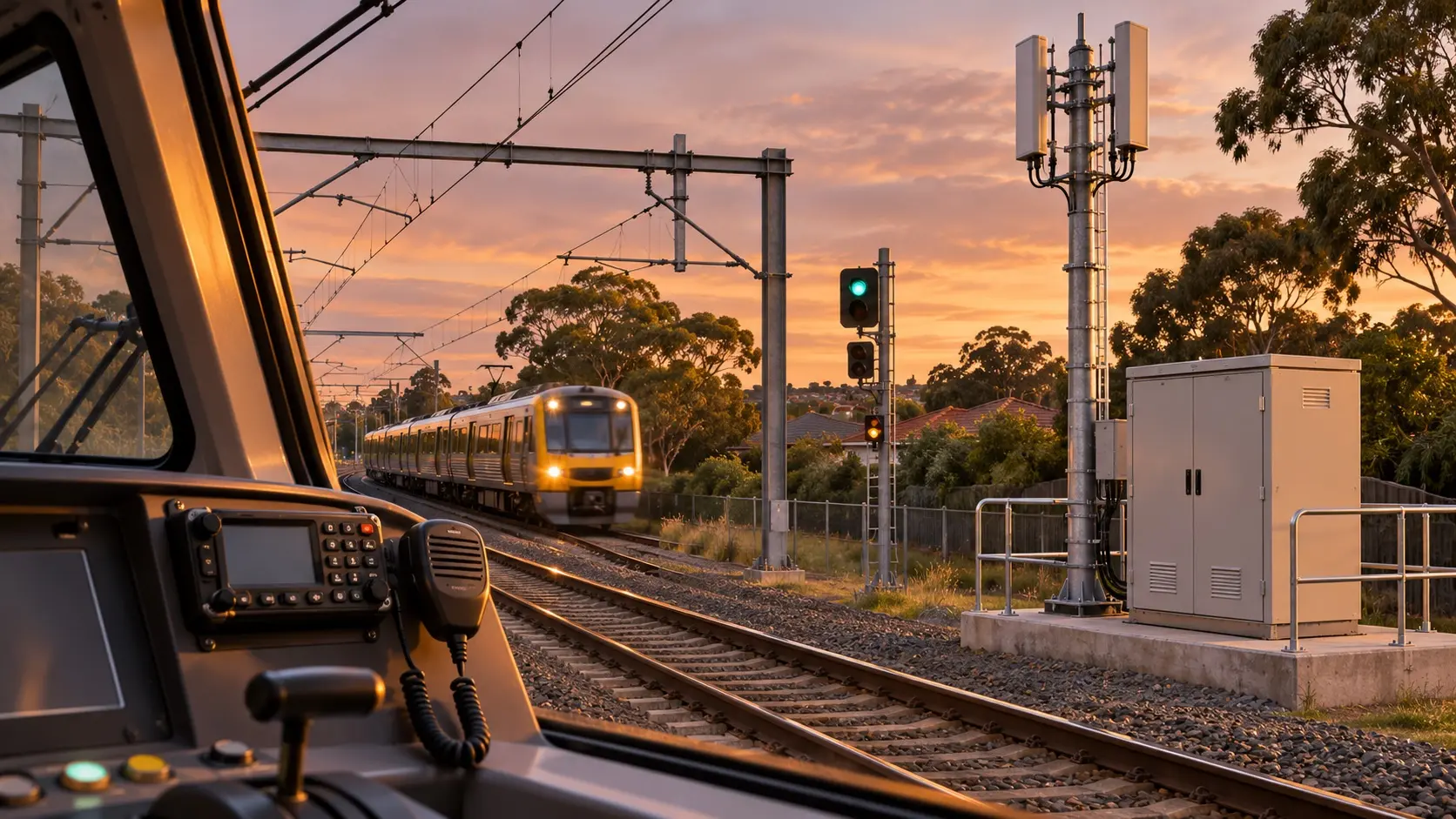
A railway cannot replace a safety-radio network at the pace of a handset upgrade. Radios sit in cabs, base stations follow tracks, and migration has to meet an operating timetable. The Australian Communications and Media Authority has written a plan for that awkward middle period. It offers to keep the 1800 MHz rails open after incumbent spectrum licences expire. The ticket, however, comes in five-year pieces.
The consultation page sets out the preference: state rail authorities move to apparatus licences on 18 June 2028, while their existing spectrum licences end the day before. The paper says a current holder may still seek renewal of a spectrum licence, with ACMA deciding each case. The regulator's preferred route is a real change in tenure. Existing exclusive frequency and geographic areas would be reserved for the relevant rail authority; the legal instrument securing them would become shorter and easier to revisit.
The duration argument is the argument
The opposing bids are unusually plain. Rail participants asked for 20-year apparatus licences to support capital investment. Some wanted the present users to keep the spectrum indefinitely. Wireless broadband respondents preferred shorter terms; some proposed shortening each later renewal to push a move out of 1800 MHz. ACMA chose neither indefinite occupancy nor a progressively shrinking licence. It proposes a maximum five-year PMTS-B term, renewable generally until 1 January 2037. From the first proposed issue date, that is about eight and a half years of access under the stated policy.
Why five? ACMA says the states are not at the same stage. Some have established GSM-R systems; others have used little or none of their allotted 1800 MHz spectrum. One holder began buying and testing equipment after a long period of non-use. A twenty-year grant to every incumbent would bind a scarce band to very different investment records. The regulator wants to decide the band's best long-term use in a separate proceeding, then retain room to act on that decision. Rail wants a horizon long enough to buy and run a system without returning to the spectrum counter midway through its life.
That is the conflict hidden in the phrase “service continuity.” A train network can have continuity of operation and still lose continuity of tenure. ACMA promises a bridge across the 2028 expiry, not a twenty-year commitment to the same band. Its paper explicitly allows the 2037 preference to change if later work finds continued rail use the best long-term public benefit. The date is a policy ceiling in a proposal, with a future decision attached. It is also a very effective planning clock today.
Keep the sites, change the paper
The proposed bridge has carefully engineered planks. Rail base stations would move to Public Telecommunications Service apparatus licences of the PMTS-B subtype. Cab radios and other mobile units would rely on the cellular mobile class licence. A transmitter already recorded on the Register of Radiocommunication Licences could be carried into the new PTS arrangement without fresh coordination if its details match. ACMA would generally give the incumbent rail authority the PTS licence for the same frequency range and area it held under its spectrum licence.
In the paper's Appendix A, those areas cover the existing authorisations for Adelaide, Brisbane, Melbourne, Perth and Sydney.
Continuity also has a narrow purpose. ACMA proposes a special condition limiting these transmitters to rail safety and control communications across the relevant paired 1800 MHz ranges. That reaches parts of the current authorisations that lack the same condition today. The regulator is offering a way to keep trains communicating; it is not handing a rail authority a general-purpose metropolitan mobile franchise.
The tax proposal uses the existing PMTS-B rate rather than a discount for rail. ACMA lists a base annual rate of A$0.01 per MHz per population within each Level 2 HCIS area, calculated using half the paired bandwidth. Its sample table gives A$467,661 for one Melbourne set of blocks and A$130,277 for a Brisbane set, each assuming a paired 10 MHz allocation. Those are example licence taxes for listed areas, not budgets for building a rail network. ACMA says its licensing system cannot yet calculate a smaller geographic block for underground rail, although a licensee already covering an area would not pay again for each underground transmitter.
A back-office limitation thus becomes part of the price argument.
The radio physics makes the handover less administrative than it sounds. ACMA proposes that spectrum-licensed neighbours do not gain priority over rail merely because rail moves to a PTS licence. For one interference case — a cab receiver near the edge of its cell beside an adjacent-frequency base station — the agency uses rail base-station registration data to infer about 5 km from a site to a worst-case cell edge. Nearby renewed spectrum transmitters would face the relevant unwanted-emission limit; a later rail base station could force a neighbouring operator to adjust.
Five kilometres here is a proposed coordination test derived from a roughly 10 km maximum spacing in registered sites, not a measured guarantee on every stretch of track.
The second rail band changes the bargaining table
ACMA is preparing 1900–1910 MHz as an Australia-wide home for 5G-based Future Railway Mobile Communication System equipment. It calls 1.9 GHz the primary long-term broadband rail band. The 1800 MHz proposal would accommodate existing GSM-R and newer equipment while different state networks age at different rates. The document even names investment tied to the 2032 Queensland Olympics as a reason to consider early requests case by case. Operators cannot schedule a network replacement by drawing a single date on a national map.
The two bands create a negotiation over who pays for time. A rail authority with an active GSM-R network can use the 1800 MHz bridge while it funds, procures and tests a replacement. The regulator can avoid granting a twenty-year claim over spectrum whose later use it has yet to settle. An operator planning a new 1800 MHz build must decide whether an initial five-year instrument and an outer 2037 preference support the equipment's working life. The consultation supplies the proposed rules; it does not supply each state's replacement budget or a final post-consultation decision.
Those investment plans and the outcome would change the assessment of how costly the short term really is.
For now, the actual status matters. ACMA closed consultation on 22 July 2026 and still labels the proceeding “under review.” Its five-year terms, 2037 preference and coexistence details are proposals. The immediate fact is an institutional bid: the regulator will keep the railway's radio operating path open while reclaiming the power to set the end of the lease. That is a more consequential timetable than the printed expiry on a single licence.
Member Briefing
Deeper Profile Context
Sign in with the right membership level to unlock the full briefing and source notes.
Only for Strategic Circle
Strategic Circle
Open to all readers. Unlock profile briefings after joining and signing in.
Join Strategic CircleOnly for Leadership Alliance
Leadership Alliance
For qualified IP-asset owners and management; sign in to unlock alliance briefings.
Join Leadership Alliance