Summary
- ACMA's September 2026 outcome retains its proposed 50.2 dBm/5 MHz total-radiated-power ceiling for 2.5 GHz advanced antenna systems. Mobile interests had asked for 53 dBm/5 MHz. The wider request went to a future expiring-spectrum-licence review.
- The regulator also retained proposed unwanted-emission limits beside the 2690–2700 MHz radio astronomy band. Radio astronomy respondents said the proposed AAS allowance was about 9 dB above existing limits. ACMA kept the telescope protection criterion and says the spectrum licensee must meet it regardless of distance.
- The transmitter guideline says coordination is typically needed for fixed transmitters within 100 km of a protected receiver. ACMA explicitly places responsibility on the licensee beyond that circle. The guideline variation is in force; ACMA says it will work with licensees to update individual licence conditions.
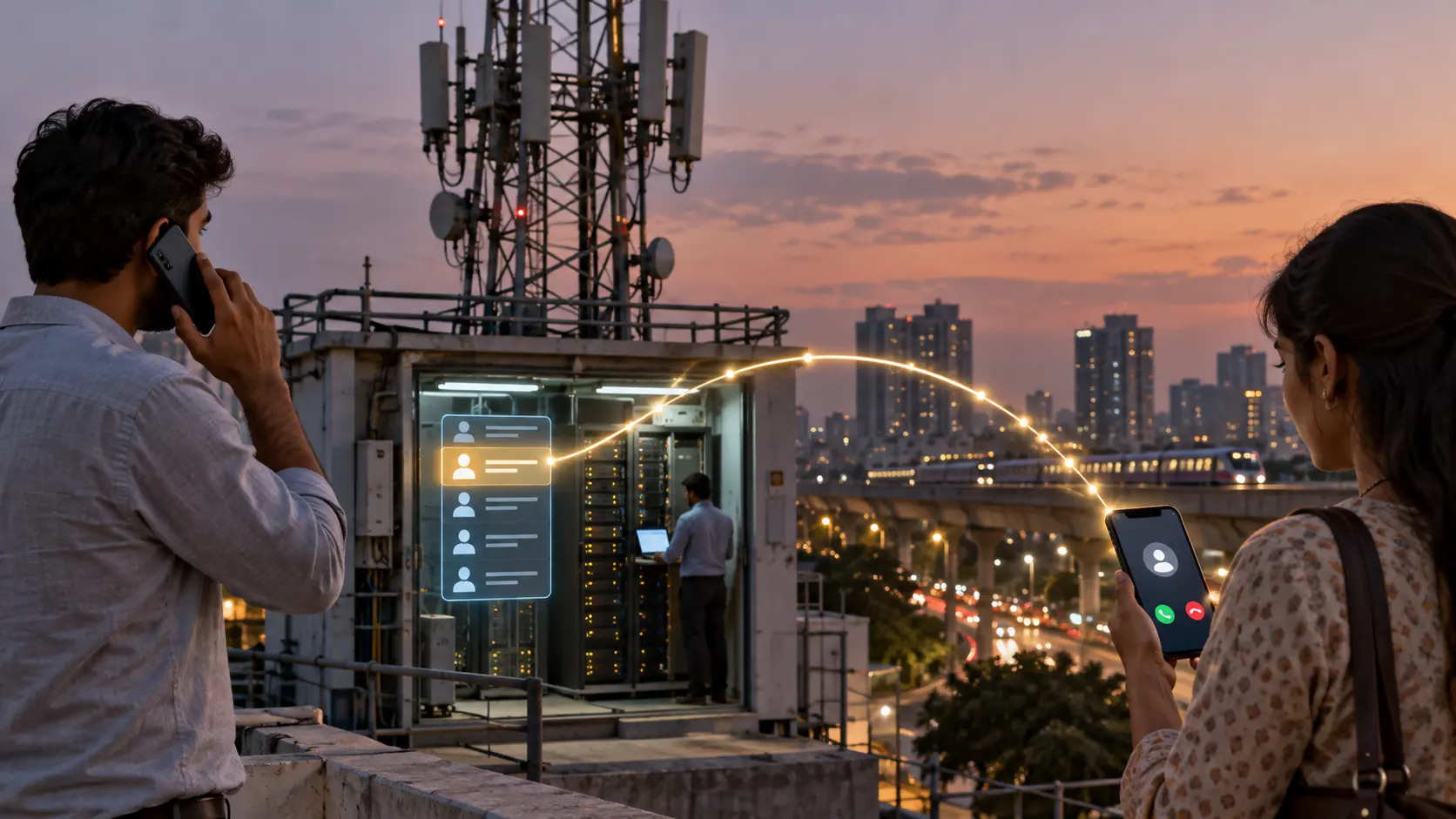
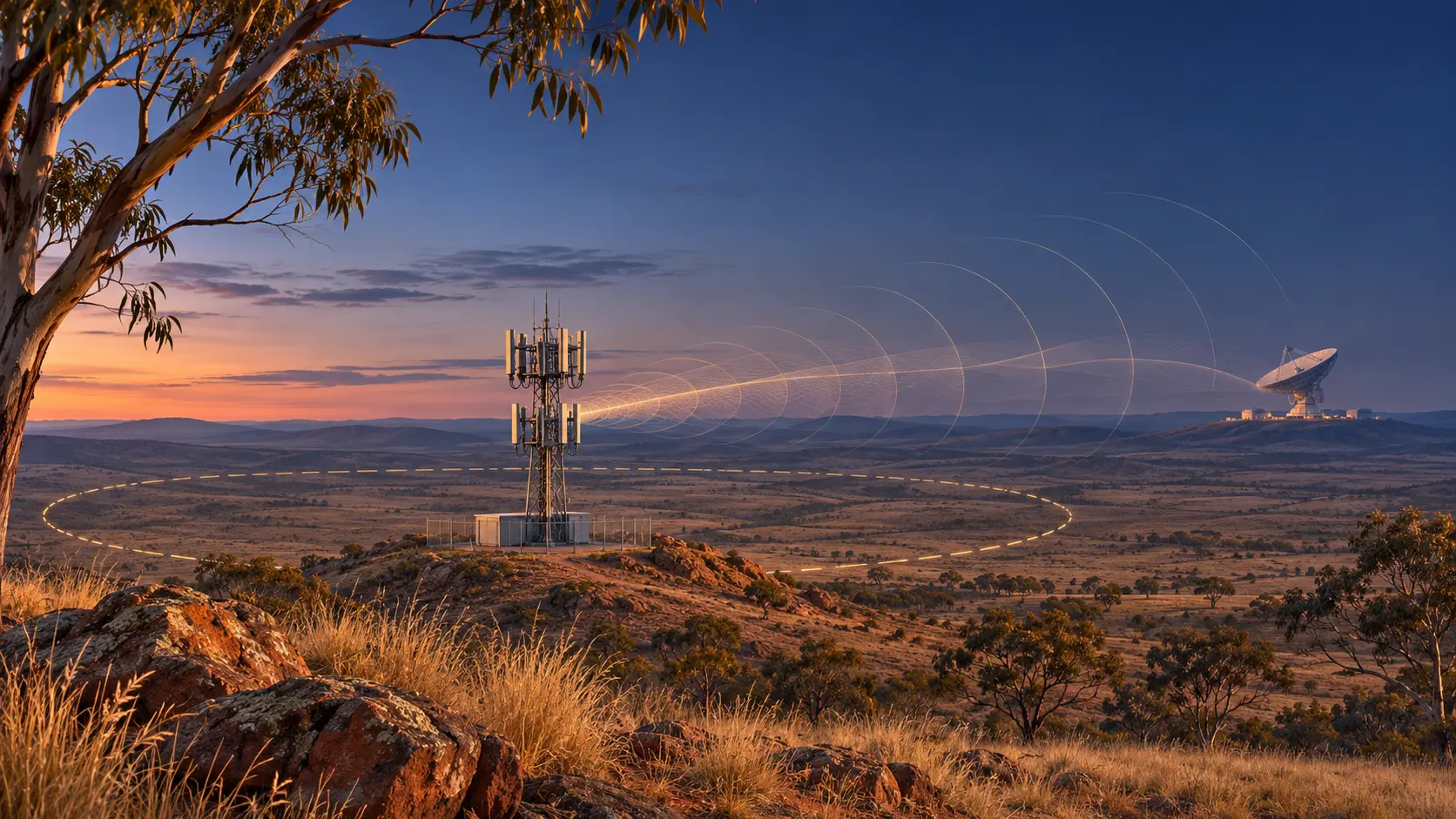
A neat circle is attractive on an engineering map. Draw 100 km around a radio telescope, check which mobile sites fall inside, and the job looks finite. ACMA's own 2.5 GHz outcomes paper takes that shortcut away. The transmitter advisory guideline says coordination is typically needed for fixed transmitters inside that distance. The licensee, it says, remains responsible for meeting radio astronomy protection requirements irrespective of distance.
That sentence carries the risk in Australia's 2.5 GHz modernisation. The paired 2500–2570 MHz and 2620–2690 MHz ranges carry wireless broadband. The framework was built before advanced antenna systems became common. ACMA decided to make room for 5G and advanced 4G equipment while maintaining coexistence with users next door in frequency. The radio astronomy service is one such neighbour at 2690–2700 MHz, directly above the paired upper block. A carrier can leave the 100 km ring behind in a planning tool. Its obligation stays on the vehicle.
More antenna room, one ceiling held back
The debate was not whether 2.5 GHz should carry modern antennas. ACMA's review page says it has finished the technical-framework review and varied the transmitter advisory guideline. The decision accepts a package of changes to in-band and unwanted-emission rules, subject to the next step of updating relevant spectrum licence conditions with holders. Four submissions represented wireless broadband, radio astronomy and consumer interests. They disagreed about the room a transmitter should receive and the proof its neighbours should demand.
Wireless broadband interests asked for an in-band total-radiated-power ceiling of 53 dBm per 5 MHz. ACMA held its proposed 50.2 dBm per 5 MHz. That lower figure is the agency's chosen bridge between newer antennas and existing arrangements. A further increase, or closer alignment with European technical limits, belongs to the expiring-spectrum-licence review ACMA plans to begin in the first quarter of 2027. This is a real refusal in a decision that otherwise gives the sector more flexibility.
The more uncomfortable argument sits outside a transmitter's own band. For unwanted emissions landing in 2690–2700 MHz, radio astronomy respondents said the proposed advanced-antenna allowance could be about 9 dB higher than current limits. They questioned whether coordination distances established under the old interference environment still captured the new one. Wireless interests urged greater reliance on site coordination and argued that existing protections already did the job. ACMA retained its proposed unwanted-emission limits.
The roughly 9 dB comparison is the astronomers' submission recorded by the regulator; ACMA supplied no measurement of an operating telescope losing observations.
Here the agency chose a split answer. It allowed the new technical limit but kept the protection obligation. The outcomes paper points to the transmitter guideline's radio astronomy criteria, tied to ITU-R Recommendation RA.769-2. It says a 100 km distance is a usual trigger for coordination, while the licensee must meet the protection level wherever the transmitter sits. For a network planner, the difference is blunt: a checklist can screen for coordination; it cannot grant an interference exemption outside its search radius.
The missing aggregate calculation
Radio astronomy respondents also wanted a clearer published threshold and method for assessing cumulative AAS emissions. ACMA left the existing coordination arrangements in place. It said the applicable radio astronomy coexistence instruments do not require aggregate-interference modelling and saw no reason in this review to add an AAS-specific requirement. It might revisit an explicit radio astronomy threshold in the planned expiring-licence process. The agency has therefore assigned a result to protect while leaving a contested calculation method for another round.
There is a practical asymmetry in that choice. A carrier can point to a registered transmitter, a licence, power figures and an advisory radius. A radio astronomer cares about the received interference from many sites over time. ACMA says the radio astronomy service gets the same protection level under the relaxed AAS limits. The operating record that would test that claim is site-specific coordination and receiver evidence after deployment. The September paper gives the rule and the reasoning; it does not supply that field record.
Several small corrections show why licence text matters more than a press summary. ACMA accepted removal of a stray 0.05 term from equations for emissions into 2620–2690 MHz. It agreed that certain adjacent-range EIRP limits apply per antenna. It accepted changing max(Channel BW, 5) to max(Channel BW, 6) in a proposed table and corrected a lower-band receiver reference from 3GPP TS 38.101-1 to TS 38.104. Those are not decorative edits. They decide what an engineer calculates when a device is registered or a licence is varied.
The Federal Register shows the transmitter advisory guideline variation in force, registered on 4 September. ACMA's review page says it will work with 2.5 GHz licensees on the relevant licence-condition changes. The distinction is worth keeping on the calendar: a varied guideline is already on the books; a particular carrier's updated core conditions need their own documentary check. ACMA's broader 2027 review is another decision point, with the requested 53 dBm ceiling and radio astronomy methodology waiting on it.
The story ends with an operational question rather than a radius. When a new AAS transmitter is deployed, which licence condition governs its emissions, what coordination record supports its registration, and what does the protected receiver actually see? The 100 km line helps the regulator organise a task. It never did the licensee's work for it.
Member Briefing
Deeper Profile Context
Sign in with the right membership level to unlock the full briefing and source notes.
Only for Strategic Circle
Strategic Circle
Open to all readers. Unlock profile briefings after joining and signing in.
Join Strategic CircleOnly for Leadership Alliance
Leadership Alliance
For qualified IP-asset owners and management; sign in to unlock alliance briefings.
Join Leadership Alliance