
Summary
- The Timbuktu centre joined Internet access to telephony, fax, computer training, printing and other services; in the 2000–2001 field study, Internet use was only one part of its work.
- Community participation was real in fundraising and advice, but the evaluation found blurred authority, uneven reporting, operational dependence on project funding and no accounts adequate to establish financial viability.
The first question about a public Internet centre is often how it connected. Timbuktu’s multipurpose community telecentre poses a harder one: what had to be governed locally for a connection to become a dependable public service?
The dates do not resolve into one clean “launch.” An International Telecommunication Union (ITU) article in 2002 called the pilot a project launched in 1997. The 2003 International Development Research Centre (IDRC) volume describes a joint project begun in 1998, while its Timbuktu chapter says the centre opened its doors in April 1999. The local community later raised USD 30,000 toward a permanent building, inaugurated in June 2001. These accounts can refer to successive project, operating and building stages; the evidence does not justify compressing them into one date.
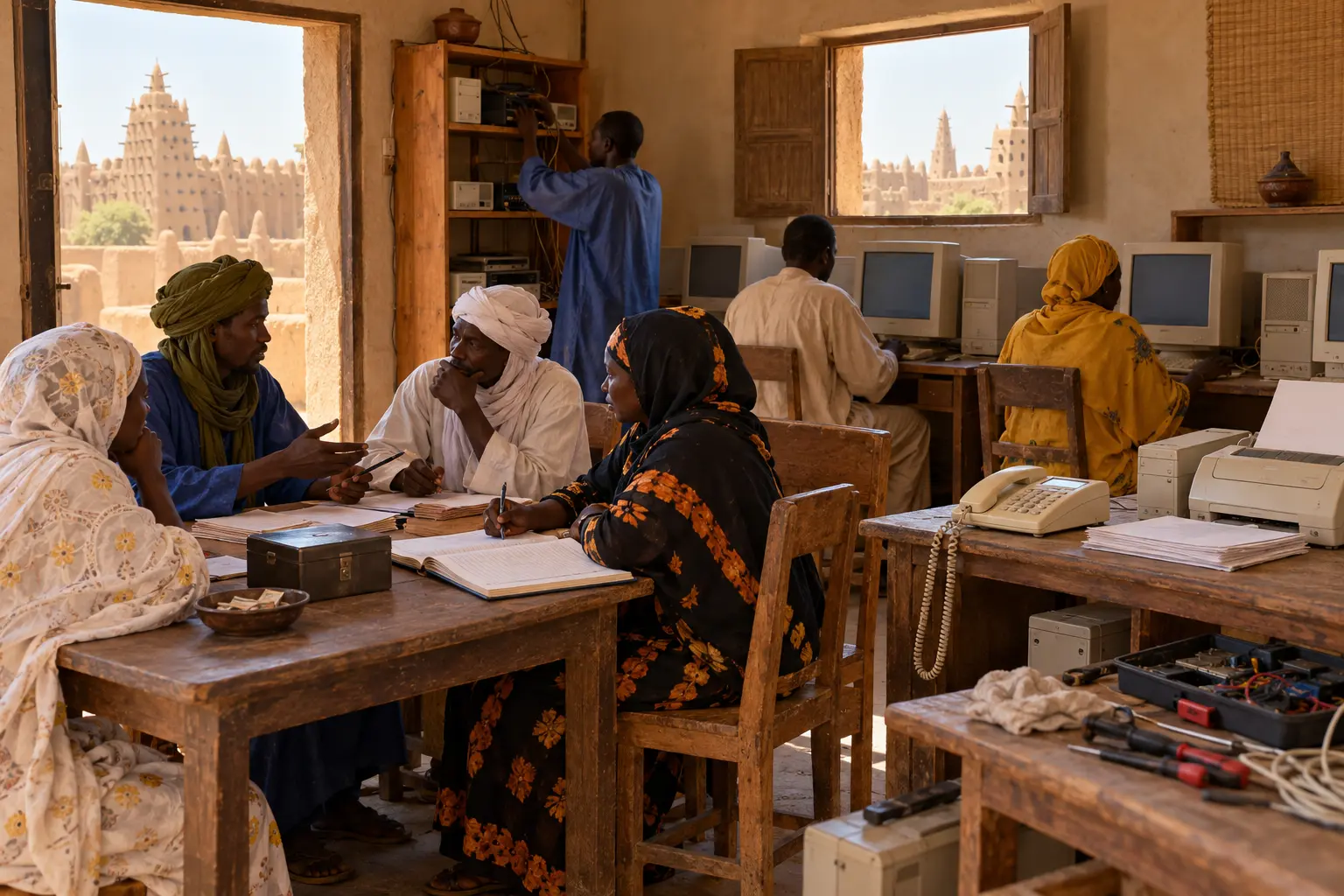
What opened was not simply an Internet café. The centre offered telephone and fax, email and Internet, word processing, printing, photocopying, scanning, training, web services and equipment support. It also supported local radio programming. This service mix matters because connectivity was not always reliable, and because residents needed practical communication and information services whether or not a web page loaded.
The strongest close-up comes from the IDRC’s 2003 study, based on fieldwork in Timbuktu in December 2000 and February 2001, alongside records extending from April 1999. Among nearly 4,000 registered users, only 10 percent of those surveyed said they used the centre to access the Internet; 40 percent came to acquire computer skills. Telephone and fax were widely used. The study reports that 42 percent of visitors made calls, 37 percent received them and 26 percent sent faxes. These are survey and centre-record findings, not a census of every resident or a measure of Internet access across Mali.
In that period the equipment inventory listed 15 computers, four of which were out of use because they had broken down. A telephone connection could be interrupted for days; the evaluation team found it disconnected during its visit. Staff could repair many computer and printer faults, but depended on outside help for telephone, electricity and photocopier problems. Internet continuity therefore rested on more than an upstream link: it also depended on local repair capacity and on services the centre could not fix itself.
The governance story is similarly layered. ITU’s 2002 account describes a steering committee that included the mayor, businesses, artisans, librarians, health workers, women’s associations and other residents. It says this committee set prices and offered special discounts to women and children. The community had also contributed to construction. These were concrete forms of participation, not merely promotional language.
But the later field study asked what “ownership” meant in daily operation. Project documents assigned the telecentre to the district, with a possible future transfer to a local consortium or cooperative. People interviewed often said it belonged to the community; staff and committee members were less certain about the legal and practical meaning. The local committee was supposed to oversee revenue, expenses, procurement and hiring. In practice, the manager and national coordinator handled daily supervision and financial management, while the committee’s mandate and the coordinator’s role were not clearly separated.
Regular reporting to the wider community was weak, and changes in civil-service committee membership disrupted continuity.
The difference between participation and control is visible in the work itself. Residents organized cultural events and made family contributions toward the building. Yet the evaluation found they were not involved in planning, running or maintaining the centre. Management staff controlled those tasks. The report records community complaints about a lack of regular reports and feedback. The study does not say the centre had no community influence: it shows that fundraising, representation, price-setting and operational authority were distinct powers, and that they did not sit neatly with one body.
That distinction also changes how affordability should be read. Special discounts were reported, but in the IDRC survey half of respondents thought high charges relative to women’s purchasing power helped explain women’s lower use; 65 percent expected that lower prices would bring a significant increase. Women accounted for 23.2 percent of users in centre records for the period studied. These are respondents’ assessments and an observed share, not proof that price alone caused the gap. Service availability, literacy, language, hours, equipment and connection quality also shaped who could use the facility.
Nor did growing receipts demonstrate that the pilot could pay its way. The centre depended primarily on donor funds. In February 2001, partner grants totalled just over FCFA 213 million, and staff were still paid from project funds. Although recorded service revenue rose between 1999 and 2001, investigators could not determine financial viability because they found no comprehensive income statement or balance sheet. A fee schedule and rising receipts answer different questions from whether a service can fund staff, connectivity, replacement equipment and repairs after a grant ends.
The centre’s historical significance lies in this gap. Shared access brought communications, training and information services into a town where a private connection was not the only imaginable route online. But the service depended on a hybrid institution: local fundraising and price decisions, technical staff and the national telecom operator, international project money, and community groups seeking influence. “Community” described an important constituency; it did not by itself define enforceable rights, a stable operating budget or responsibility for keeping the telephone and computers working.
The evaluation did not establish that the telecentre closed, nor did it deliver a final verdict on its long-term survival. The careful conclusion is narrower and more useful: by 2000–2001 it had produced measurable use and locally valued services, yet its authority and finances remained too unsettled for researchers to certify economic viability. Timbuktu’s experiment therefore belongs in Internet history not as a simple story of a link reaching a remote city, but as a record of the institutional work required to make access public—and of the limits of participation when operating responsibility, accountability and resources are not aligned.
Sources
- “Timbuktu telecentre, Mali,” in Information and Communication Technologies for Development in Africa, Volume 2: The Experience with Community Telecentres (IDRC/CODESRIA, 2003), especially the field findings and sustainability sections.
- “Timbuktu,” ITU News, May 2002.
- “The MCT programme in perspective,” ITU News, May 2002.
- Birama Diallo, “Telecenter in Mali,” 10 November 1999, Network Startup Resource Center.
Member Briefing
Deeper Profile Context
Sign in with the right membership level to unlock the full briefing and source notes.
Only for Strategic Circle
Strategic Circle
Open to all readers. Unlock profile briefings after joining and signing in.
Join Strategic CircleOnly for Leadership Alliance
Leadership Alliance
For qualified IP-asset owners and management; sign in to unlock alliance briefings.
Join Leadership Alliance