Summary
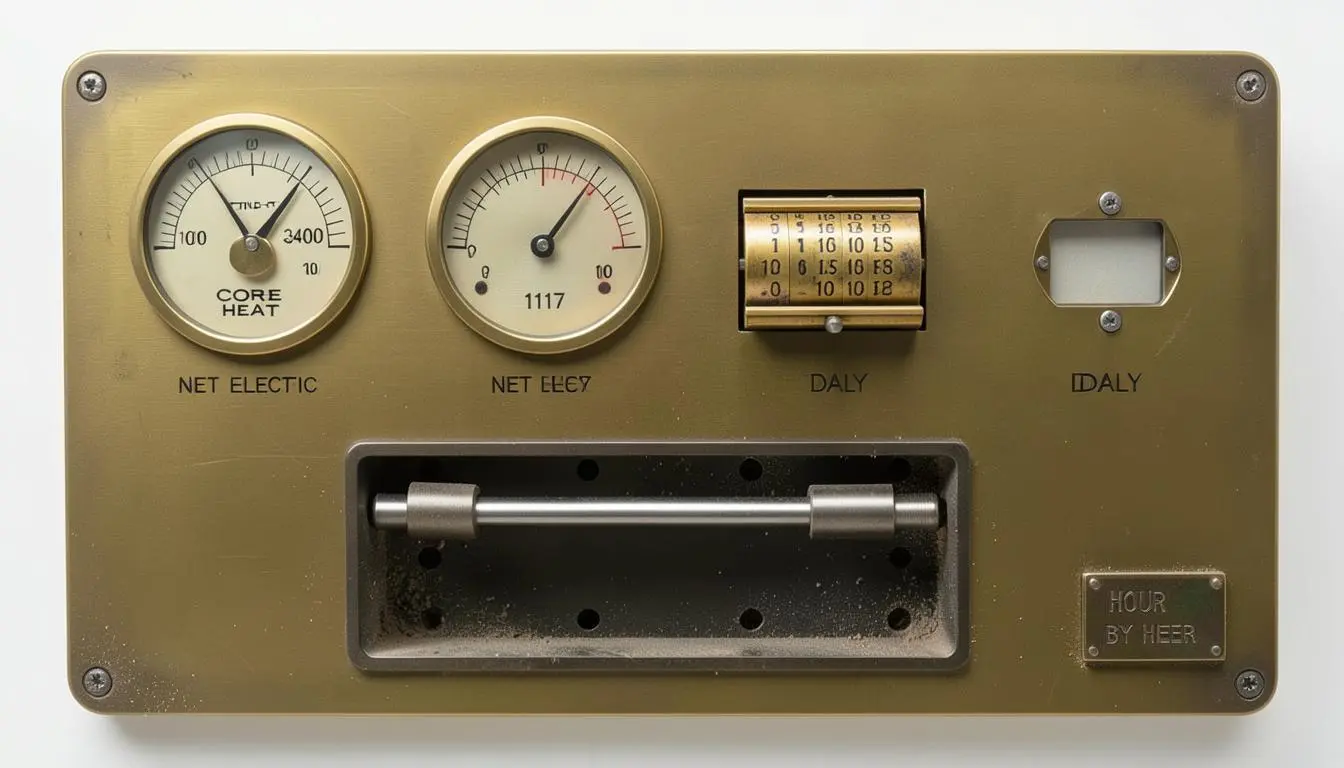
- The federal combined licence for Vogtle Unit 3 authorises “steady state reactor core power levels not to exceed 3400 MW thermal (100-percent thermal power)” — heat transferred into the reactor coolant, a quantity no data-centre operator buys and no meter bills.
- The 1,117 MWe figure is the operator's own net electric rating inside a safety analysis, the megawatt-hour record from the federal statistics office is a plant total across four reactors, and the only per-unit operating number the regulator publishes is a daily integer under a column headed only “Power”.
The sentence the licence actually wrote
On 10 February 2012 the Nuclear Regulatory Commission issued two combined licences for the two new reactors at Plant Vogtle in Burke County, Georgia, together with two limited work authorisations. The Federal Register notice of 29 February 2012 records the issuance and names five licensees: Southern Nuclear Operating Company, Georgia Power Company, Oglethorpe Power Corporation, Municipal Electric Authority of Georgia and the City of Dalton, Georgia (Federal Register, 29 February 2012). It does not print a power level. The instrument that does is the licence.
Condition 2.D.(6) of Combined License NPF-91, Docket 52-025, revised through Amendment No. 202, reads: “SNC is authorized to operate the facility at steady state reactor core power levels not to exceed 3400 MW thermal (100-percent thermal power), as described in the UFSAR, in accordance with the conditions specified herein.” (Combined License NPF-91). Read the subject of that sentence carefully. The number it caps is a rate of heat transfer into the reactor coolant. It is not a generator terminal, a busbar, a substation or a contract.
The regulator's own summary page for the unit agrees and stops where the licence stops: reactor type AP1000 pressurised light-water, licence issued 10 February 2012 and expiring 3 August 2062, and “Licensed Reactor Power: 3400 MWt” (NRC, Vogtle Unit 3). Unit 4 is licensed separately as NPF-92, Docket 52-026, issued the same day; the commission's package index for that licence lists the licence and its appendices and prints no thermal rating on the page itself, which is why every thermal figure in this piece is anchored to the Unit 3 condition (NRC package ML113060407).
What the ceiling means is defined in the design-certification technical specifications that combined-licence applicants adapt: “RTP shall be a total reactor core heat transfer rate to the reactor coolant of 3400 MWt.” The same section defines “THERMAL POWER shall be the total reactor core heat transfer rate to the reactor coolant,” and the operating-modes table states its thresholds as percentages of rated thermal power with a footnote excluding decay heat (AP1000 DCD Rev. 17, Tier 2 §16.1). This is the generic Westinghouse document, not the issued Vogtle Appendix A, and it is the document that fixes what the licence's unit means: core heat into coolant, decay heat excluded. A utility that wants that ceiling moved files an amendment. It does not get a new ceiling by running the machine harder.
The second number, and a third one hiding behind it
The operator's Updated Final Safety Analysis Report pairs the heat rate with an electric one in a single sentence: “Each unit represents a portion of the total generation capacity to be added and will consist of one reactor with a thermal power rating of 3,400 MWt and a net electrical output of 1,117 MWe (Reference 201).” (Vogtle 3&4 UFSAR Rev. 3, Chapter 1). That is the clearest site-specific bridge I found between heat and electricity, and it is a design statement, not a measured output.
Behind it sits a third number that gets quoted far less. The same chapter states that net producible electrical power to the grid is at least 1,000 MWe at the 3,400 MWt core rating, and that the nuclear steam supply system rating including reactor coolant pump heat is about 3,415 MWt. So the same document carries 3,400 MWt of core heat, 3,415 MWt of steam-supply heat, at least 1,000 MWe guaranteed to the grid and 1,117 MWe of net electrical output. Four quantities, one chapter, and no conversion-efficiency percentage anywhere in the passages I read.
The owner's public material rounds the electric figure and drops the thermal one entirely: “TECHNOLOGY: Two Westinghouse AP1000 nuclear units • about 1,117 MW each,” with ownership of Georgia Power 45.7 percent, Oglethorpe Power 30 percent, MEAG Power 22.7 percent and Dalton Utilities 1.6 percent (Georgia Power Vogtle 3 & 4 fact sheet). The line does not say gross and does not say net. The company's plant page gives combined generating capacity of approximately 2,234 MW for the two AP1000s and dates commercial operation at 31 July 2023 for Unit 3 and 29 April 2024 for Unit 4 (Georgia Power, Plant Vogtle).
Divide the two headline numbers and you get an efficiency nobody printed: 1,117 divided by 3,400 is 32.9 percent, my arithmetic on the safety report's own pairing. The heat that is not electricity is 3,400 minus 1,117, or 2,283 MWt rejected per unit at that pairing, and the pair runs at 3,044 MWt per MWe. Those three figures are mine. No document in this corpus writes an efficiency percentage for Vogtle 3 or 4, and the absence is worth as much as the number: a buyer who has only ever seen 1,117 MW has never seen the eight-digit thermal side of the machine.
Margins that look like allowances and are not
Two numbers circulate that read like permission to exceed the ceiling. Neither is.
The Vogtle 3&4 inspection test and acceptance criteria require the installed feedwater flow instrumentation — a Caldon LEFM CheckPlus system — to demonstrate, through Westinghouse methodology APP-GW-GL-046, that secondary-side power calorimetric uncertainty is below 1.0 percent of rated thermal power, and the criterion itself says: “The plant calorimetric uncertainty and plant instrumentation performance is bounded by the 1 % calorimetric uncertainty value assumed for the initial reactor power in the safety analysis.” (NRC ITAAC item C.2.5.04.04a). That one percent is a measurement-performance criterion and an analysis assumption. It is not a licence to run at 3,434 MWt, which is what 3,400 multiplied by 1.01 gives.
The historical two percent is the same species of number. A commission safety evaluation for a different plant explains the origin: “At the time of the issuance of initial operating license to South Texas Project, Title 10 of the Code of Federal Regulations (10 CFR) Part 50, Appendix K, required licensees to assume a 2.0 percent measurement uncertainty for the reactor thermal power and to base their transient and accident analyses on an assumed power level of at least 102 percent of the licensed thermal power level.” The 1 June 2000 final rule allowed a smaller justified margin where better instrumentation supports it, and the commission states plainly that the rule alone raises no licensed power level — an amendment does (NRC South Texas Project safety evaluation). At Vogtle's ceiling, 102 percent is 3,468 MWt and 101 percent is 3,434 MWt, both my arithmetic, both analysis starting points.
Here is why this distinction is not pedantry. When an AI buyer is told a plant offers “firm, 24/7 nuclear megawatts,” three different regulatory quantities — a licensed heat ceiling, a measurement-uncertainty assumption and an analysis margin — can be assembled into a headline that no single document contains. The licence caps heat. The margin sizes a calculation. Neither measures delivered energy.
Where the energy record lives, and whose perimeter it has
The federal statistics office is explicit about which product answers which question. “We publish monthly net generation for every grid-connected power plant located in the United States with at least 1 megawatt (MW) of nameplate capacity in our Electric Power Monthly, Electric Power Annual, and Power Plant Operations detailed data files. We publish hourly net generation reported by local and regional balancing authorities in the Lower 48 states in our Hourly Electric Grid Monitor” (EIA, Today in Energy, 27 May 2025). The same explainer warns that summing hourly grid-monitor generation over a month will not equal monthly plant-level net generation, and that plant codes and generator IDs are the crosswalk between the two products.
The hourly product is a balancing-authority product by construction: “Form EIA-930 data collection provides a centralized and comprehensive source for hourly operating data about the high-voltage bulk electric power grid in the Lower 48 states. We collect the data from the electricity balancing authorities (BAs) that operate the grid,” and “Net generation represents the metered output of electric generating units in a BA's electric system,” published as demand, demand forecast, net generation, net generation by energy source, interchange and estimated CO2 (EIA-930 about page). No plant row, no unit row, no hourly Vogtle.
The monthly product is a plant product. The survey collects generation at plant and prime-mover level, with generator and boiler detail only for a subset — steam-electric plants of 10 MW and above — and the latest releases are 23 October 2026 for August 2026 monthly data and 14 September 2026 for final 2025 annual data (EIA-923 landing page). The form's instructions also close a trap that the landing page's wording opens: “Do not report for steam turbines where the exclusive energy source is nuclear, geothermal, solar, purchased steam, or waste heat.” Nuclear generation travels on the form's nuclear schedule, by generating unit, with net generation defined as gross generation minus station use, reported monthly in megawatt-hours (EIA-923 instructions).
That last sentence matters more than any number in this article. The per-unit monthly megawatt-hour path exists on paper. I did not open the 2024 or 2025 EIA-923 or EIA-860 files, so I cannot show you a single Vogtle unit row from a primary federal file. Everything numeric that follows is a third-party restatement of those files, and I label it as such at every step.
What the plant record shows, and what it cannot
The restatements agree on the frame: plant code 649, operator Georgia Power Co, balancing authority Southern Company Services – Trans, Burke County, Georgia, plant nameplate 4,658 MW and net summer capacity 4,530 MW, with four nuclear generators rated 1,215, 1,215, 1,114 and 1,114 MW that went on line in 1987, 1989, 2023 and 2024 (gridprims, plant 649; powerplantfacts, plant 649).
For 2025 the plant-level monthly net generation series sums to 37,144,415 MWh, with monthly values running from 2,430,789 MWh in March to 3,470,814 MWh in December (ratewatt, Vogtle). Divide that total by 8,760 hours and the four reactors averaged 4,240.2 MW across the year — my arithmetic. Divided by the 4,658 MW nameplate, that is 91.0 percent, which is the capacity factor one mirror also prints; divided by the 4,530 MW summer rating it is 93.6 percent. Two denominators, two answers, both mine except the first, and neither of them describes Unit 3 or Unit 4 alone.
For 2024 the same family of mirrors gives 33,871,811 MWh across twelve months (powerplantfacts, plant 649), which is 3,856.1 MW average and 82.8 percent of nameplate over 8,784 hours, my arithmetic. The 2024 figure is depressed by a perimeter fact rather than a performance fact: Unit 4 entered commercial service on 29 April 2024, so most of the first third of that year had one fewer reactor than the year that followed. The year-on-year change is 3,272,604 MWh, or 9.66 percent, mine.
Then the conflict that keeps this from being a tidy table. One mirror reports 2024 as 29,035,055 MWh over only 10 of 12 months, and 2023 as 15,378,787 MWh over 7 months (inframap, plant 649). I did not open the annual file, so I cannot adjudicate between 29.0 million and 33.9 million megawatt-hours for 2024. I can tell you that any annual capacity factor computed from either number inherits the choice, and that a figure which moves by 4.8 million megawatt-hours depending on which mirror you read is not a figure to build a load forecast on.
One more piece of arithmetic makes the perimeter vivid. A single unit running at its printed 1,117 MWe for a full year would produce 9,784,920 MWh; two such units, 19,569,840 MWh. The plant total for 2025 is 37,144,415 MWh across four units. Nothing in that total can be attributed to the two new reactors without a per-unit series, and subtracting the older pair's output from the plant total would be inventing a number rather than reading one.
The closest thing to a per-unit record is a bare integer
The commission does publish something per unit, daily. The Power Reactor Status Report is organised by region, its tables have exactly two columns — Unit and Power — and it notes that reactor status data are collected between 4 a.m. and 8 a.m. Eastern each day, with additional plant status made available after 28 days (NRC Power Reactor Status Report). On the edition dated 13 May 2026, Vogtle 3 and Vogtle 4 appear as separate rows with Power values of 0 and 100. There is no megawatt-hour column. There is no hour count. There is no printed unit in the header at all — it reads “Power” and nothing else.
Reading that integer as a percentage of rated thermal power is our inference, not a field definition the page supplies. It is a good inference: the licence's own vocabulary attaches “100-percent thermal power” to the 3,400 MWt ceiling, and the AP1000 technical specifications state their operating modes as percentages of rated thermal power. Two independent descriptions of the raw data set call the value a percentage of rated power, and one adds that it is not electrical megawatts (UCS toolkit, reactor daily power levels; Ask the Grid catalog). Those are secondary descriptions. The primary page prints a number and a plant name.
Suppose you try to turn the integer into energy anyway. A unit reading of 100, held for a 24-hour day and multiplied by the printed electric rating, gives 26,808 MWh-electric per unit-day; the same day in thermal terms at the ceiling gives 81,600 MWh-thermal. Both products are mine. Both require two things the daily report never prints: an hour count and the assumption that the single 4 a.m. to 8 a.m. reading held for the whole day. A plant can be at 100 in the morning and at 60 by the evening, and nothing in that table would tell you.
So the chain of recomputable quantities ends here, and the honest statement of what a reader can rebuild from public documents on 24 November 2026 is short: a licensed heat ceiling of 3,400 MWt per unit; a printed net electric rating of 1,117 MWe per unit with a separate guarantee of at least 1,000 MWe to the grid; a plant-level annual total for four reactors; and a daily integer with no unit. That is four megawatts, and none of them is an hour.
The instrument that is missing
The gap has a name and a shape. What would close this chain is a per-unit hourly generation record — megawatt-hours, unit by unit, hour by hour — for Vogtle 3 and 4. Not a licence condition, not a nameplate, not a daily percentage of a thermal ceiling, and not a four-reactor annual total: a metered series at the grain an AI load actually consumes.
The reporting path for the monthly version of that grain already exists in the federal forms, which is the uncomfortable part. Someone could read the 2025 nuclear schedule and settle whether Units 3 and 4 delivered their megawatt-hours in a flat band or in a pattern. Until that reading is done and published in a form a reader can check, the sentence “Vogtle supplies firm 24/7 nuclear power” is a claim about a licence ceiling and a nameplate, dressed as a claim about delivered energy. The ceiling is real. The nameplate is real. The hourly record is the one object in the chain nobody has put in front of the public.
Our position is accordingly simple and unembarrassed. Nuclear plants are the strongest firm-power assets on the American grid, and Vogtle 3 and 4 are the best case the industry has built this decade. That is exactly why the industry should stop selling them in a unit nobody meters. Ask for the record in megawatt-hours, per unit, per hour, and let the annual average, the capacity factor and the licence ceiling take their proper subordinate places behind it. Southern Nuclear Operating Company's directory entry is at btw.media/en/directory/southern-nuclear-operating-company.
Member Briefing
Read the full trend briefing
Members read the full briefing with the source notes behind every finding.
Strategic Circle
A daily briefing in your language, built from changes we have verified.
Join for USD 20/monthCancel anytime.
Members also get the full research library, a daily briefing on the networks they follow and the private forum.