
Summary
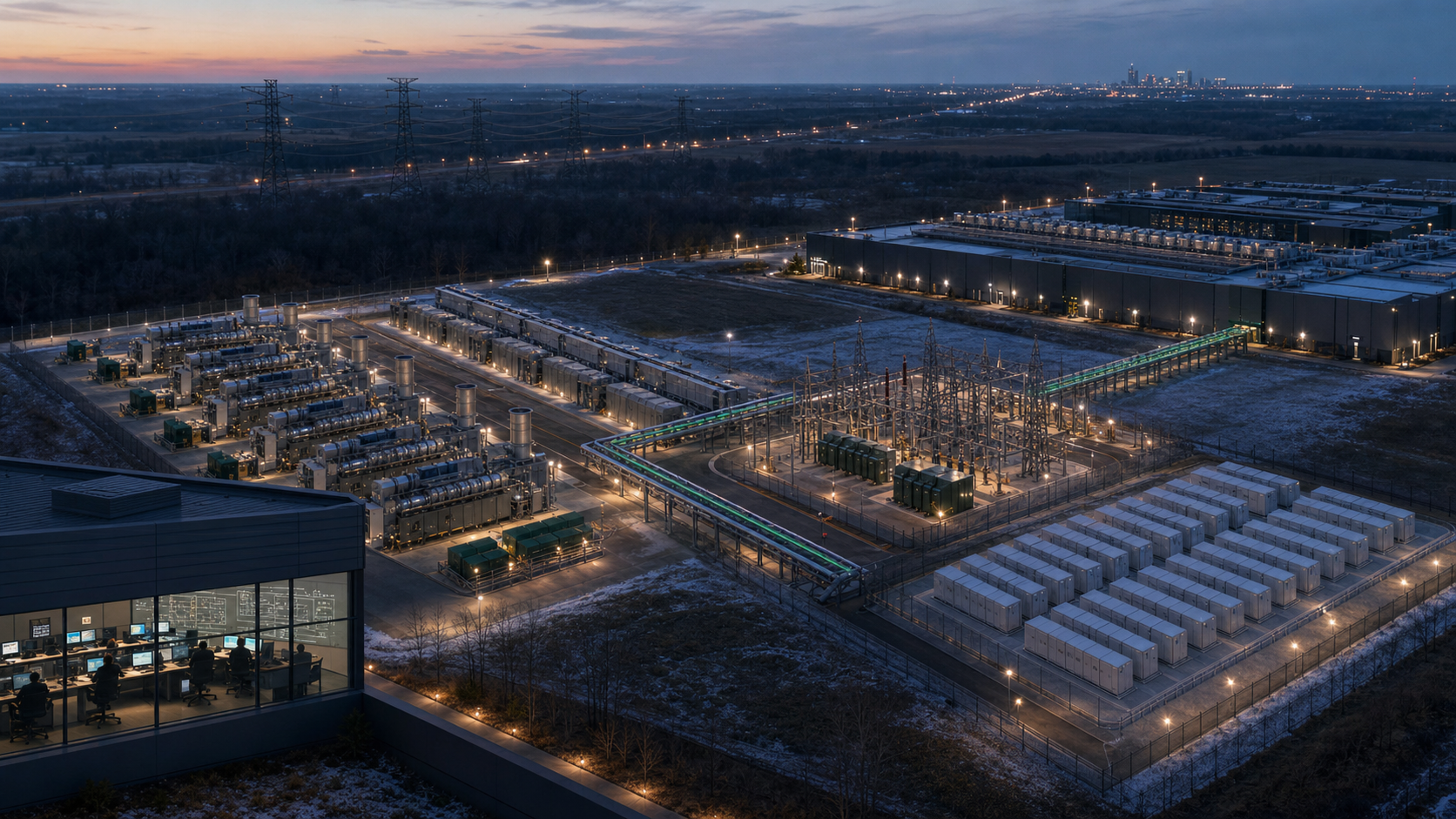
- Veolia will operate and maintain a planned 350MW microgrid for an undisclosed AI data-centre campus in Ohio.
- Energy-Storage.news locates the project in New Albany, while the customer and developer remain unnamed.
- Gas engines and linear generators are to be combined with a 430MWh battery energy-storage system.
- The plant is intended to supply all campus power behind the meter without relying on the grid.
- Veolia entered before commercial operation to support commissioning, procedures and coordination among contractors and equipment suppliers.
- Contract value, term, fuel and emissions profile, commissioning date, actual IT load and measured availability are not public.
Operations, not ownership, is the disclosed decision
The announcement identifies who is to integrate and run the plant, not who financed it or who will consume its electricity. Veolia’s remit includes commissioning support, operating integration and long-term plant operations under a performance-based model.
That is a consequential control surface. A private energy system must dispatch multiple generator types, maintain the battery, manage planned work and respond to failures without the wider grid serving as the normal balancing resource.
The developer and AI customer are undisclosed. The contract price, duration and performance formula are also absent, so the allocation of financial risk cannot yet be calculated.
A 350MW plant is not a 350MW server load
The announced figure describes generation capacity. It may include reserves, maintenance margin, conversion losses and capacity required for cooling and other non-IT systems.
No source gives the campus’s commissioned IT load, ramp schedule or power-usage effectiveness. Treating the plant rating as live computing demand would overstate the project’s present scale.
The useful operating measure will be simultaneous delivered load over time, separated into IT, cooling and electrical losses.
The battery is measured in energy
The 430MWh figure says how much energy the storage system can hold under its stated rating. It does not reveal the battery’s MW discharge limit or how long it can support the campus at a particular load.
At a purely illustrative 350MW draw, 430MWh is only a little over one hour before losses and reserve requirements. The actual duration cannot be calculated without the battery’s power rating, usable depth of discharge and operating reserve.
Storage can bridge starts, ramps and short generator outages. It does not by itself prove long-duration resilience.
Leaving the grid creates a fuel and maintenance dependency
The design is intended to supply 100% of site power behind the meter. That can bypass a constrained interconnection queue and give the operator direct control over generation.
It also moves dependency toward fuel delivery, engine availability, linear-generator performance, spare parts and on-site maintenance. The sources do not disclose fuel contracts, emissions controls or how capacity is split between technologies.
An islanded campus is therefore not dependency-free. It exchanges one external system for a tightly coupled private one.
Commissioning is where the promise becomes measurable
Veolia says it joined before commercial operation to develop procedures and coordinate several contractors and original-equipment manufacturers. Early involvement can reduce interface failures that appear only when subsystems operate together.
Energy-Storage.news reports an expected 35 to 40 full-time staff for round-the-clock operations. Staffing indicates the plant is being treated as critical infrastructure rather than a passive utility connection.
Neither staffing nor a commissioning plan proves readiness. Integrated load tests, black-start exercises, failover tests and sustained operation will provide that evidence.
Availability and performance remain targets
The reported availability target is 99.9%. That corresponds to roughly 8.76 hours of unavailability a year if measured across a full year, but the contract’s exact denominator, exclusions and penalty rules are not public.
A performance-based model matters only when the measured service, test window and accountability are known. Planned maintenance, fuel interruption and downstream campus faults may be treated differently.
The next decisive disclosures are the commercial-operation date, measured generation and storage availability, delivered load, fuel efficiency, emissions, water use and any service-level penalties. Until those appear, Veolia has assumed an important operating role in a project whose performance remains prospective.