Summary
- We Energies has begun building three Wisconsin projects: 150MW of solar with 50MWh of battery storage in Rock County, 110MW of wind across Iowa and Grant counties, and a separate 75MW battery facility in Walworth County.
- The projects are expected to finish by the end of 2027; starting construction does not mean they are generating, energised, commercially operational or supplying the Port Washington campus.
- Invenergy will develop the facilities and transfer them to Wisconsin utilities, with We Energies holding a majority stake and Madison Gas & Electric and Wisconsin Public Service sharing the remainder; exact ownership and costs are undisclosed.
- Around 50% of each project’s capacity is allocated to the Vantage campus, which is not evidence that the portfolio supplies 50% of campus demand or energy.
- Vantage says 70% of campus power is intended to originate from zero-emission resources, while the remainder will be matched annually with renewable purchases prioritising Wisconsin; annual matching is not hourly carbon-free delivery.
- The campus is described at 902MW at full build-out, while a WEC filing cites 1.3GW of demand forecast through 2030 and up to 3.5GW of site potential; those perimeters cannot be treated as one committed load.
The portfolio has three physical jobs, not one green percentage
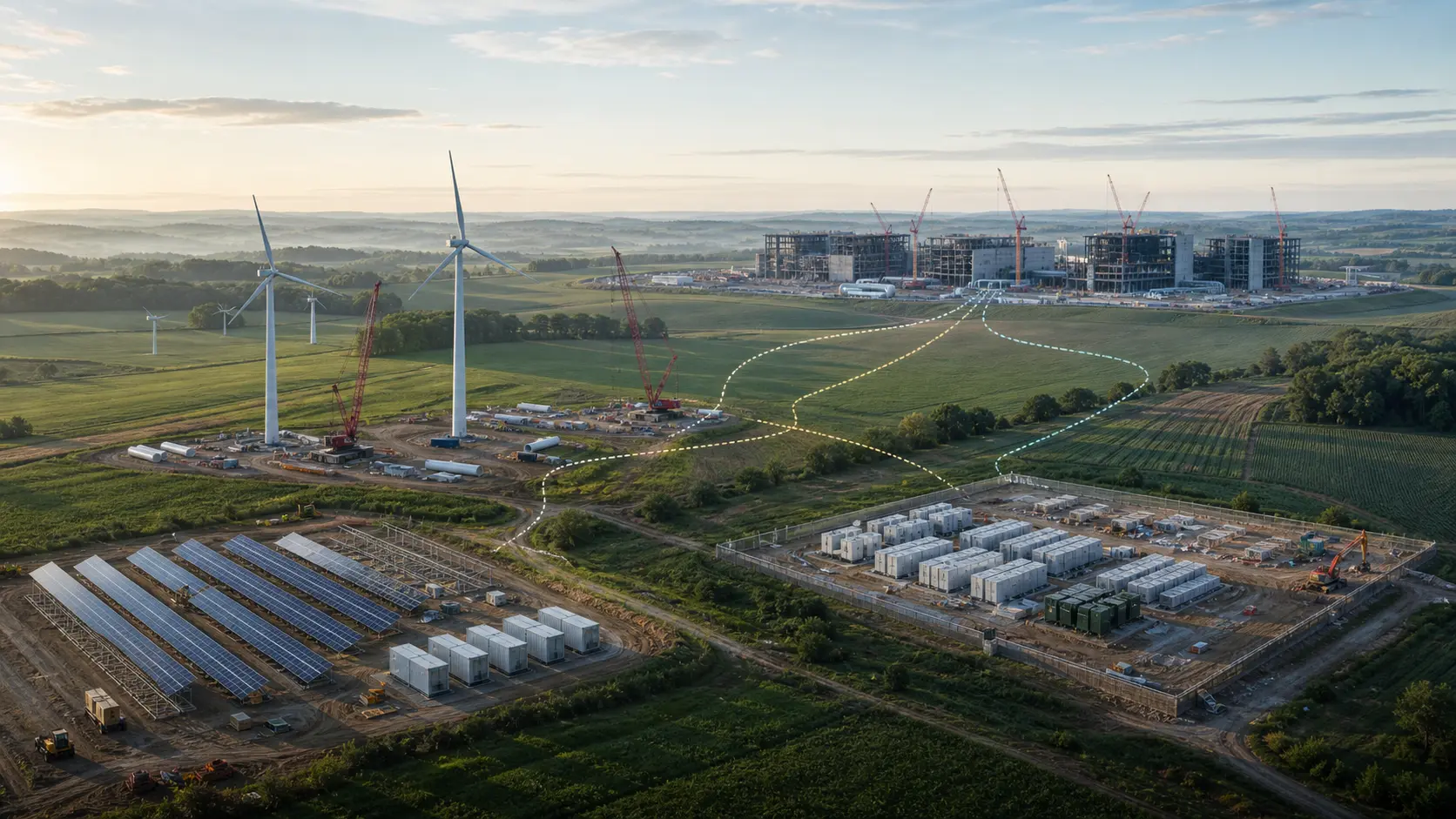
The construction programme spans different technologies and counties. Rock County gets a 150MW solar plant paired with 50MWh of storage. A 110MW wind farm crosses Iowa and Grant counties. Walworth County receives a 75MW battery energy-storage facility whose duration is not stated.
MW measures instantaneous power; MWh measures stored energy. Adding the Rock County battery’s 50MWh to 150MW of solar would create a meaningless total. The 75MW battery cannot be converted into MWh without its discharge duration. Keeping those units separate is essential before estimating the portfolio’s output or flexibility.
A construction start begins the risk clock
We Energies expects all three projects to be complete by the end of 2027. That leaves development, equipment, grid interconnection, testing, transfer and commercial-operation milestones between the announcement and usable supply. The Port Washington campus itself is targeted to go live in 2028.
Those dates line up as a plan, not as proof. A site can be under construction without an energised building, and a generation asset can be physically complete without commercial operation. No current source supplies construction percentages, interconnection status, delivered MWh or commissioning dates for individual campus buildings.
Half of project capacity is not half of campus electricity
The current report allocates about 50% of the capacity of each project to the campus. That statement creates a contractual or planning share for three assets. It does not say that the portfolio covers half of the campus’s peak demand, annual consumption or every hour of operation.
Solar and wind output vary, while batteries move energy between periods rather than create it. Capacity allocation also says nothing about capacity factor, curtailment, losses or availability. A credible supply ratio will eventually need generated and discharged MWh compared with campus consumption over the same interval.
The campus has more than one load boundary
The current project description puts the full build-out at four buildings, 902MW and 2.5 million square feet across 672 acres, with a cost of $15 billion and closed-loop liquid cooling. A May WEC filing, meanwhile, described four buildings under construction, 1.3GW of demand forecast through 2030 and site potential as high as 3.5GW.
These numbers may reflect different dates, phases or electrical perimeters. A 902MW design figure, a 1.3GW forecast and a 3.5GW potential ceiling are not interchangeable. Until the parties reconcile them, none should be promoted into a single statement of contracted or operating load.
The carbon claim also has two clocks
Vantage says 70% of campus power is intended to originate from zero-emission sources including solar, wind and battery storage. For the remaining energy, it plans annual matching through renewable purchases with a preference for Wisconsin supply.
The first statement describes an intended source mix; the second is an accounting match over a year. Annual procurement can balance total MWh while leaving individual hours served by the wider grid. Neither construction nor matching proves hourly carbon-free operation, and batteries are a storage medium whose emissions depend on what charges them.
Cost protection is a structure to test, not a settled outcome
We Energies says data-centre customers will pay for their electricity and for new generation and equipment built to serve them. The current report also says regulators approved a large-load tariff and that Vantage will underwrite 100% of dedicated power-infrastructure investment.
That design is more informative than a general promise, but it remains an attributed protection mechanism. The sources do not publish project costs, transfer prices, power prices, utilisation or eventual rate treatment. Evidence that other customers are protected will require tracking actual capital allocation, tariff collections, overruns and any stranded infrastructure over time.
Sources
Member Briefing
Deeper Profile Context
Sign in with the right membership level to unlock the full briefing and source notes.
Only for Strategic Circle
Strategic Circle
Open to all readers. Unlock profile briefings after joining and signing in.
Join Strategic CircleOnly for Leadership Alliance
Leadership Alliance
For qualified IP-asset owners and management; sign in to unlock alliance briefings.
Join Leadership Alliance