
Summary
- U Mobile and ZTE say they installed and activated a portable, solar-powered 4G and 5G site with satellite backhaul in three days at each of two East Malaysian pilot locations.
- The disclosed limits are useful but separate: battery operation for up to 52 hours without sunlight depends on configuration, while a peak download of up to 134 Mbps says nothing about sustained busy-hour service.
- The next proof should be a continuity envelope covering load and weather assumptions, satellite capacity, battery health, remote alarms, field access, restoration ownership and repeat-site acceptance.
The ceremonial moment for a mobile site is the first successful connection. That is also when a different set of clocks starts. How long can the stored energy carry the actual radio load? What happens to usable capacity when the satellite path is busy? How quickly can a fault be seen, reached and repaired? Installation time answers none of those questions, even when the installation itself is unusually fast.
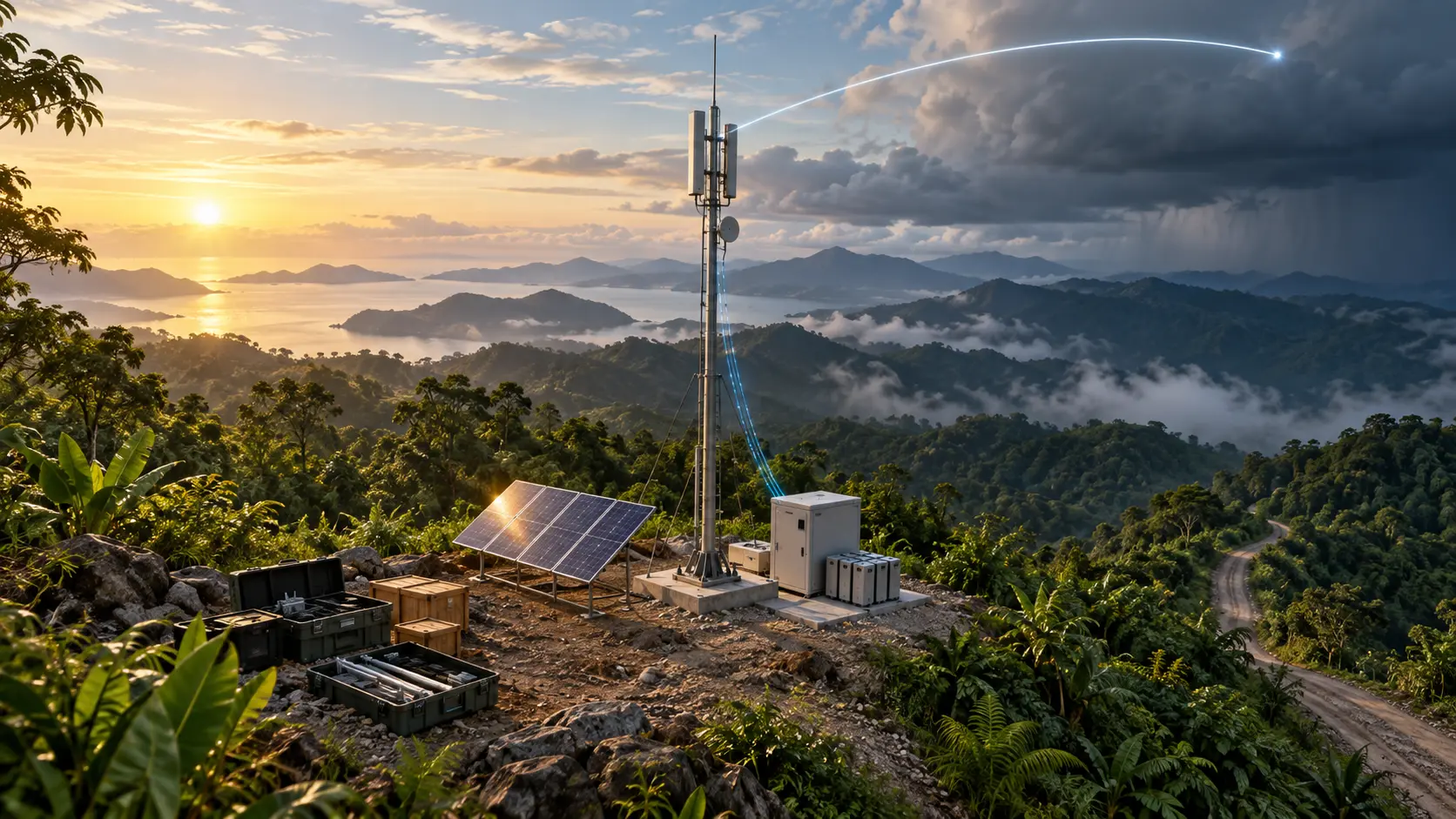
U Mobile and ZTE announced on 22 September that they had completed a proof of concept at SK Mentu, a primary school in Sebuyau, Sarawak, and Balai Kebudayaan Iburu, a community hall in Sipitang, Sabah. Each site used a lightweight 12-metre pole, solar panels, battery storage and satellite backhaul into U Mobile's core network. The design did not require grid electricity, fibre or another terrestrial transmission link.
The companies say each site was installed and fully activated within three days. They compare this with conventional towers in challenging rural locations that can take close to a year once site acquisition, construction, transmission and grid readiness are included. That comparison is a claim by the parties, not an audited schedule study. Even so, the PoC demonstrates a meaningful capability: several dependencies that normally arrive in sequence can be replaced by a compact, integrated package.
Three days closes only the first clock
Fast activation matters where the conventional path is blocked by distance, terrain or slow supporting infrastructure. It can also change the order of decisions. An operator can test demand and radio conditions before committing to a heavier permanent build. A community can receive an interim connection while fibre, power or a conventional tower remains uneconomic or delayed.
But portability is a property of equipment. Continuity is a property of a service. The announcement establishes the time to first activation at two sites; it does not establish the time to repeat the result across a fleet, maintain it through seasons or restore it after a failure.
The missing distinction is important because the architecture removes familiar dependencies by creating new operating ones. Grid readiness becomes solar yield, battery condition and load management. Fibre readiness becomes satellite capacity, latency and terminal availability. A conventional tower's civil works become a lighter structure whose access, security and maintenance still need an owner.
The 52-hour and 134 Mbps figures test different boundaries
The battery system is described as capable of operating for up to 52 hours without sunlight, depending on configuration. That is a boundary, not yet a service commitment. To use it for planning, a buyer needs to know the starting state of charge, radio configuration, carried traffic, power-saving policy, battery temperature and age, and the weather sequence used for the claim. A fresh battery at a lightly loaded pilot is not the same operating case as an older battery during a busy period after several poor-solar days.
ITU-T L.1210 provides a useful discipline without certifying this site. Its sustainable power-feeding framework includes remote observation of battery voltage, current, temperature, state of charge and state of health, as well as remote testing and reporting. The commercial lesson is simple: autonomy should be visible while it is being consumed. A site operator should not discover the real energy margin only when the radio turns off.
The peak download result of up to 134 Mbps belongs to another clock. It shows that useful throughput was reached during live testing. It does not disclose sustained download, uplink, latency, jitter, packet loss, concurrent users, traffic mix, satellite capacity or congestion behaviour. Battery endurance and network capacity can move in opposite directions: more traffic can increase power demand while also placing more pressure on the backhaul.
That is why the two headline numbers should not be blended into a single claim of reliability. One describes a configuration-dependent energy limit. The other records a peak traffic observation. A repeatable service needs a joint trace showing how energy, radio load and satellite performance behave over the same period.
A continuity envelope is the missing product
The next unit of proof should not be another photograph of a mast. It should be a site acceptance record. For each deployment, it would state the intended user and traffic load, minimum usable service, solar and battery assumptions, backhaul commitment, alarm coverage, spare-parts location, access constraints and restoration target. It would also show who is responsible at each hand-off.
U Mobile controls the promise made to users and the integration with its network. ZTE controls the supplied architecture and its support boundary. The unnamed satellite provider controls a separate capacity and availability dependency. A school, community hall or other host may control physical access. If public money or a coverage obligation is involved later, the funder or regulator will need an acceptance measure that is stronger than “activated.”
The announcement also identifies emergency and disaster response as a possible use. That is plausible: Malaysian and ITU technical material both recognise satellite backhaul for remote, fast-deployment, temporary or emergency cells. It is not yet a demonstrated emergency service. A disaster configuration would need priority rules, resilient logistics, local operation when backhaul is impaired, trained ownership and a restoration exercise. Rapid assembly alone cannot supply those controls.
This does not diminish the PoC. It identifies the transaction that follows it. U Mobile and ZTE have shortened the route to first signal. To turn that result into a market category, they now need to publish the operating envelope that keeps the signal useful—and makes a failure recoverable—after the installation team leaves.
Sources
Member Briefing
Deeper Profile Context
Sign in with the right membership level to unlock the full briefing and source notes.
Only for Strategic Circle
Strategic Circle
Open to all readers. Unlock profile briefings after joining and signing in.
Join Strategic CircleOnly for Leadership Alliance
Leadership Alliance
For qualified IP-asset owners and management; sign in to unlock alliance briefings.
Join Leadership Alliance