Summary
- Tucows said its software network reached more than 1,000 servers in over 100 countries by 31 December 2002.
- The company owned the main hubs and the update software; local managed-service providers owned many of the servers that delivered the files.
The thousand-server network had a centre
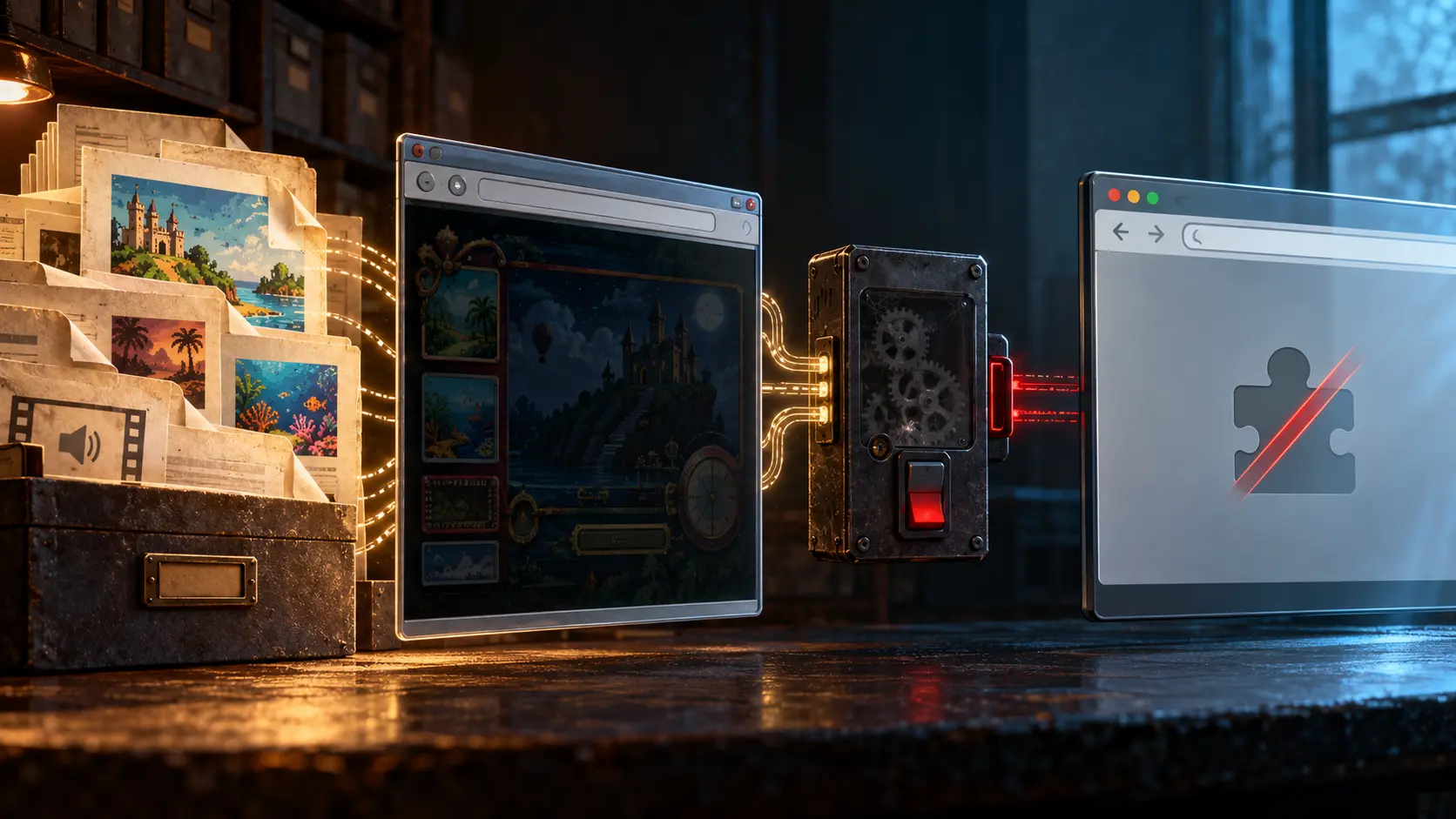
By the end of 2002, Tucows told the U.S. Securities and Exchange Commission, its software network reached more than 1,000 servers in over 100 countries. The number sounded like a library without an address. Tucows' own filing supplied the topology: the company owned the main hubs, while managed-service providers owned servers in their facilities. Proprietary software sent compressed, incremental updates from the centre to the mirrors.
That arrangement distributed the download. It did not distribute every job that made the library useful.
Tucows' current corporate timeline dates the site's origin to 1993 in Flint, Michigan. It says Scott Swedorski, then working for local libraries, used a personal website to offer downloadable software. The name stood for The Ultimate Collection of Winsock Software. A company release from 1999 called 1994 the year Tucows was founded; the record in this source set contains no incorporation document distinguishing the personal-site launch from the company's formal formation.
The first problem was access. A user needed software before the web became a routine delivery channel for software. Tucows' 1999 release described a library for Windows, Macintosh, Linux and PDA programs. In 1994, according to the company's later timeline, Internet service providers and other partners began mirroring those libraries. The stated benefits were practical: a nearby copy could speed the download and save bandwidth.
A mirror therefore had two addresses. One was the address a user visited on a local provider's network. The other was the upstream source that supplied the files and the library structure. In 1995, Tucows' timeline says, Internet Direct acquired Tucows; Internet Direct had been one of its early mirror sites. A local delivery partner had become the owner of the catalogue it once mirrored.
The operation soon became larger than a collection of hobby downloads. In May 1999, Tucows said its software could be accessed through more than 900 mirror sites on six continents and in over 75 countries. The same announcement reported more than 70 million monthly page views. Those are the company's own figures, not an independently audited count. A separate company filing later described a network of partners and servers, which makes the scale easier to read as a system rather than a promotional total.
A local copy was still a Tucows library
Tucows' 2003 Form 10-K described eight main software libraries containing more than 36,000 titles. The company said every title was reviewed, virus-tested and rated from one to five. Its delivery network sent the libraries to managed-service providers' networks, which were the first access points for their end users. A partner was expected to download the libraries it offered at least once a day.
Tucows owned the main hubs. Its partners owned servers at their own facilities. Mirroring software then sent compressed, incremental updates to the mirrors. Tucows said the method reduced bandwidth use and update time and kept the libraries more current.
The distinction matters. A user could fetch a program from a nearby provider, while the catalog's categories, review and rating remained part of the Tucows service. A mirror was a distribution point, not a separate publisher of the shared library. The network gave partners a role in delivery and gave Tucows a path to keep the collection aligned across many sites.
That also created two clocks. Tucows' clock determined when a title or update entered the central library. The partner's clock determined when the local copy finished its next refresh. The filing states the expected daily download and the compressed update method; it does not give a measured lag for every mirror.
In May 1999, Tucows announced that an investment group had acquired a majority interest through a new company, TUCOWS.com Inc. The new company acquired Tucows' assets and businesses; the announcement said the investor group would control and chair the company, while the founders and managers retained interests and operational roles. The physical network could be spread across many providers as the central library changed corporate hands.
The service's ending made the distinction between a live network and a saved collection visible. On 25 January 2021, Tucows said the downloads site had served its last file and that much of its library had been transferred to the Internet Archive. The notice records a retired site and a preserved collection. It does not give an inventory of what moved or describe a continuing mirror-update service.
The mirrors made software local. The center maintained the catalog, hubs and update path. That was the bargain behind the thousand-server count: reach was distributed; the work of keeping a shared library current stayed organized around one publisher.
Sources
- Tucows' corporate history, including its 1993 origin, the 1994 mirror timeline and Internet Direct's 1995 acquisition.
- Tucows' 27 May 1999 acquisition announcement, including the company's mirror-site and page-view figures.
- Infonautics' 2001 Form S-4/A, including the network's 2001 topology and scale.
- Tucows' 2002 Form 10-K, including library review, partner refresh expectations and mirror-update architecture.
- Tucows' 25 January 2021 retirement notice.
Member Briefing
Deeper Profile Context
Sign in with the right membership level to unlock the full briefing and source notes.
Only for Strategic Circle
Strategic Circle
Open to all readers. Unlock profile briefings after joining and signing in.
Join Strategic CircleOnly for Leadership Alliance
Leadership Alliance
For qualified IP-asset owners and management; sign in to unlock alliance briefings.
Join Leadership Alliance