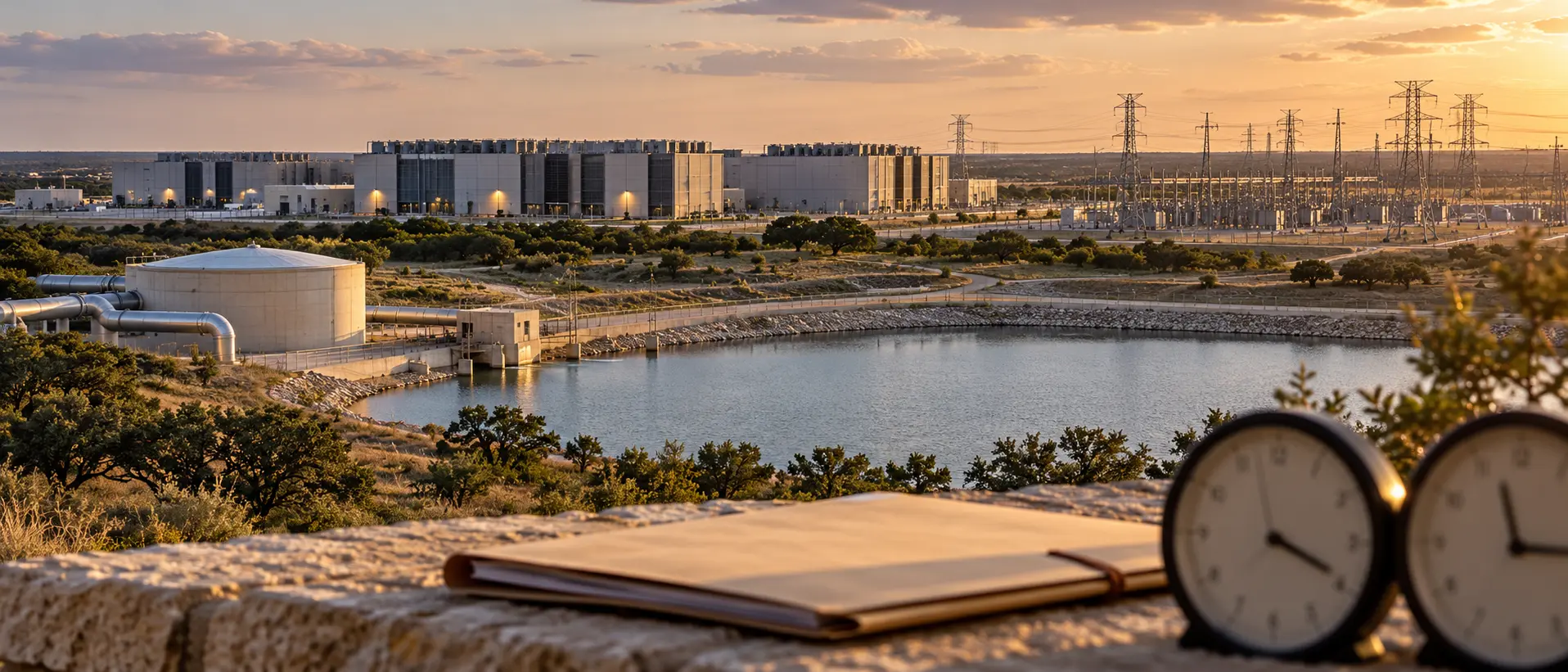
Texas has hit pause on data-center permits, and it never marked the exit. On 21 September 2026, Governor Greg Abbott signed a letter ordering the Texas Commission on Environmental Quality (TCEQ) to stop issuing every permit tied to data-center projects until the grid operator, ERCOT, completes its review. Two dates now shadow the industry—TCEQ's compliance update due 19 October and ERCOT's report planned for 10 December—and neither is an automatic expiry. They are checkpoints on two separate clocks, and nobody has publicly said who gets to call the review finished.
The short version
- Abbott's 21 September 2026 instruction pauses all TCEQ data-center permit issuance until ERCOT completes its review. The 19 October compliance update and the report planned for 10 December are checkpoints, not automatic expiry dates.
- ERCOT's RFI targets developers seeking ERCOT interconnection for at least 25 MW—a narrower group than the permit pause covers. The reviewed sources do not establish closure criteria, who formally declares the review complete, or any public evidence that issuance has resumed.
Two clocks, one unmarked exit
The letter builds an interagency evidence gate. Other state agencies are told not to advance related approvals until the information requested by the Public Utility Commission of Texas (PUCT), ERCOT and the Texas Water Development Board (TWDB) is in hand. But mind the distinction that matters: that condition is about obtaining information. TCEQ's own pause is keyed to a completed review. A submission landing in an inbox is not the same as a review being done—so receiving paperwork cannot, by itself, satisfy the condition that governs permit issuance.
ERCOT's 25 MW threshold is narrower than the pause
The ERCOT RFI covers developers pursuing ERCOT interconnection for at least 25 MW. Responses were due 12 October, with joint analysis alongside PUCT planned. That population is narrower than the permit freeze and does not include every facility or every permit applicant. The 25 MW line is a survey boundary, not the edge of TCEQ's instruction—do not confuse the two.
Water: what TWDB's 2026 survey can and cannot prove
TWDB is tasked with enforcing existing water-use reporting and coordinating information with ERCOT. Its 2026 survey asks facilities that operated at any point in 2025—and that received the survey—to report their 2025 water use. Two caveats matter for anyone reading the numbers: construction water is excluded from industrial-use data, and the initial facility and contact lists may contain duplicates. So industrial-use figures cannot stand in for construction consumption, and a list entry is not a verified distinct facility until someone checks it.
Who declares the review complete?
Abbott's stated goals are cost allocation, lower residential bills, audits, community water, reporting, setbacks and the elimination of incentives. His letter frames TCEQ's role as kicking in "once these laws are enacted." Keep those goals attributed to him: the reviewed sources do not establish the whole package as enacted requirements, nor its intended benefits as achieved outcomes. TCEQ's stormwater page carries the pause notice with no individual permit counts or outcomes. And the reviewed sources do not establish completion criteria, name who formally declares ERCOT's review complete, describe a public closure procedure, or show issuance has resumed. That is a source limitation, not proof that no procedures or records exist.
Here is where Heng Lu's Note 73 earns its keep—as an editorial lens on participation and authority, not as Texas evidence. Contributing information does not settle who can declare completion. Being asked to submit is not the same as holding the pen that signs off. Public verification has to connect three things: the evidence accepted, the completion decision, and the permit activity that follows.
Sources: Governor release; signed letter; ERCOT RFI; TWDB survey; TCEQ notice; Heng Lu Note 73 (editorial lens).
Member Briefing
Read the full trend briefing
Members read the full briefing with the source notes behind every finding.
Strategic Circle
A daily briefing in your language, built from changes we have verified.
Join for USD 20/monthCancel anytime.
Members also get the full research library, a daily briefing on the networks they follow and the private forum.