Summary
- At 3:31am on 1 March 2024 Telstra's Triple Zero call centre lost both databases behind the call-taker's screen — the one carrying calling-line identification and the one holding the emergency services' primary contact numbers — and eight of the twenty-four backup numbers operators could dial instead were wrong.
- The same regulator published that failure twice in December 2024: 473 contraventions in an investigation report, and 160 priced allegations in an infringement notice dated 11 November 2024 whose operative allegation says 1 March 2023 while its own schedule prints 1 March 2024.
- The only public trace of the incident review Telstra says it commissioned is one sentence in a media release, with no name, no scope and no due date. The same regulator had already written all three fields into a remedial direction to the same company seven months earlier.
At 3:31am on 1 March 2024 an operator answering a Triple Zero call in Australia could see a telephone number and nothing else. The two databases behind that screen — the one carrying calling-line identification, and the one holding the primary contact numbers for police, fire and ambulance services — were both offline. What remained was the fallback: a stored list of numbers a call-taker could dial by hand.
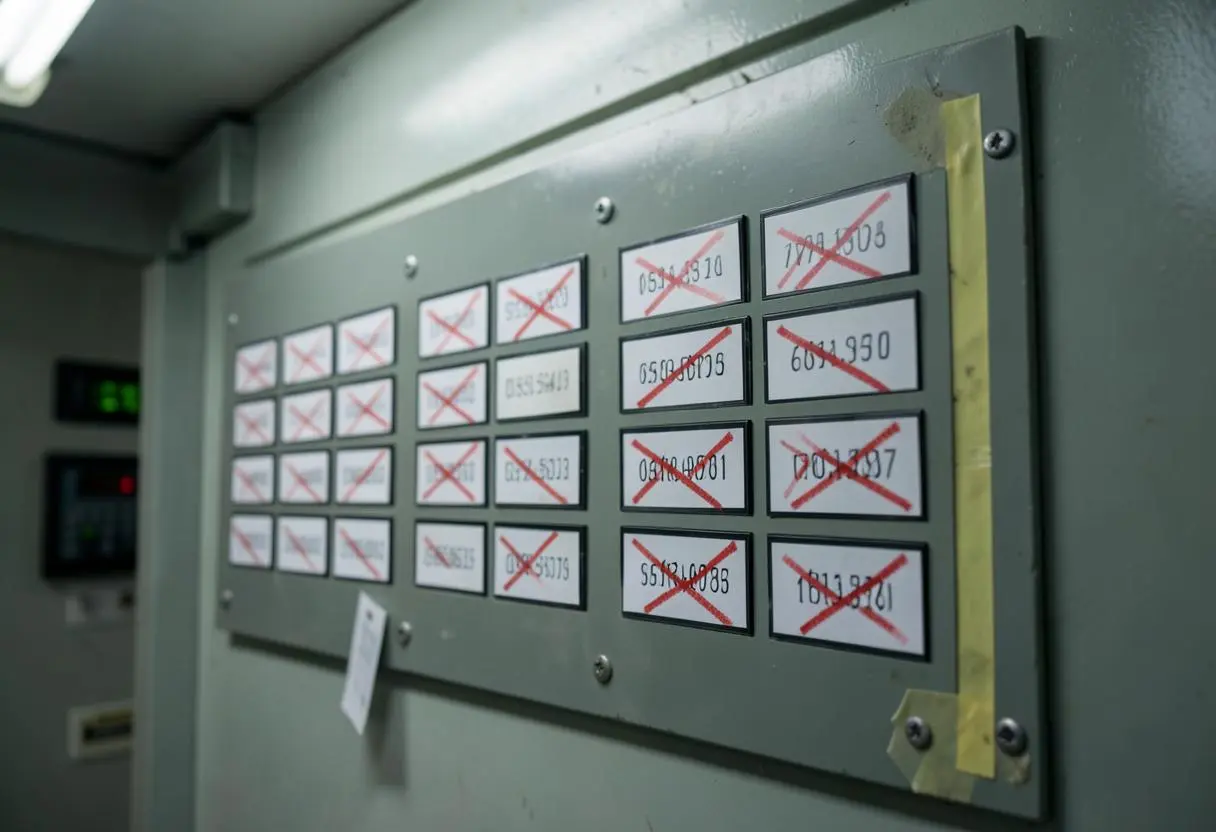
There were twenty-four numbers on that list. Eight of them were wrong.
That is the incident, and it is worth stating plainly because it is not a routing error, a cable cut or a supplier failure. It is a maintenance failure on the one artefact that exists precisely to survive a database failure. The list is the control. A third of it was dead.
Telstra's own account, dated 25 November 2024 and attributed to Chief Executive Officer and Managing Director Vicki Brady, names the mechanism to the component. At 3:30am AEDT the Triple Zero team identified calling-line identification not appearing. A high volume of registration requests from medical alert IoT devices coincided with other system activity, reached the maximum number of database connections, and triggered an existing but previously undetected software fault that made the platform unresponsive. An updated email address for Triple Zero Victoria had been entered incorrectly; that error was identified within 13 minutes. Within 90 minutes the impacted server was restarted and the service returned to normal.
That is an unusually specific account, and it earns its specificity: very few operators publish the mechanism down to the connection pool. What the document does not carry is a dated commitment.
The fixes it lists — more database connection capacity, additional monitoring and notifications, updated work instructions, a hold on changes to Triple Zero platforms, correction of the eight wrong backup numbers with scheduled regular reviews, a lab reproduction, a software fix, a network change to cut non-emergency IoT registrations, the same change arranged with two other operators, updated business-continuity processes — arrive with no owner, no role and no completion date. The only timeframes in the document are retrospective.
The count lives somewhere else, and it lives in more than one place.
The ACMA's investigation report finds that on 1 March 2024 Telstra Limited (ACN 086 174 781), in its capacity as the emergency call person for 000 and 112, contravened subsection 148(1) of the Telecommunications (Consumer Protection and Service Standards) Act 1999 on 473 occasions. The two limbs are printed separately: 127 failures to comply with subsection 42(2) of the Telecommunications (Emergency Call Service) Determination 2019 by failing to transfer a call, and 346 failures to comply with section 51 by failing to make available the caller's name and the most precise location information available. The disruption affected 494 calls, of which 346 were transferred using the backup contact list. The investigation was commenced on 5 March 2024 under section 510 of the Telecommunications Act 1997; preliminary findings went to Telstra on 9 August 2024 and the company responded on 23 August 2024.
Run the first piece of arithmetic and the report is exact: 127 and 346 make 473. Run the second and something is left over. On the figures as printed, 473 of 494 leaves 21 calls inside the affected population and outside the contravention count, and none of the twelve documents read for this article on 24 November 2026 accounts for them. That is not a dispute about whether the failures happened. It is a note about what a published count can be used for.
Then there is the instrument that prices the same event. The infringement notice is dated 11 November 2024 and signed by authorised infringement notice officer Cathy Rainsford. It alleges 160 contraventions of subsection 148(1): 80 under subsection 42(2) and 80 under section 51, each priced at 60 penalty units of $313, giving 9,600 penalty units. The penalty payable under paragraph 572G(1)(b) is printed as $3,004,800, built as $1,502,400 plus $1,502,400. That arithmetic reconciles too. The figure 473 does not appear anywhere in the notice.
And the notice carries two dates for one incident. Its operative allegation states reasonable grounds to believe that on 1 March 2023 Telstra committed multiple contraventions. Paragraph 2.1 of its own Schedule 1 states that on 1 March 2024 Telstra experienced a disruption between 3:31am and 5:00am. Two years apiece, one document, one failure. Whether the 2023 is a keying error or something else is a question the document does not answer, and none of the twelve documents read for this article on 24 November 2026 answers it either. I am not going to harmonise them for the publisher's convenience.
The duration has the same quality. The report records the window as 3:31am to 4:41am and adds a footnote: in later correspondence Telstra amended the end time to 5:00am. That is 70 minutes in the body and 89 minutes in the footnote. The media release says the call centre was hampered for 90 minutes. Telstra says the server was restarted within 90 minutes. Three durations, three sources, one morning.
Now the sentence that matters most, printed in full in the 11 December 2024 release and nowhere else in the reviewed set: 'The ACMA also notes the action Telstra has taken to rectify its processes following the incident, including updating its backup phone number list and appointing an independent consultant to conduct an incident review.'
That is it. No consultant. No firm. No terms of reference. No due date. No statement that any report arrived, was read, or was relied on. A commissioned review of a national emergency-call failure exists in public as a noun.
The regulator's own record of the morning starts thin and widens. Its statement of 1 March 2024 says only that the ACMA is aware of an incident that impacted Telstra's ability to transfer Triple Zero calls to police, fire or ambulance services 'this morning' and is 'undertaking preliminary assessment of the issue'. The statement of 5 March 2024 fixes the date and the instrument — an investigation commenced that day into Telstra Limited's compliance with the Telecommunications (Emergency Call Service) Determination 2019 in relation to the incident on 1 March 2024 — and promises that the findings will be made public once concluded. They were, nine months later.
The counterweight is that this publisher already writes the fields, in its own hand, to the same company. A remedial direction dated 17 May 2024 — and it must be said clearly that this instrument, listed on the ACMA's July 2024 publication page, concerns unlisted numbers, the White Pages and the directory assistance database, not Triple Zero, so it is evidence of drafting capacity rather than of anything done here — requires Telstra to seek the ACMA's written approval for a nominated, appropriately experienced and qualified independent person as Independent Reviewer within 30 business days; to appoint the approved person within 10 business days of that approval and require the reviewer to report to Telstra and the ACMA within 4 months of appointment; to provide a Draft Action Plan within 30 business days of receiving the report, including reasons for not implementing any recommendation and dates for each proposed action; to resubmit within 7 business days if the ACMA proposes changes; to report every 6 months thereafter until all actions are fully implemented; and to retain records for at least 24 months. The direction continues until a periodic report demonstrates full implementation.
Six fields — nominator, approver, report clock, action plan, return cycle, end condition — all in one instrument, all printed, for a different file. On the Triple Zero file, one adjective.
So what can a stranger check? The investigations register records, among the 2024 outcomes, that Telstra Limited breached subsection 42(2) and section 51 of the Determination, that 'The ACMA issued an infringement notice to Telstra', and that the report was published in December 2024. No review outcome. No consultant. No due date. No later entry. The annual report appendix records the outcome for the matter solely as 'Infringement notice totalling $3,004,800'. The December 2024 publication page that hosts both documents prints 'Last updated: 17 September 2026' and nothing else — no incident date, no count, no penalty, no reviewer.
And the same publisher has since shown what the alternative looks like. In June 2025 it published a court-enforceable undertaking from Telstra following the separate 106 emergency call service outage of 5–6 July 2024, during which that service was unavailable for 12 hours and 46 minutes: an undertaking to improve change management processes and to engage an independent reviewer to look at the range of operational arrangements supporting reliable delivery. That instrument binds. It sits on a publication page with the investigation report, the infringement notice and the undertaking itself. The December 2024 Triple Zero matter appears there only as background — 473 breaches, 90 minutes, $3 million — and the March 2024 consultant does not appear at all.
BTW has tracked Telstra here as a network footprint, a deal counterparty, a cable partner, a 5G programme and a coverage claimant. None of that coverage read a failure investigation as an instrument, and none of it asked what the record lets a stranger verify. This is the first piece on this desk to set an operator's own account of a national emergency-call failure against the same regulator's separate investigation of it, and then to test the regulator's own drafting for the fields its other file leaves blank. Our directory entry for Telstra Corporation Limited is where the company's number-resource footprint is recorded.
The bound on the negative is exact. Across the twelve documents listed at the end of this article, read on 24 November 2026, no document records the name or firm of the consultant named in MR 33/2024, the scope or terms of the review, a due date for it, the receipt or delivery of any report, or the completion of any remediation arising from it. That is a statement about twelve documents on one date, not a claim that nothing happened and not an allegation that anything was concealed. An absence in a record is not a finding against the people who probably did the work.
Which is why the recommendation is a field, not an accusation. Print the reviewer's name and the regulator's written approval when it is given. Print the report's due date in months from appointment. Add a return line to the investigations register that says whether the report arrived and what the action plan commits to. Every one of those is already drafted, in the same publisher's own instrument, in the same house style, addressed to the same company. The outage produced five numbers. A sixth would cost one column.
Sources
- ACMA investigation report, Telstra ECP disruption 1 March 2024
- Infringement notice, Telstra ECP disruption, dated 11 November 2024
- Telstra pays $3 million penalty for Triple Zero outage, MR 33/2024, 11 December 2024
- Our Triple Zero outage: the facts, the cause, and what's next, Telstra, 25 November 2024
- Remedial Direction, Telstra Limited, 17 May 2024
- Investigation report and remedial direction – Telstra Corporation Limited and Telstra Limited, July 2024 publication page
- ACMA statement on Telstra Triple Zero outage, 1 March 2024
- ACMA statement on Telstra Triple Zero incident investigation, 5 March 2024
- Investigations into telco providers, ACMA outcomes register
- Investigation report and infringement notice – Telstra Limited, December 2024 publication page
- ACMA Annual Report 2024-25, Appendix 1.4: telecommunications consumer protection compliance and enforcement outcomes
- Telstra penalised for disruption to emergency call support service, June 2025
- Directory: Telstra Corporation Limited
Member Briefing
Read the full trend briefing
Members read the full briefing with the source notes behind every finding.
Strategic Circle
A daily briefing in your language, built from changes we have verified.
Join for USD 20/monthCancel anytime.
Members also get the full research library, a daily briefing on the networks they follow and the private forum.