Summary
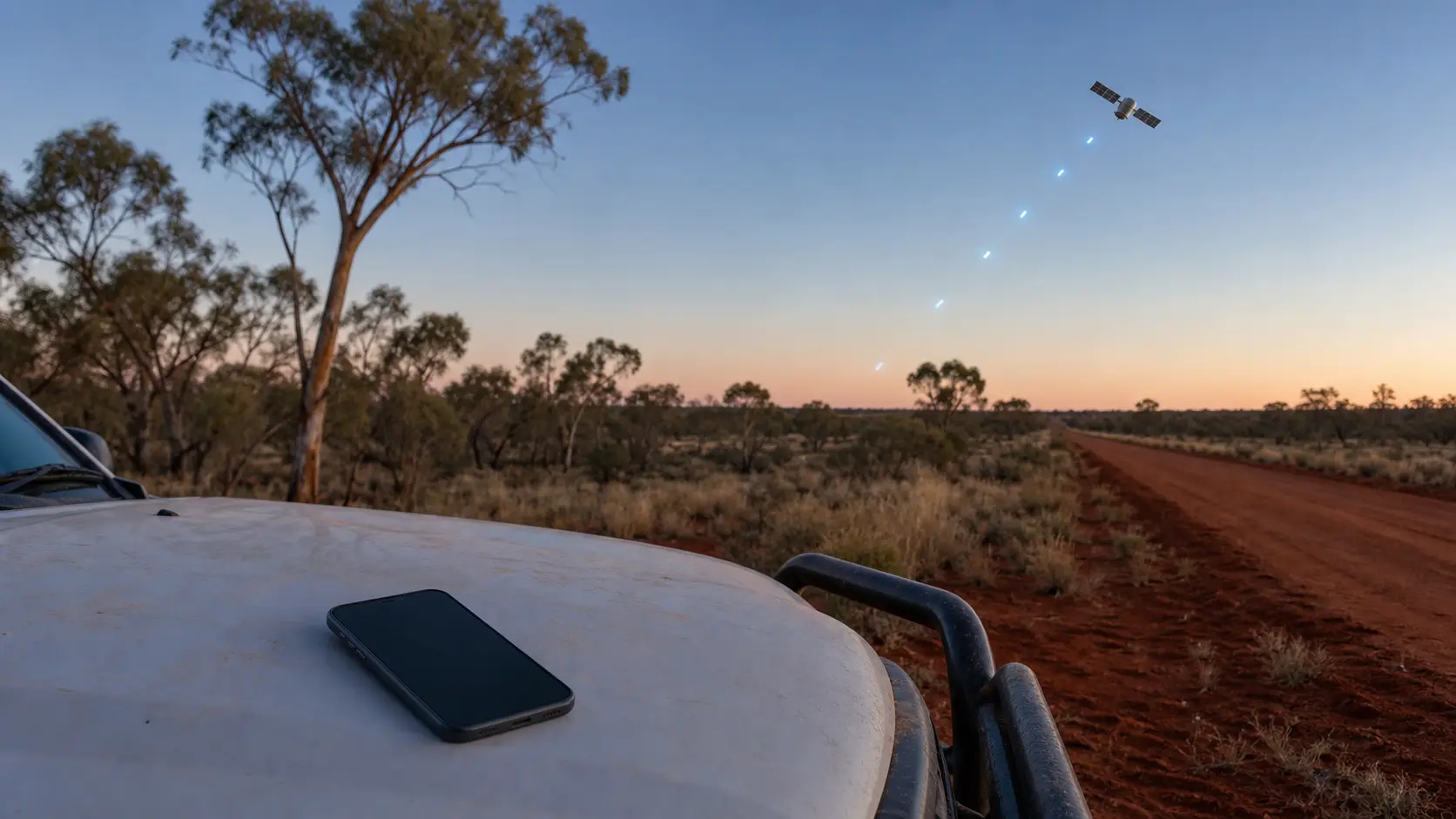
- Eligible Telstra customers can now use selected satellite-optimised apps outside terrestrial mobile coverage.
- The list includes Apple Maps, Google Maps, AllTrails, iMessage, WhatsApp, Facebook Messenger, Signal, Google Messages, weather services, Google Fitness and My Telstra.
- Supported devices include iPhone 13 or newer and Samsung’s Galaxy S26 family, subject to eligible plans, software and preparation.
- Apps must be installed, updated and logged in before users leave terrestrial coverage; downloads and updates are not available through the satellite layer.
- Capacity can be intermittent and slower, real-time audio and video are not reliable, and neither app-based calls nor Telstra Satellite provides Triple Zero calling or direct texting.
The most revealing part of Telstra’s satellite-data launch is not which apps made the list. It is what every approved app has learned to avoid.
Maps can load small route changes. Messaging can queue compact packets. Weather can refresh a narrow forecast. These tasks can tolerate delay and limited throughput better than video, voice or unrestricted browsing.
The service is therefore a design around scarcity, not a claim that scarcity has disappeared.
An app list is a capacity-control mechanism
Telstra names navigation, weather, messaging, light-social, fitness and account-management applications. By curating the list, the operator limits the traffic shapes that reach the direct-to-device satellite path.
That matters because one satellite beam serves many devices across a large area. If ordinary app-store downloads, video autoplay and background synchronisation were unrestricted, they could consume capacity before a user’s route or message gets through.
Application optimisation also shifts responsibility. Developers must reduce payloads, tolerate longer response times and recover gracefully when connectivity disappears. The network does not promise the steady session behaviour customers expect from terrestrial 4G or 5G.
Preparation is part of coverage
Users have to install, update and log into apps before leaving terrestrial service. An application missing from the phone cannot be downloaded over the satellite link. An expired login or required software update can make nominal coverage unusable.
Supported hardware includes iPhone 13 and newer models and the Samsung Galaxy S26 family, with eligible plans and current software. This creates several gates between a coverage map and a working session: handset radio support, operating-system version, account status, app state and a clear satellite view.
Coverage should therefore be measured at the completed-task level, not simply by the number of square kilometres where a satellite may be visible.
The Triple Zero boundary belongs near the top
Telstra states that neither app-based calls nor Telstra Satellite provides Triple Zero calling or direct texting. The service is not a substitute for an intact emergency network.
This is operationally important because remote connectivity is most valuable when ordinary options fail. A map update or WhatsApp message can help, but users must not assume that seeing a satellite indicator means an emergency call will work.
Real-time audio and video are also not designed to be reliable. Capacity is intermittent, and actions may take longer. The correct comparison is not urban mobile broadband; it is having a small number of useful transactions where terrestrial service is absent.
Usage totals show demand, not session quality
Telstra reports more than 26 million satellite messages, over 200,000 average daily connections compared with about 80,000 at launch, and more than 2.9 million users over 13 months.
Those figures show adoption of the earlier messaging layer. They are company-reported totals and do not disclose how many attempts failed, how long delivery took, how traffic was distributed or how many users were in genuine no-coverage areas.
They also do not predict app performance. A navigation refresh can contain more data and more state than a text. App growth must be evaluated separately.
Scarce bandwidth changes the business model
For Telstra, selected applications add value to eligible plans without pretending to replace its terrestrial network. For Starlink, direct-to-device traffic can monetise satellite capacity and deepen an operator partnership. For app developers, access to remote users comes with engineering cost.
The downside remains with the user when a device is ineligible, an app is not prepared, the sky view is poor or a congested beam delays a transaction. Clear boundaries are therefore part of the product, not a footnote.
The next useful evidence is the share of eligible sessions that complete, typical delay by app, traffic per beam, geography and the performance of repeated tasks under congestion. Independent validation would matter more than another aggregate connection total.
Telstra has widened the satellite control surface from messaging to selected data. The expansion is meaningful precisely because it does not promise the whole internet.