
Summary
- FUNET introduced Frame Relay on its backbone in 1992; by 1994, a published Nordic networking account described a network using both TCP/IP and DECnet.
- That snapshot records an operating multiprotocol network, not a nationwide public Internet service or proof that one protocol displaced another.
A backbone with more than one past
The cleanest Internet origin stories often end with a protocol transition: the new suite arrives, the old one disappears, and one network becomes another. FUNET’s record is less tidy. The Finnish University and Research Network had been assembled for universities and research institutions before international IP connectivity became its most famous feature. A FUNET historical overview dates the ministry-backed project and first X.25-based network to 1984. It records TCP/IP routers on fixed lines by 1987 and a 56 kbit/s connection to the Internet through NORDUNet in 1988. Those are separate layers of one evolving service: the local research network, its protocols, and a route beyond Finland.
The Finnish Internet Association’s chronology adds the work between these milestones. In 1985, FUNET tested Telecom Finland’s Datapak X.25 service at 4.8 kbit/s. Most universities then used Digital Equipment Corporation computers, and the account says DECnet was selected for the network. Researchers received terminal access, file transfer and email; gateways connected mail to other systems. In 1987, FUNET began linking local networks with Ethernet bridges and fixed 64 kbit/s lines. The same retrospective says Datapak’s volume-based charges made it expensive relative to fixed lines. That does not establish a uniform bill or prove that tariffs alone determined the architecture. It does show that a research network’s design depended on the price and form of the carrier service beneath it.
The transition was not a simple march from X.25 to IP. Local Ethernet, fixed lines, DECnet, TCP/IP and international gateways each answered a different operational need. FUNET’s 1985 chronology, 1987 chronology and 1992 chronology are useful for that sequence, but they are a later institutional history, not packet logs. They do not show that every university moved at once or that each system carried the same traffic.
Frame Relay added a shared layer
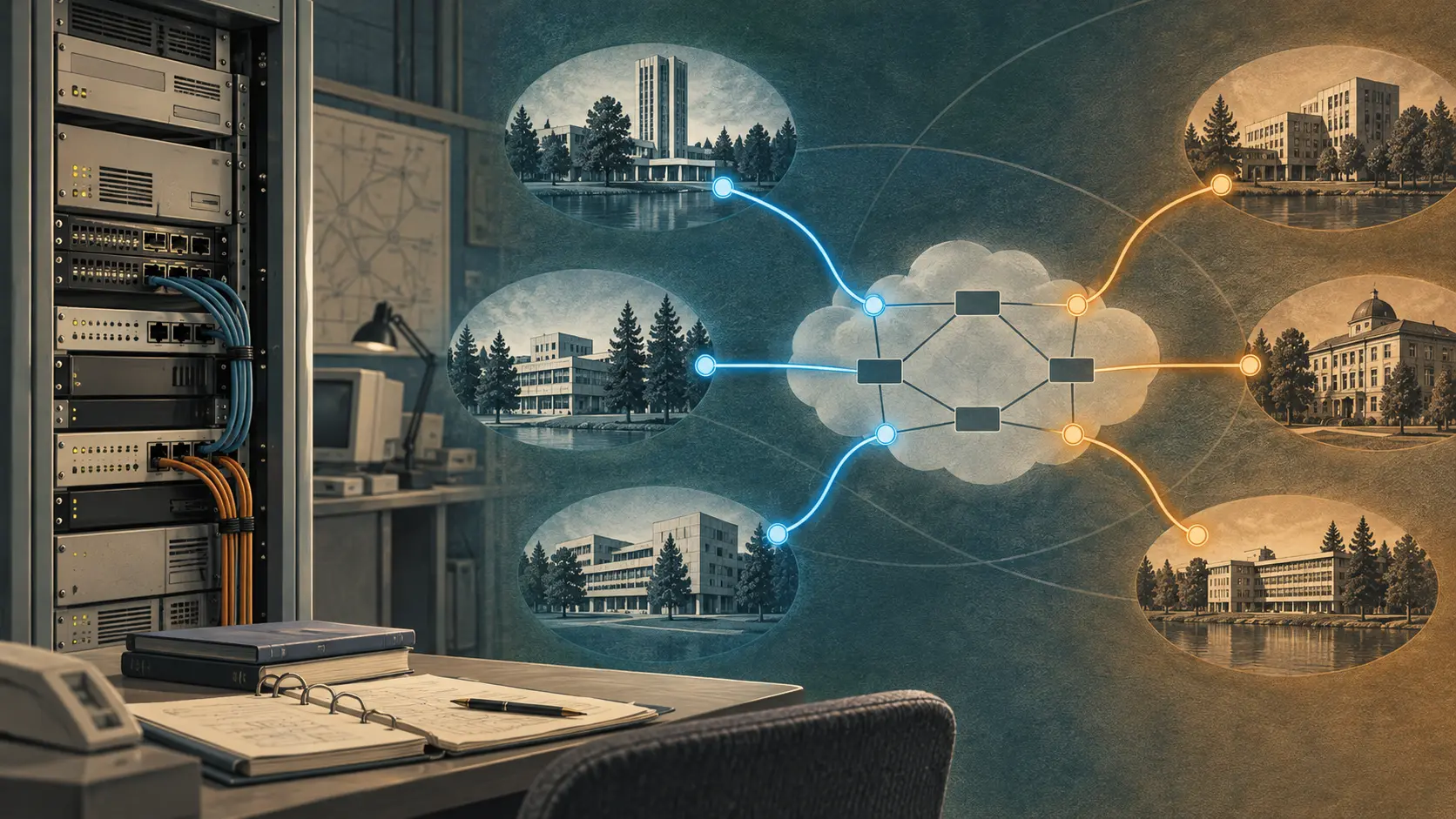
In 1992, FUNET introduced Frame Relay on its backbone, with the Finnish Internet Association’s account giving a range of 64 kbit/s to 2 Mbit/s. The timing matters, but so does the name of the source: this is a retrospective date, not a surviving commissioning order. A 1992 paper by Juha Heinänen describes Frame Relay as a data-link alternative to TDM multiplexers, multiprotocol routers and X.25 switches. Its subject is how a shared backbone can serve multiple protocols and customers. The paper discusses Telecom Finland’s public service; its abstract does not, by itself, identify FUNET’s circuits or prove a cost saving there.
The standards record gives the mechanism more precisely. RFC 1294, published in January 1992, specifies how multiprotocol traffic can be carried over Frame Relay. The network provides virtual circuits and a frame-level service; IP is one passenger, not the only possible network-layer protocol. This distinction helps explain why an Internet backbone could retain routes for an older campus environment while also carrying IP. It does not mean that Frame Relay performed protocol translation or made unlike hosts interoperable by itself. End systems, routers, circuit configuration and network management still had to do their jobs.
A 1994 Nordic networking reference gives a later, bounded view of the result. It describes FUNET as connecting Finnish universities and research institutes; reports 2 Mbit/s trunk capacity and 256 kbit/s as the slowest connections; names Frame Relay as the transfer technology and lists TCP/IP and DECnet among the protocols in use. It estimates about 15,000 connected computers and says international connections were maintained through NORDUNET. These are the publication’s 1994 figures, not a census of users, a traffic measurement or evidence that every attached computer used both protocol families. The useful fact is narrower: nearly six years after the 56 kbit/s NORDUnet Internet link, the national research network was still described in multiprotocol terms.
FUNET’s network was also more than its international circuit. The University of Oulu’s campus-network history recalls 64 kbit/s links in 1987 and 1988 even as campus LANs expanded and FUNET replaced bridges with routers; it records faster local links in later years. These are Oulu-specific milestones, not national backbone speeds. They help keep the scale straight: a university’s campus network, the Finnish research backbone, a Frame Relay service and NORDUNET’s cross-border route were connected systems, but not one interchangeable pipe.
The 1992 FUNET technical-day archive preserves presentations on network planning and information services. Its paper on ATM and faster networking is evidence of contemporary interest in the next backbone technology, not proof that ATM was already the production network. A separate paper on information services in FUNET explains how a central archive and shared services could save resources elsewhere, including line capacity. Those documents show that capacity, applications and network technology were being considered together; they do not make Frame Relay the sole cause of later growth. The institution’s 1993 chronology and 1994 chronology place the shift toward ATM and commercial competition in a later stage.
What the record can—and cannot—say
The evidence supports a measured sequence: a university network built around earlier data services; DECnet and IP as distinct protocol choices; Frame Relay introduced on FUNET’s backbone in 1992; and a 1994 description of TCP/IP and DECnet coexisting within a network that reached universities and research institutes. It does not establish exact virtual-circuit maps, per-protocol traffic shares, utilization, prices, service-level commitments, or a universal migration schedule. Nor does it show that the 1988 international link and the 1994 backbone capacities were the same circuit.
That limit makes the story more useful. The Internet did not need every institution to discard its working network before it could carry IP. Shared infrastructure could host different protocols while operators changed links, routers and services in stages. The historical achievement is not a clean cutover that the sources never document. It is a network that kept serving a research community while its international reach and internal architecture changed.
Sources and editorial method
- Suomen Internet-yhdistys, “History of the Finnish Internet”
- FUNET, historical overview
- FUNET chronology: 1985, 1987, 1992, 1993 and 1994
- Juha Heinänen, “Frame relay as a multiprotocol backbone interface” (1992)
- RFC 1294, Multiprotocol Interconnect over Frame Relay
- Nordic Council of Ministers, “Information Networking in the Nordic Countries” (1994)
- University of Oulu, network construction milestones
- FUNET Technical Day 1992, “ATM – Faster” and “Information Services in the FUNET Network”
Lu Heng’s Note 64 on minimum initial specifications is used only as an editorial question about shared infrastructure and local implementation choice; it is not evidence about Finnish network history.
Member Briefing
Deeper Profile Context
Sign in with the right membership level to unlock the full briefing and source notes.
Only for Strategic Circle
Strategic Circle
Open to all readers. Unlock profile briefings after joining and signing in.
Join Strategic CircleOnly for Leadership Alliance
Leadership Alliance
For qualified IP-asset owners and management; sign in to unlock alliance briefings.
Join Leadership Alliance