
Summary
- A January 1997 network update describes a university mail service built around DOS, Waffle and UUCP, with a connection to the University of Puerto Rico.
- Its author says 200–300 people paid monthly by the kilobyte for sent and received e-mail; he also recalls that the group lost its customers after Telesur began an online service in October 1995.
The network behind the mailbox
Suriname’s first public Internet date is often stated as 1995. Telesur’s own 2010 annual report places “Suriname via Telesur op internet” in that year, while a 2016 anniversary article by the Vereniging Surinaams Bedrijfsleven (VSB) identifies 30 October 1995 as the introduction date. Neither retrospective account explains what a user could actually do on the university network that preceded or overlapped with this public service.
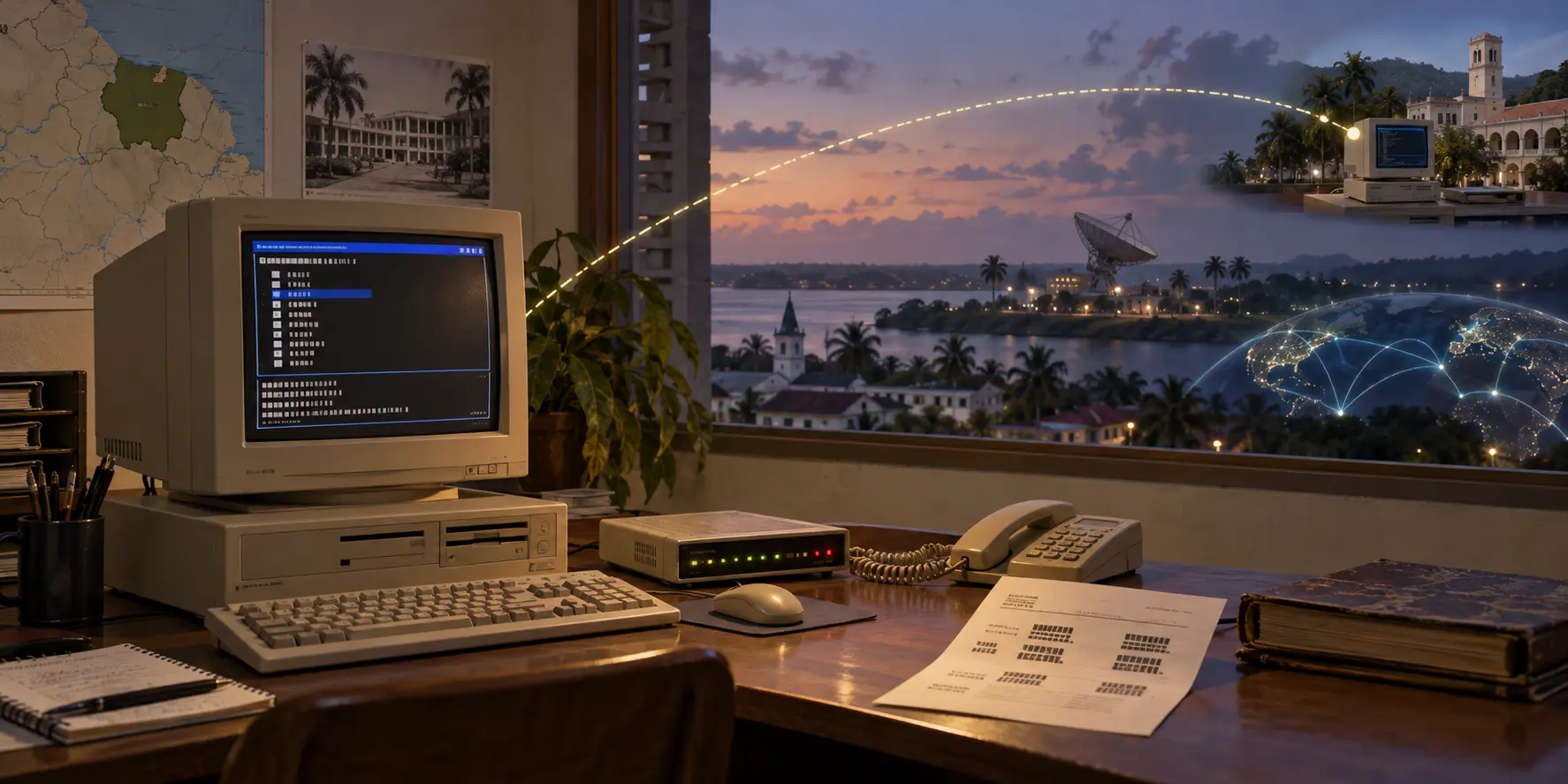
A January 1997 update preserved by the Network Startup Resource Center (NSRC) offers a more granular view. Its author, Jan David, describes an academic network whose first setup was a DOS computer running Waffle, a bulletin-board program, with a 9,600-baud Telebit modem and one telephone line. The system used UUCP to exchange mail with the University of Puerto Rico. Later, a 386 running Waffle and a 486 running Linux retrieved messages from the DOS machine. That was an e-mail path, not a general Web connection.
The same update distinguishes this university arrangement from two operational networks described elsewhere in the report: a “full-fledged” service and a separate e-mail-only service. Both were connected through Telesur’s F2 earth station and an international satellite link. The distinction matters. A customer buying the e-mail-only dial-up offer was not necessarily using the university’s UUCP route, and the archive does not map every customer to one of these systems.
A price attached to each message
David writes that the university setup served between 200 and 300 people who paid each month according to the kilobytes of mail sent and received. He says the university computer-centre director, Gerold Van Dijk, and volunteers, including Andy Lo A Foe, administered the system. The account gives no subscriber ledger, tariff sheet or breakdown of how the monthly amount was calculated, so the user count and billing description remain a participant’s report rather than independently audited figures.
The update lists separate prices for the commercial networks it describes: full dial-up access cost US$25 a month, including two online hours and then 20 cents per minute; e-mail-only access cost US$10 a month, also followed by 20 cents per minute. It quotes US$3,000 monthly for a 64-kilobit-per-second leased line. These figures show that “Internet access” bundled different capabilities and payment units. They should not be mistaken for the university system’s per-kilobyte mail charge.
David’s account says Van Dijk never secured the money for a leased line, or did not want to take that financial risk. When Telesur started its online service in October 1995, David says, the university setup lost its customers “almost overnight.” This is a vivid explanation from a person close to the network, not a measured market study. Telesur’s 2010 chronology confirms an Internet milestone in 1995 but does not corroborate the precise October date or the loss of university subscribers.
What the archive can and cannot settle
The records support a layered chronology: a university-linked, store-and-forward e-mail system; commercial dial-up services with different access levels; and Telesur’s 1995 Internet service. They do not establish the first packet sent in Suriname, the extent of household access, a national subscriber count, or whether the university system ended immediately after Telesur’s launch. The 1997 message looks backward from a particular network’s experience; the two later histories summarize a national milestone.
That scale difference is useful. A national “first Internet” anniversary can describe the arrival of a carrier service while leaving out how a campus or research community exchanged messages before and after it. In Suriname, the surviving account makes the e-mail unit visible: not a Web page or an always-on line, but bytes sent through a volunteer-administered path whose users paid for mail volume.
Sources: SR.Net – Suriname Update (1/97), Network Startup Resource Center, 20 January 1997; Telesur Annual Report 2010, historical overview; VSB, “Telesur en Suriname markeren 30 jaar internet en digitale vooruitgang”; ICT Association Suriname, “Bloggen over ICT, Mens en Maatschappij”, which also frames the 30-year anniversary but does not describe the university network.
Member Briefing
Deeper Profile Context
Sign in with the right membership level to unlock the full briefing and source notes.
Only for Strategic Circle
Strategic Circle
Open to all readers. Unlock profile briefings after joining and signing in.
Join Strategic CircleOnly for Leadership Alliance
Leadership Alliance
For qualified IP-asset owners and management; sign in to unlock alliance briefings.
Join Leadership Alliance