
Summary
- SUBCO’s January target for 12T of Sydney–Melbourne capacity and its new SM-1 construction schedule are separate commitments; the October announcement does not update the earlier milestone.
- SM-1’s minimum 96 fibre pairs describe a planned physical build, not yet lit, accepted, contracted or billable service.
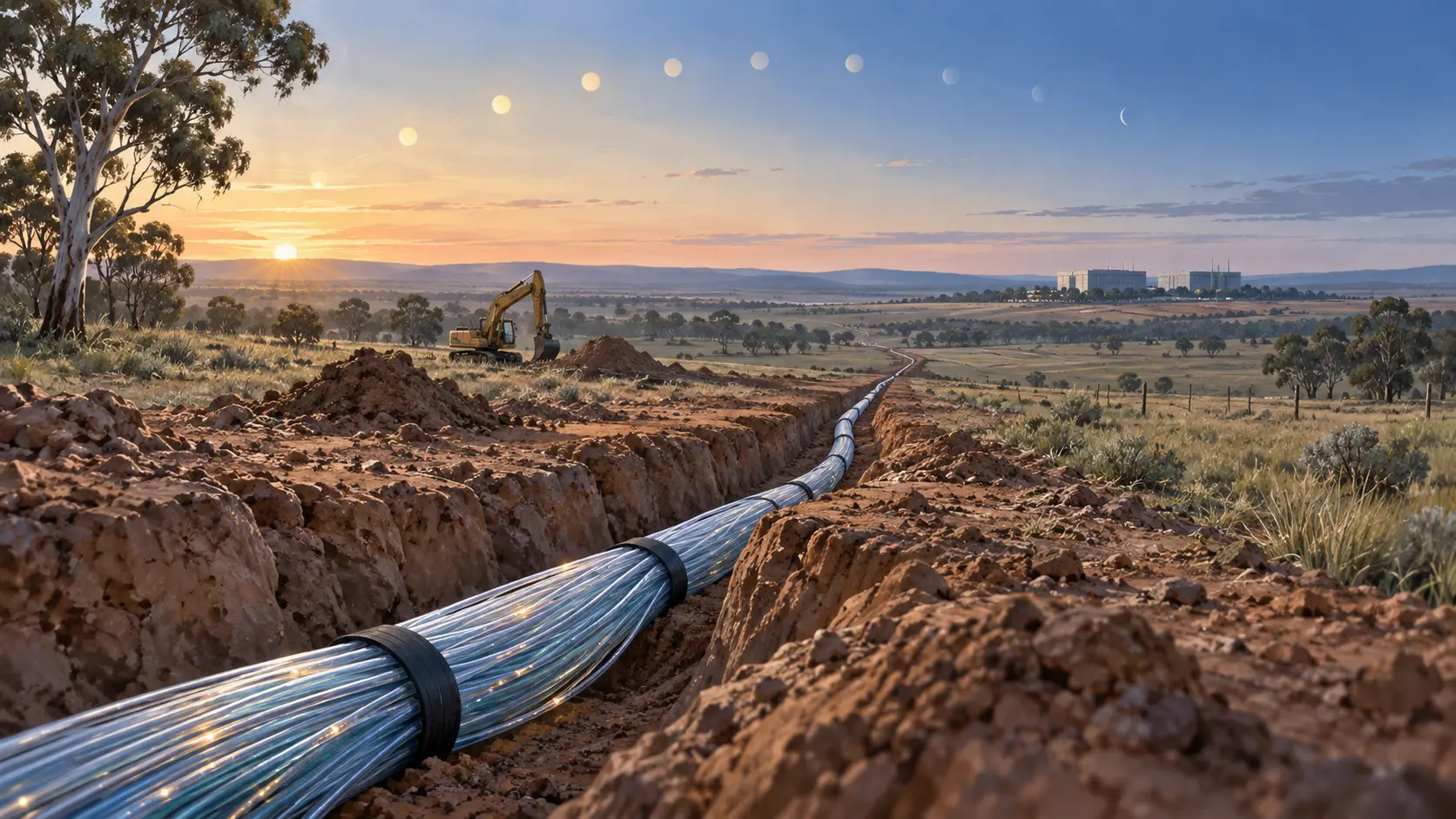
On 13 October, SUBCO announced SM-1, an 850-kilometre terrestrial fibre network between Sydney and Melbourne. The company says the build will have at least 96 fibre pairs, that construction is commencing immediately, and that Ready for Service is targeted for June 2028. It also says survey notices have been issued and permits are expected to be in hand. Those are project statements and a future target, not evidence that the route is already permitted or in service.
The announcement sits beside a different clock. On 8 January, SUBCO said it had secured “12T” of terrestrial capacity on the same corridor, due to go live in March 2026. The release does not define the abbreviated unit in that sentence. By October, that target date had passed, but the public announcements reviewed here do not confirm either delivery or failure. The SM-1 release does not say whether the earlier capacity is operating, whether it will continue, or whether it is connected to the new build.
That gap is commercially more useful than treating the two numbers as interchangeable. Securing capacity and constructing a long-distance fibre route can have different timing, control and cost profiles. This is an analytical inference from the two different commitments; SUBCO has not published a cost comparison, financing plan or statement that SM-1 replaces the earlier arrangement. The January release describes a capacity commitment. The October release describes plant to be built.
Nor does 96 fibre pairs state how much service a buyer can order. The usable product depends on equipment, endpoints, capacity allocation, commissioning and commercial terms. SUBCO says SM-1 is intended to link cable landing stations, carrier-neutral data centres and cloud on-ramps, and to reduce reliance on existing inter-capital routes. The release names no customer, committed allocation, price, capital cost, route segment or acceptance test. Its cloud and AI demand case remains the company’s rationale rather than a disclosed customer order.
Heng Lu’s Note 68 offers an editorial question, not project evidence: when does infrastructure become a continuity asset customers build around? For SM-1, that point comes after installed fibre becomes a tested service with a customer handoff and a commercial commitment. Kilometres and pairs are inputs; customer use and provider revenue are later states.
Sources
- SUBCO’s SM-1 announcement, 13 October 2026
- SUBCO’s capacity announcement, 8 January 2026
- SUBCO’s 17 March route update — background only: it described two geographically independent paths but does not place SM-1 on either.
- Heng Lu Note 68 — editorial lens only; not evidence about SM-1.
Member Briefing
Deeper Profile Context
Sign in with the right membership level to unlock the full briefing and source notes.
Only for Strategic Circle
Strategic Circle
Open to all readers. Unlock profile briefings after joining and signing in.
Join Strategic CircleOnly for Leadership Alliance
Leadership Alliance
For qualified IP-asset owners and management; sign in to unlock alliance briefings.
Join Leadership Alliance