
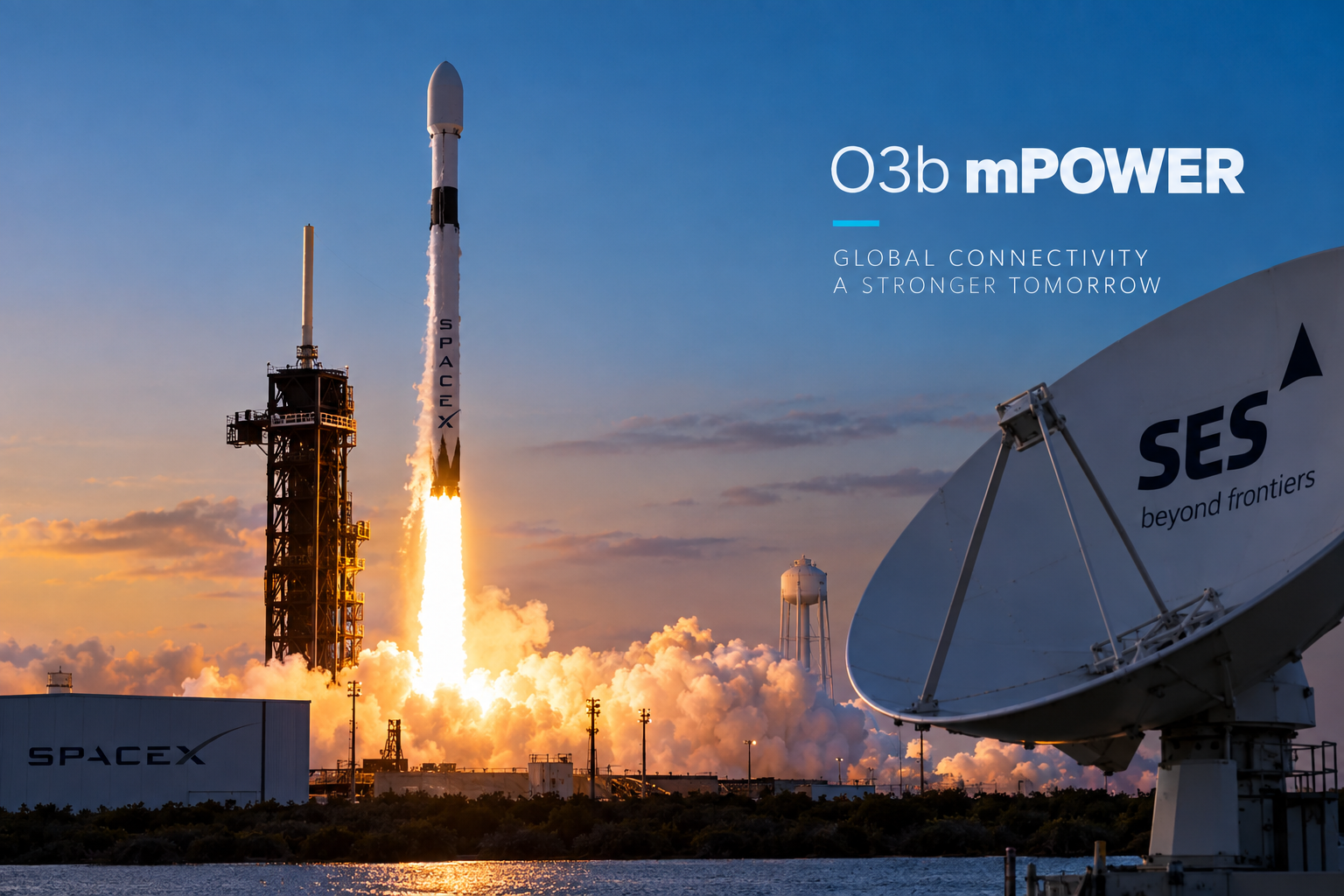
- SpaceX launched O3b mPOWER satellites 11, 12 and 13 from Cape Canaveral on 13 September, putting all 13 spacecraft in orbit
- The three new satellites are expected to enter service by mid-2027 after orbit raising, initialisation, and network integration
The fact
SpaceX launched the final three O3b mPOWER satellites for SES from Cape Canaveral, Florida, on 13 September. The Falcon 9 lifted off from Space Launch Complex 40 at 2:49pm local time carrying satellites 11, 12 and 13. The launch puts all 13 spacecraft in the O3b mPOWER constellation in orbit. Ten are already operational in medium Earth orbit, providing connectivity for customers including telecom operators, mobility businesses and governments.
The three Boeing-built satellites are not yet providing commercial service. SES expects them to become operational by mid-2027 after orbit raising, initialisation, and integration into the network. O3b mPOWER uses software-controlled communications payloads. Boeing says the satellites can steer and shape beams and adjust how bandwidth is allocated between locations as demand changes. Satellites nine and ten entered service earlier this year.
The assessment
The launch completes delivery to orbit, but it does not immediately increase the capacity customers can use. SES must first move the spacecraft into their operational orbits, initialise them, and integrate them into the network. Until then, services continue to depend on the ten satellites already operating.
Once active, the additional spacecraft should give SES more capacity to allocate across the system. O3b mPOWER can direct bandwidth towards particular locations, so the useful measure for a customer is not simply the number of satellites in orbit. It is how much capacity SES can provide where that customer needs it.
For BTW readers, mid-2027 is therefore the more important operational milestone. SES has not disclosed how much additional capacity individual routes or customers will receive. The practical benefit will become clearer when the spacecraft enter service and SES begins assigning the additional capacity.
What to watch
Watch for SES to confirm that satellites 11, 12, and 13 have entered commercial service and identify where their additional capacity is being deployed. Customer or route-level commitments would show how the larger constellation changes what SES can actually provide.
Member Briefing
Deeper Profile Context
Sign in with the right membership level to unlock the full briefing and source notes.
Only for Strategic Circle
Strategic Circle
Open to all readers. Unlock profile briefings after joining and signing in.
Join Strategic CircleOnly for Leadership Alliance
Leadership Alliance
For qualified IP-asset owners and management; sign in to unlock alliance briefings.
Join Leadership Alliance