
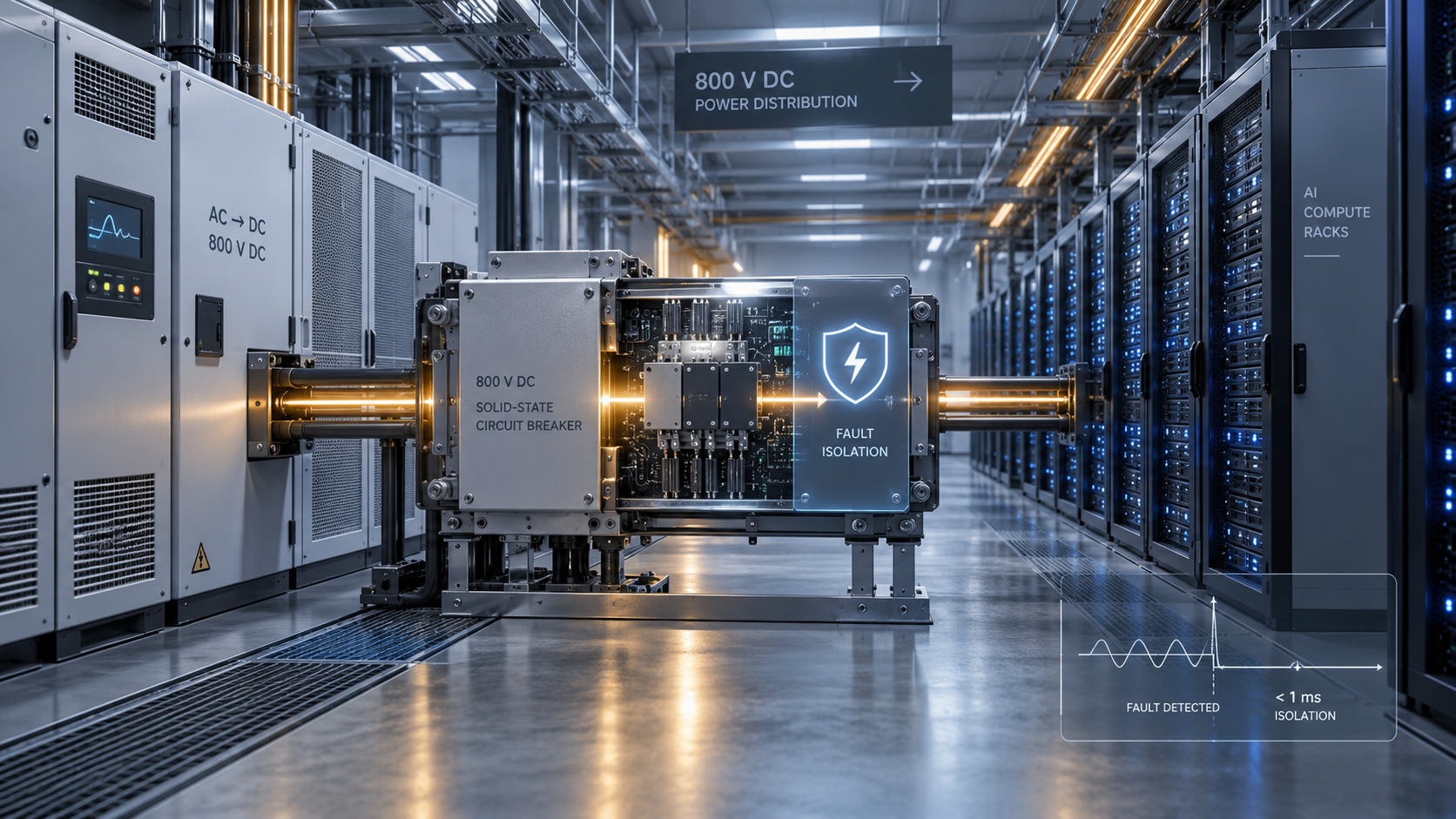
- SolarEdge and Infineon are developing electronic circuit breakers for 800V DC power distribution in AI data centres
- The work extends a 2025 transformer collaboration, but no customer deployment or facility-wide efficiency data has been disclosed
The fact
SolarEdge and Infineon said on 9 September that they had expanded their data-centre power collaboration to develop electronic circuit breakers for 800V direct-current distribution. SolarEdge will design the breaker using Infineon silicon-carbide switching components.
The companies intend to place the protection between their power-conversion equipment and computing racks. Unlike alternating current, direct current does not regularly pass through zero, making interruption more difficult. The proposed electronic breaker is designed to disconnect a faulty circuit within microseconds and without mechanical contacts.
The work follows a collaboration announced in November 2025 on modular 2–5MW transformers designed to convert medium-voltage electricity directly to 800–1,500V DC. The companies target conversion efficiency above 99%, but that figure applies to the conversion equipment rather than the efficiency of an entire data centre.
The September announcement covers development of the protection technology. The companies have not identified a customer facility operating the complete system or published measured facility-wide electricity savings from a deployment.
The assessment
For a data-centre buyer, conversion efficiency and fault protection have to be assessed as parts of the same power system. A transformer may reduce losses during conversion, but the proposed architecture also needs to show how faults are isolated without unnecessarily interrupting equipment that remains healthy. Component efficiency alone is therefore not enough to compare complete power designs.
The relevant evidence will come from tests showing what happens when a fault occurs within an actual distribution layout. Switching speed is one measure, but operators will also need to know which part of the system is disconnected, whether unaffected branches remain supplied and how power is restored after the event.
For BTW readers, the next useful step is a system-level comparison under a defined operating load. Testing the transformer and breaker together would allow buyers to judge both electrical losses and fault behaviour before using the proposed efficiency gains as an assumption in data-centre design or operating budgets.
What to watch
Watch for system-level tests combining the transformer and electronic breaker, including measured losses, fault-isolation behaviour and recovery procedures. A named customer deployment would provide stronger evidence by showing how the design performs when connected to operating data-centre equipment.
Member Briefing
Deeper Profile Context
Sign in with the right membership level to unlock the full briefing and source notes.
Only for Strategic Circle
Strategic Circle
Open to all readers. Unlock profile briefings after joining and signing in.
Join Strategic CircleOnly for Leadership Alliance
Leadership Alliance
For qualified IP-asset owners and management; sign in to unlock alliance briefings.
Join Leadership Alliance