Summary
- The February 2025 text that introduced the 100-day revocation window is a RIPE policy proposal posted to the Routing Working Group list, not an Internet-Draft; it carries none of the IETF header fields.
- By the published ripe-847 the threshold reads "more than three months", and the RIPE NCC's own analysis on the proposal page converts that to "90 days as a threshold rather than three months" — a conversion credited to no individual.
A proposal, not a draft
The 25 February 2025 message is a policy proposal submitted to the RIPE Routing Working Group. Its metadata block prints a policy proposal name, an author field, a proposal version still "to be assigned by the RIPE NCC", a submission date, a proposal type and a policy term of "Indefinite". It has no Dateline, no Expires field, no Status of This Memo and no Copyright Notice (routing-wg posting, 25 February 2025).
That absence matters, because the days people remember are attached to it. There is no instrument here with a publication expiry and an operator deadline sitting side by side. There is a proposal with a trigger, and the trigger is expressed in days.
Four phrasings of one figure
Inside that single message the figure is 100 every time; the wording is not. The covering note says "over a 100 days". The proposed policy text says "one hundred consecutive days". The opposing-arguments section says "more than one hundred days". An out-of-scope example says "the previous one hundred days". Four phrasings, one author, one afternoon. Read together, they show a writer who knew the unit was still an open question.
The reply that named the problem
Nick Hilliard answered on the same list the same day: "Minor nit: it would be more normal to use calendar months for longer time periods instead of base-10 numbers of days. I'd suggest reconsidering the 100 days thing" (routing-wg reply, 25 February 2025).
That is the whole argument in one sentence, and it is not a quarrel about whether 100 days is long or short. It is a quarrel about what kind of object a duration is. A base-10 day count is exact and unrepeatable: 100 days from a given instant is one moment. Calendar months are approximate and repeatable: "more than three months" describes a different number of days depending on where you start counting.
What the accepted document prints
Proposal 2025-02 version 1.0 is dated 05 Jun 2025 and lists two authors. The accepted document, ripe-847, prints a publication date of 15 Oct 2025 and this text: "If the RIPE NCC is unable to discover and validate a Delegated RPKI Certification Authority's (CA's) current Manifest and Certification Revocation List (CRL) for more than three months, that Delegated CA's resource certificate shall be revoked by the RIPE NCC" (ripe-847).
The PDF of the same document carries a month and nothing finer: "Approved by: Routing Working Group", "Date: October 2025" (ripe-847 PDF). The web page has the day, the file has the month — two resolutions of one publication, not two dates.
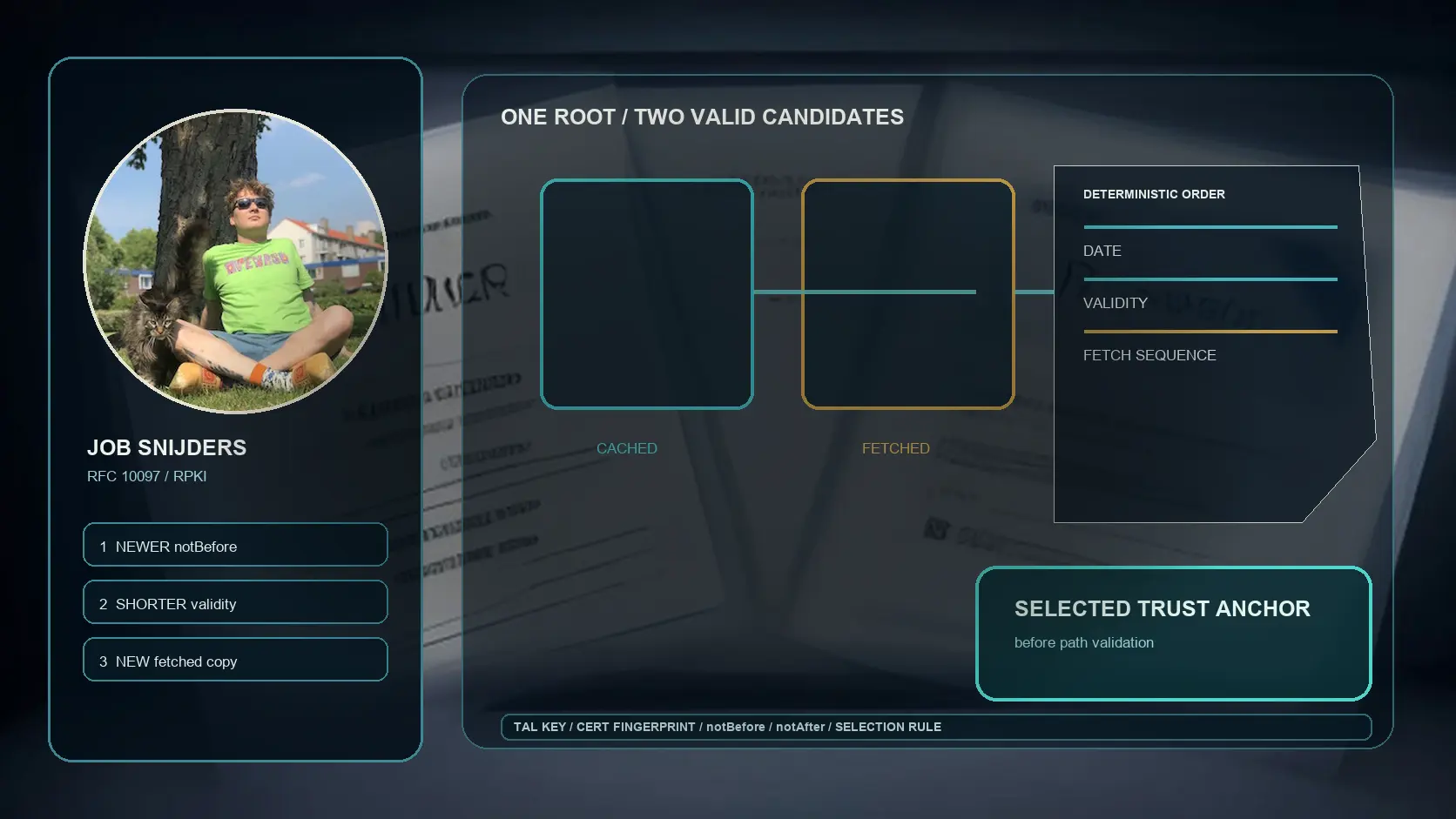
The 90 days is in neither. It sits in the impact analysis on the proposal page: "Because months do not have a constant length, the RIPE NCC will use 90 days as a threshold rather than three months." The same page's operations section repeats the operational figure and describes a delegated CA being removed as a child after more than 90 days (Policy Proposal 2025-02). Nobody signs that analysis. It appears as "the RIPE NCC's understanding".
The field that is missing on every surface
This is where the piece belongs on a desk concerned with named responsibility. The drafting post's author field prints a name and a personal address; no organisation appears anywhere in the retrieved message. The proposal page lists both authors and tags one of them with an institutional affiliation — the other carries none. The ripe-847 web page lists both names with no affiliation tags at all. The ripe-847 PDF prints "Author(s): Job Snijders, Nick Hilliard" with no affiliations and, in place of a signature, an approving body: the Routing Working Group.
So the number that binds operators was drafted under one name with no institution attached, accepted under two names with no institution attached, and turned into the operative figure by an analysis with no name attached. Not one of those four surfaces tells a reader which organisation stood behind the threshold at the moment it was chosen.
That is a documentation finding, not an accusation. RIPE's process does not require an author's employer on a proposal, and working-group consensus rather than authorship is what makes the text binding — the PDF says as much. The point is narrower. If you want to know who chose 100 days and who chose 90, the record gives you one name for the first question and none for the second.
Two kinds of date, one hand
The IETF record shows why the distinction is not pedantry. On draft-spaghetti-sidrops-rpki-erik-protocol-02, published 15 September 2025 and expiring 19 March 2026, the Authors' Addresses block prints a name and a country with no organisation, while the same page's author metadata carries a different address on a different domain (draft-spaghetti-sidrops-rpki-erik-protocol-02). On draft-snijders-constraining-rpki-trust-anchors-08, published 5 May 2025 and expiring 6 November 2025, the only dated limit is a six-month draft lifetime; the body imposes no operator deadline whatever (draft-snijders-constraining-rpki-trust-anchors-08).
An Internet-Draft's Expires field tells you when the document stops being current. It does not tell you when anyone must act. The profile page lists 18 RFCs and 26 expired drafts and describes the author as providing consultancy with no employer affiliation stated; that page came to hand only as a summary, so treat the counts as reported rather than quoted (Datatracker profile).
My arithmetic, and why it settles nothing
The drafting post is dated 25 February 2025; version 1.0 is dated 05 June 2025. That is exactly 100 days on a 2025 calendar. From 05 June 2025 to "Accepted: 15 Oct 2025" is 132 days. Both are my counts of two printed dates and nothing more. Nothing in the reviewed record says the interval between the posting and the first formal version was designed, noticed, or meant anything to anybody. A number that appears twice by coincidence is still a coincidence.
What the chain does not attest to
No reviewed document says which of the three figures an operator should plan against. The policy text is the binding one and it reads "more than three months"; the registry says it will apply 90. No reviewed page prints 100 days as operative. No reviewed page says who inside the RIPE NCC fixed 90, or on what authority they fixed it. And nothing here shows a single network losing a certificate under either reading.
The consequence is small and real: a duration written in days, moved to months, and applied in days again is now a figure three documents must agree on and no single person signed for.
Member Briefing
Read the full trend briefing
Members read the full briefing with the source notes behind every finding.
Strategic Circle
A daily briefing in your language, built from changes we have verified.
Join for USD 20/monthCancel anytime.
Members also get the full research library, a daily briefing on the networks they follow and the private forum.