
Summary
- Sina Corporation is the exact current directory company object and the sponsoring organisation recorded for
.sina,.weibo, and.微博; the Chinese IDN is represented in DNS-compatible form asxn--9krt00a. - Current public delegation, DNSSEC, RDAP, agreement, escrow, and emergency-operation records establish real registry capability and responsibility without revealing complete private architecture or proving longitudinal reliability.
- The IDN adds a U-label/A-label conversion and display boundary, while all three TLDs retain distinct root, contract, change, registration-data, and exception states.
- Supervision, integration, maintenance, portability, and authorised exception handling remain recurring costs even when specialist providers and automation perform routine work.
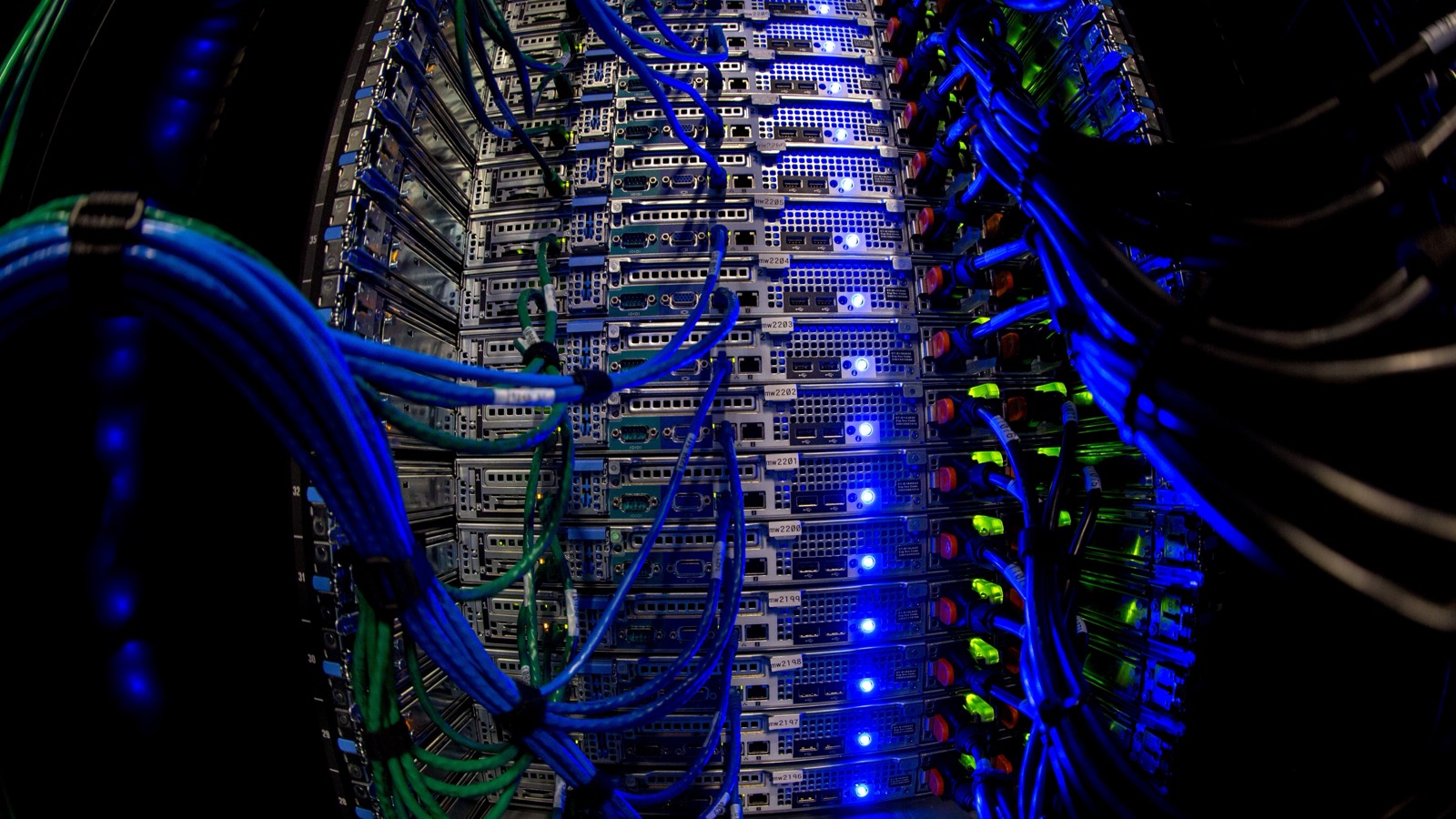
Image note: The accompanying Creative Commons photograph depicts network cabling and status lights inside Wikimedia Foundation servers. It is generic infrastructure context and does not depict Sina Corporation, its personnel or facilities, any of the three TLDs, a registry backend, a DNS operator, customers, incidents, private architecture, measured reliability, or production outcomes.
Sina Corporation has an Internet-infrastructure responsibility that is visible only when its company identity is connected to authoritative namespace records. The current BTW directory contains an existing company object for Sina Corporation.[1] Separately, the IANA root-zone database identifies the company as the sponsoring organisation for three delegated generic top-level domains: the two ASCII labels .sina and .weibo, plus the Chinese internationalized label .微博, represented in DNS protocol form as xn--9krt00a.[2][3][4] ICANN's registry-agreement records name the same operator for all three strings.[8][9][10] These records establish a concrete control surface: one company is recorded against three durable objects in the public DNS.
The labels are related by company and brand context, but they are not interchangeable technical identifiers. .sina, .weibo, and .微博 have separate delegation records, contracts, registration-data objects, security metadata, and change histories. The Chinese label also has two valid forms that serve different purposes: a user-facing Unicode form and an ASCII-compatible form used by the DNS. A resolver, RDAP client, certificate process, monitoring rule, change request, or continuity record must preserve the intended object exactly.
That relationship is narrower than ownership of the Internet and more consequential than control of three marketing labels. Sina Corporation is not the DNS root authority, a domain-name regulator, or a sovereign over the words represented by the strings. IANA records delegation data, ICANN administers contractual relationships, authoritative service operators answer queries, resolvers interpret responses, and other parties perform distinct technical and governance functions. Sina Corporation is the recorded registry operator and sponsoring organisation.
The retained public sources do not show that it personally implements every component or identify the complete private supplier arrangement.
The historical record shows three related but distinct delegation paths. IANA lists a registration date of 29 February 2016 for each TLD. It links .weibo to a delegation report dated 25 March 2016 and links .sina and .微博 to reports dated 28 March 2016.[2][3][4][5][6][7] ICANN's records connect each string to its own registry agreement and operator entry.[8][9][10][11][12][13] The proximity of those dates can make the portfolio look like one system. Operationally, however, each TLD remains a separate delegated object with a separate possibility of correct state, drift, or failure.
The public evidence supports analysis of declared capability and observable control surfaces. It does not establish private backend topology, staffing, supplier allocation, budgets, incident history, uptime, registration volume, user adoption, universal-acceptance performance, or customer results. A successful DNS or RDAP response shows that one path answered at one time. It is not a service-level history. A registry agreement records duties; it is not proof that every duty was performed perfectly. Familiarity with the Sina or Weibo names does not prove that any TLD is heavily used or operationally resilient.
The useful question is therefore not whether a corporate TLD looks innovative. It is what Sina Corporation must keep unique, accurate, secure, recoverable, and attributable across three separate namespaces, including one internationalized label. That question exposes four recurring cost categories:
- Supervision cost: establishing who may authorize a change, how supplier work is reviewed, and what evidence confirms the intended public state for the exact TLD.
- Integration cost: connecting delegation data, DNS, DNSSEC, IDNA conversion, RDAP, access controls, reports, certificates, monitoring, and continuity arrangements without merging three identities.
- Maintenance cost: keeping keys, contacts, credentials, service endpoints, agreements, conversion rules, escrow arrangements, runbooks, and dependency maps current over a long namespace lifetime.
- Exception-handling cost: diagnosing partial failures, stale data, mismatched authority, Unicode or A-label errors, transport problems, invalid security chains, supplier transitions, and incidents for which a simple availability check is insufficient.
The accompanying image shows network cables, server interfaces, and status lights inside a Wikimedia Foundation server rack. It is generic infrastructure context. It does not show Sina Corporation, any of the three TLDs, a Sina facility, a registry backend, a DNS operator, customers, an incident, private architecture, measured reliability, or a production result.
Identity, three TLDs, and the responsibility boundary
Entity precision comes first. The company object examined here is Sina Corporation, identified by the current directory record.[1] The IANA pages for .sina, .weibo, and .微博 each name Sina Corporation as the sponsoring organisation.[2][3][4] The corresponding ICANN pages identify the operator and maintain separate agreement records for the three strings.[8][9][10] Those independent records support the company-to-TLD binding without relying on assumptions based on a familiar service name or a trademark.
The distinction matters because a company, a commercial mark, an affiliate, and a technical service provider are not interchangeable. .sina uses the company name, while .weibo and .微博 reflect related ASCII and Chinese labels. Yet the public operator record names Sina Corporation for all three. If a nameserver, RDAP hostname, contact record, or certificate points to another organisation, that observation may identify a participant in one technical function. It does not automatically move contractual responsibility or reveal who designed the complete system.
IANA's delegation reports provide a bounded historical record. The three reports identify Sina Corporation as the proposed sponsoring organisation and record that eligibility, contact, and technical-conformance steps were completed before delegation.[5][6][7] These reports are useful evidence of the authority checks and readiness process at that time. They do not extend into a reliability benchmark. A TLD can pass delegation review and still require continuing supervision through later key changes, endpoint changes, contract amendments, personnel changes, and supplier transitions.
The ICANN agreement pages add agreement identity, operator identity, and dated contract records.[8][9][10] The underlying agreements describe duties that go beyond ordinary website hosting, including registry data, continuity, reporting, security, transition, and cooperation with the wider naming system.[11][12][13] A root-zone record says where delegated authority begins. An agreement describes responsibilities attached to operating the delegated namespace. Neither record alone describes the complete running implementation.
This is why a registry is best understood here as a recordkeeping and operational function, not as a sovereign. A registry maintains authoritative data and participates in controlled changes within a larger hierarchy. It does not own the DNS root, control every resolver, or gain general authority over language and users. The boundary becomes clearer when every actor is tied to a specific record, protocol, or decision right.
The IDN adds a further identity boundary. .微博 is the Unicode presentation of the same label whose DNS-compatible A-label is xn--9krt00a; RFC 5890 defines the relevant terminology, and RFC 5891 describes the application protocol for converting and validating labels.[28][29] The two forms are related representations of one TLD, not two additional delegations. At the same time, .微博 is not merely a display alias for .weibo: the Chinese IDN and the ASCII .weibo are separately delegated TLDs with separate root and contract records.[3][4][9][10][12][13]
The portfolio therefore should not be reduced to one "Sina domain" control. .sina, .weibo, and .微博 have distinct labels and registry records. An authorization that correctly names one does not necessarily cover the others. A report, deposit, endpoint, security change, or transition step can succeed for one and fail for another. Shared sponsorship does not remove the need for per-object evidence.
A workable responsibility model has three layers. Sina Corporation is the recorded company associated with all three delegations and agreements. One or more parties may execute technical functions, but the public record does not disclose the complete allocation. Independent records and observations can verify selected public outcomes without revealing private architecture. Keeping these layers separate prevents both under-accountability and unsupported attribution.
Delegation records and the running DNS control surface
Delegation turns a label into a reachable part of the DNS hierarchy. The root-zone database publishes the authoritative nameserver information associated with .sina, .weibo, and .微博.[2][3][4] A resolver begins with the parent delegation and follows it toward the authoritative service. This process depends on multiple records and systems: the TLD label, nameserver names, address reachability, authoritative responses, caching behavior, transport, and any security chain used to validate answers.
Current DNS observations retained for this research showed five authoritative nameserver names for each TLD: ta.ngtld.cn through te.ngtld.cn. The same visible set answered for .sina, .weibo, and the A-label xn--9krt00a.[2][3][4] This is evidence that five authority names were published and observable. It is not proof that all entries use independent networks, facilities, control planes, or operational teams. Several names can still share dependencies that delegation data does not expose.
The difference between a capability signal and reliability evidence is fundamental. Multiple authoritative names are a capability signal. A set of successful queries is a bounded observation. Reliability would require repeated tests over time, from multiple networks, with explicit expected answers and a method for classifying partial failures. The public record used here does not provide such a longitudinal series. It therefore supports no claim about uptime, latency, capacity, or recovery performance.
DNSSEC adds security metadata to the delegation path. Current observations showed DS records for all three TLDs. DNSSEC resource-record formats are defined in RFC 4034, while RFC 4035 describes validation behavior and protocol modifications.[26][27] At a high level, the parent publishes information that lets a validator connect the child zone to a chain of trust. That chain depends on coordinated state. An incorrect DS record, expired signature, incomplete rollover, unreachable authoritative service, or inconsistent child key can cause validating resolvers to reject data even when ordinary unsigned checks appear to work.
The security benefit therefore creates a maintenance discipline. Key generation, storage, publication, rollover timing, parent updates, signature validity, monitoring, and emergency reversal all need owners. The correct procedure cannot be inferred from a DS record alone. Nor can a public DS record prove that key custody, operational separation, or recovery practice is strong. It proves that security metadata is present at the observed boundary.
DNS transport is another source of hidden failure. RFC 7766 explains why modern DNS implementations need reliable TCP support as well as UDP behavior.[30] A small query can succeed over UDP while a larger answer is truncated and a TCP retry fails. Firewalls, connection limits, path problems, or overloaded handling can create a transport-specific outage. A health check that asks one simple question from one network can therefore miss a condition that affects other record types or clients.
Caching also complicates change verification. A correct new record can coexist temporarily with cached old data. A failed change can appear healthy to a resolver that still holds the previous answer. Operators need expected-state records, timing assumptions, and multiple observation points. "DNS propagation" is not a complete explanation; it should have a defined start, expected duration, and escalation threshold. After that threshold, inconsistent answers become an exception that requires diagnosis.
Precise role vocabulary reduces fault-attribution errors. RFC 8499 distinguishes concepts such as authoritative servers, recursive resolvers, zones, delegations, registries, and registrars.[31] A user who says that a "domain is down" may be encountering a parent-delegation problem, authoritative response problem, DNSSEC validation failure, recursive cache issue, network path failure, certificate problem, or application policy. The registry operator is accountable for selected parts of this chain, not every component of the user experience.
The three TLDs make portfolio verification useful. A control can compare approved and observed state for .sina, .weibo, and .微博 without assuming they must be identical. Differences should either be intentional and documented or treated as exceptions. The comparison should include delegation, authoritative names, address records where relevant, DS data, response codes, transport, and the paths used for registration-data discovery. A shared template can reduce work, but it must retain the distinct TLD identifier at every step.
Running code and current records must be considered together. A contract can identify the accountable operator but cannot prove that an endpoint is answering. A successful endpoint response can prove bounded reachability but cannot by itself establish the correct accountable entity. For Sina Corporation, the public record and current observations align sufficiently to show three real delegated control surfaces, including one IDN represented publicly by both a U-label and an A-label. They do not reveal the full design or demonstrate sustained reliability.
RDAP, registration data, and the risk of false health
Registration data is a second public control surface. IANA publishes an RDAP bootstrap registry that maps DNS labels to service base URLs.[14] The bootstrap mechanism matters because an RDAP client should discover the authoritative service rather than guess an endpoint from a label. RFC 7484 describes this discovery model and the structure used to locate the appropriate service.[25]
Current observations for nic.sina, nic.weibo, and nic.xn--9krt00a returned RDAP domain objects from the current IANA-listed rdap.ngtld.cn service.[14][15][16][17] The responses included object names, status values, events, entities, nameserver information, and secure-DNS structures. Each observed object carried server transfer, update, and delete prohibition statuses. The IDN object exposed nic.xn--9krt00a as its LDH name and nic.微博 as its Unicode name. These are bounded facts from three public responses, not a view into the complete registry database, access policy, internal synchronization design, or reliability over time.
The visible hostname is evidence about the endpoint used for the observed request, not a complete supplier map. It would be an overreach to attribute a private backend design, operational event, service level, or architecture to Sina Corporation or to any endpoint operator solely from the URL. The correct statement is that the public bootstrap and observed requests led to queryable RDAP services for all three objects.
RDAP health has several layers. RFC 9082 defines query formats and search paths.[23] RFC 9083 defines JSON response structures, notices, links, events, errors, and related semantics.[24] A request can reach a server and still fail at another layer: the HTTP status may be wrong, the media type may be unexpected, the JSON may be malformed, the object name may not match, required fields may be absent, an error may be returned as apparent success, or the data may be stale.
This is why an HTTP 200 response is not a complete health verdict. Monitoring should validate the requested object, content type, parseability, schema, identifiers, expected status fields, and bootstrap consistency. It should also record whether a response is an ordinary result, a referral, a rate-limit response, or an error. For important changes, a human-readable summary should be backed by machine-readable evidence so that reviewers can compare old and new states.
RDAP events require careful interpretation. A response may include registration, last-changed, expiration, or database-update events. These timestamps describe fields in the returned object; they are not an incident log or a service-level history. A recent "last changed" value can indicate that a record changed, but it does not explain who changed it, why, whether it was planned, or whether dependent systems remained correct. Those questions require change records and operational evidence that are not public here.
Legacy WHOIS and current RDAP can also coexist in registry operations. The public root pages and agreement material reflect a long-lived ecosystem in which service-discovery and registration-data requirements have evolved.[2][3][4][11][12][13][20] The ICANN RDAP operational profile provides contracted-party expectations for RDAP deployment.[20] Operators need to know which interface is authoritative for which purpose, how older clients behave, and how access rules differ. Similar-looking records from two systems are not automatically equivalent.
Data accuracy creates another control problem. A registration-data service may be reachable while selected contacts, statuses, or events are stale. Conversely, a legitimate privacy or access rule may remove details that a simplistic monitor expects. The test must distinguish technical failure, policy behavior, object-specific state, and client error. Treating every difference as an outage creates noise; treating every parseable response as healthy creates false assurance.
Three corporate TLDs multiply this work. Bootstrap entries, base URLs, certificates, schemas, object identities, and expected statuses need explicit per-TLD tests. Shared monitoring is efficient only if it retains separate expected state. A test that recognizes nic.sina but silently skips nic.weibo and nic.xn--9krt00a can report green while most of the portfolio is unobserved. A test that assumes all three objects must contain identical events can produce false alarms.
Registration-data controls also intersect with continuity. During a supplier or operator transition, clients need to discover the correct service, and the service needs accurate data in a usable format. Bootstrap changes, DNS changes, certificates, access controls, and data transfer may have different timing. A transition plan should therefore test the full discovery-to-response path rather than only checking whether a replacement server process starts.
The public evidence establishes that relevant discovery records and queryable objects existed when observed.[14][15][16][17] It does not establish complete data quality, sustained availability, or successful transition practice. That bounded conclusion is stronger than a broad claim because it identifies exactly what was observed and exactly what remains unknown.
ASCII and IDN namespaces, lifecycle integration, and change risk
Sina Corporation's portfolio combines two ASCII TLDs with one Chinese IDN. This creates more than a display difference. RFC 5890 distinguishes a Unicode U-label from its ASCII-compatible A-label, while RFC 5891 defines an application process for validating and converting internationalized labels.[28][29] For this TLD, .微博 is the U-label and xn--9krt00a is the A-label used in DNS wire-compatible and many configuration contexts. An operator must know which form a system expects and must not treat visual similarity as identifier equality.
The first lifecycle risk is identifier loss. A request such as "update the Weibo domains" is not precise enough. It could mean the ASCII .weibo TLD, the Chinese .微博 TLD, both, or an ordinary second-level domain unrelated to a registry change. A controlled request should state the exact TLD, include the A-label when the IDN is involved, name the affected record or service, record the current and proposed values, identify authority and executor, define verification, and set a reversal condition.
The second risk is conversion inconsistency. A user interface may accept Unicode while a configuration file, certificate tool, monitoring system, or log stores the A-label. A copy-and-paste path can normalize text, reject a label, or display a representation that differs from what the underlying system queried. This article does not claim that such a failure occurred at Sina Corporation. It identifies a foreseeable control boundary created by the standards and the existence of a delegated IDN.
Conversion should happen through standards-aware libraries and be tested at input, storage, output, comparison, and logging boundaries. A monitor that queries xn--9krt00a but reports only .微博 needs an auditable connection between the two. A change record that stores only the Unicode form may be difficult to compare with a DNS trace. A dashboard that stores only the A-label may confuse a reviewer who approved a user-facing Chinese string. The answer is not to prefer one form everywhere; it is to preserve the exact relationship and use the correct form for each interface.
The third risk is hidden dependency. A small endpoint or delegation change can affect DNS, certificates, RDAP bootstrap data, client configurations, monitoring, firewall rules, contact records, access controls, and recovery instructions. For the IDN, conversion and display components add further dependencies. The expensive part is often not editing one value. It is proving that every dependent control agrees on the same object after the change.
The fourth risk is cross-TLD drift. Shared ownership and visible naming relationships can encourage one template for .sina, .weibo, and .微博. Shared tooling can reduce manual error and make controls consistent. It can also send an incorrect value to all three, or silently omit the IDN because a component accepts only ASCII input without converting it correctly. Separate tooling may improve isolation but increase maintenance and divergence. Public sources do not reveal which architecture is used. A defensible control model documents shared dependencies and verifies three named outcomes.
The fifth risk is temporal drift. TLDs are long-lived. Staff, suppliers, certificate chains, contacts, credentials, standards, and technical platforms change. A namespace can continue resolving while the people who understand its recovery path move elsewhere. IDN handling can also regress when a library, user interface, or validation policy changes. Normal operation can conceal an obsolete escalation contact or an untested conversion path until an exception occurs.
Universal acceptance is another evidence boundary. The existence of .微博 proves a delegated internationalized TLD, not that every browser, email system, security product, analytics service, or enterprise workflow handles it correctly. Demonstrating application compatibility would require defined test cases across actual products and versions. The sources retained here do not provide such a benchmark, so no universal-acceptance score or customer outcome is claimed.
Evidence can fragment across teams. Contract records may sit with legal staff, DNS changes with network teams, keys with security teams, registration data with suppliers, IDN behavior with application teams, and public communications with brand teams. During an incident, each group may possess only part of the picture. A control register should connect authority, exact identifiers, execution, verification, dependencies, and recovery without pretending that every function belongs to one team.
Lifecycle integration should also account for low-use periods and eventual transition. The public evidence does not show current registration volume or application dependency for any of the three TLDs. Even a lightly used namespace retains delegation, security, data, contact, and continuity obligations while active. Low visible use can increase risk if ownership and monitoring decay. It should not be assumed to reduce technical responsibility to zero.
The historical delegation reports provide a durable process lesson.[5][6][7] Before root responsibility began, authority and technical readiness were checked for the exact labels. Later high-impact changes should retain the same discipline: confirm the correct entity and object, validate technical consistency, execute through the authorized path, observe the public result, and preserve evidence. The original readiness decision cannot substitute for present verification.
The registry agreements make the lifecycle more than ordinary web administration.[11][12][13] If technical execution is outsourced, Sina Corporation still needs enough visibility and contractual rights to understand current state, review exceptions, test recovery, and change suppliers if necessary. Outsourcing execution does not outsource the need for accountable oversight.
Supervision, integration, maintenance, and exception costs
Supervision cost begins with decision rights. Changes to delegation, DNSSEC, registration-data services, escrow, access, or supplier allocation can affect a public namespace. The operator needs a documented authorization chain, separation between request and verification, and a record of the approved target state. For three TLDs, reviewers also need to know whether a decision applies to one string, two strings, or all three.
Supervision includes supplier evidence. A service provider may report that a change completed, but the accountable organisation should verify the relevant public outcome independently. This does not require duplicating every provider system. It requires access to enough records and tests to confirm delegation, security metadata, service discovery, object identity, and recovery dependencies. A change is not proven solely by the system that executed it.
Integration cost comes from linking distinct control planes. Root delegation, authoritative DNS, DNSSEC, RDAP bootstrap, RDAP service, certificates, access controls, zone-data arrangements, reports, escrow, and incident response can be managed through different systems. Each uses different identifiers and time models. Integration must preserve those differences while making dependencies visible.
The ICANN Centralized Zone Data Service illustrates one controlled-access surface surrounding registry data.[21] Registry reports provide another public accountability channel.[22] Neither is an ordinary website feature. Access requests, data publication, reporting schedules, and technical service state can all require separate processes. A portfolio view needs to connect them without treating one successful workflow as proof that every other obligation is healthy.
Maintenance cost is the recurring work that prevents silent decay. Contacts need review. Credentials and certificates expire. DNSSEC keys rotate. Monitoring rules need changes when endpoints or schemas evolve. Escrow arrangements and recovery instructions need tests. Contracts and supplier responsibilities change. A configuration that was correct at delegation can become incomplete years later even if no one deliberately breaks it.
Maintenance should include an inventory of evidence, not merely an inventory of systems. For each TLD, the operator should know where authority is recorded, what public state is expected, which observations verify it, who owns exceptions, and what evidence demonstrates recovery. Documentation without current ownership is weak. Ownership without reproducible evidence depends too heavily on individual memory.
Exception-handling cost is usually the least predictable. A partial DNS failure can depend on record type, resolver, network, transport, or validation state. An RDAP issue can involve bootstrap data, TLS, HTTP, schema, object synchronization, access policy, or a client assumption. A disputed change can involve both corporate authority and technical execution. The repair may be quick while diagnosis, verification, communication, and recurrence prevention take much longer.
Exception handling also needs an escalation rule. A mismatch can be expected during a controlled transition, but the exception must have an owner and an expiry. Without a time boundary, expected propagation becomes an indefinite explanation for stale state. The same principle applies to accepted monitoring gaps, delayed key work, or untested recovery paths: acceptance should be explicit, dated, and reversible.
These cost categories are real even though the retained sources disclose no staffing or budget figures. It would be inappropriate to assign monetary values, headcount, incident hours, or supplier fees to Sina Corporation without company evidence. The record supports the existence of work classes and governance needs, not a financial estimate.
The cost model also reveals where economies of scale can be misleading. Shared tooling, suppliers, and procedures may reduce ordinary work across .sina, .weibo, and .微博. They may also create a common failure mode. Separate controls may improve isolation but increase drift and review burden. The correct balance depends on private architecture and risk appetite that cannot be derived from public delegation records.
Capability, operating reliability, and customer production results
Three evidence layers must remain separate.
Capability concerns what a system is required, configured, or visibly able to do. The current evidence supports capability statements: Sina Corporation is recorded for three delegated TLDs.[2][3][4][8][9][10] Historical delegation reports exist.[5][6][7] Multiple authority names and DNSSEC metadata were observable. IANA publishes RDAP discovery data.[14] The retained nic.sina, nic.weibo, and nic.xn--9krt00a objects were queryable.[15][16][17] Registry agreements and ICANN continuity resources describe data, transition, and emergency mechanisms.[11][12][13][18][19]
Operating reliability concerns whether those capabilities work consistently during normal operation, change, partial failure, and recovery. The evidence used here is not a longitudinal reliability study. It contains current records and bounded observations, not multi-vantage time series, response-time distributions, key-roll histories, recovery times, incident summaries, or change-failure rates. No uptime or resilience score can responsibly be calculated from it.
Customer production results concern whether users, registrants, partners, applications, or business units achieved a verified outcome. The retained public sources do not document customer case studies, adoption figures, dependency maps, transaction effects, or measured benefits tied to .sina, .weibo, or .微博. They also do not establish a customer failure. The correct classification is that customer outcomes are not demonstrated by this evidence.
The distinction blocks several common errors. Multiple nameservers do not prove independent resilience. DNSSEC metadata does not prove continuous validation. An HTTP success does not prove registration-data accuracy. A brand agreement does not prove high use. An escrow framework does not prove that the latest deposit was complete or restorable. A current root record does not prove that every recovery credential remains accessible.
Different evidence methods are needed for each layer. Capability can often be assessed through authoritative records, configuration, and current protocol responses. Reliability needs repeated measurement, controlled changes, failure testing, incident evidence, and recovery exercises. Customer results need documented real-world dependencies, use cases, and outcomes. Mixing these methods converts bounded facts into unsupported conclusions.
A stronger reliability assessment would request multi-network DNS and RDAP observations over time, parent-child DNSSEC consistency checks, evidence from key changes, service-review records, exception age, supplier incident summaries, escrow validation, and restoration exercises. It would define expected states separately for .sina, .weibo, and .微博 and record the reason for any differences.
A customer-result assessment would request a different record. It would need to identify actual services or communities that depend on the namespaces, establish baseline behavior, document changes, and connect outcomes to the TLDs rather than to unrelated brand activity. None of this should be inferred from the company name or registry designation.
Keeping the layers separate is not an argument that the TLDs are unreliable or unused. It is an argument for evidence discipline. The public record establishes a real operator role and running interfaces. It leaves reliability and customer impact open. That is a useful result because it tells decision makers what additional evidence would be required.
Escrow, emergency operation, and continuity beyond ordinary uptime
Continuity is broader than keeping authoritative servers online. It includes preserving critical registry functions and data when ordinary operation or a supplier relationship cannot continue. ICANN's registry data escrow framework exists to place required data with an independent escrow arrangement under defined processes.[18] The agreements for .sina, .weibo, and .微博 include continuity and transition obligations.[11][12][13]
Escrow quality depends on more than the existence of a deposit. Data must be complete, timely, correctly formatted, protected, accessible under the right authority, and usable for restoration. A file that cannot be decrypted, validated, interpreted, or connected to current service is weak recovery evidence. Public framework material explains the mechanism but does not expose private deposit quality for these three TLDs.
ICANN's Emergency Back-End Registry Operator framework describes an interim continuity path for critical registry functions under defined emergency conditions.[19] This is not a substitute for ordinary resilience. It is a last-resort mechanism that can require authority decisions, access to escrowed data, service activation, communications, and later transition. Preparation therefore needs current contacts, compatible data, known dependencies, and a tested decision path.
The three-TLD portfolio makes recovery scoping important. An incident could affect one TLD while the other two remain available. A shared supplier or control plane could affect all three. A contract or transition action could apply differently to each namespace. A recovery plan should identify shared and separate dependencies so that operators do not assume an all-or-nothing event.
Portability is part of continuity. The company may use proprietary systems or specialist suppliers, but accountable leadership needs to understand what data, credentials, certificates, keys, formats, rights, and approvals would be needed to move. A supplier relationship can perform well in normal conditions and still impose unacceptable exit risk if these assets are unclear or inaccessible.
Continuity evidence expires in practice. A restoration exercise can pass and later become obsolete after schema changes, staff turnover, supplier changes, certificate replacement, or key rotation. Reviews should be triggered by material change as well as by time. The goal is not to maintain a static binder; it is to maintain a current path from recorded responsibility to restored critical service.
Zone-data access and registry reporting also matter in a transition context.[21][22] They are not direct substitutes for escrow or emergency operation, but they form part of the wider evidence and accountability environment. A continuity review should understand what each data source can and cannot provide, who can access it, and whether it remains useful when ordinary systems are unavailable.
The strongest continuity question is practical: can the organisation demonstrate an authorized path from the current public and contractual record to restored essential function? That path should identify decision makers, data, credentials, suppliers, verification checks, communications, and exit criteria. Public evidence cannot prove that Sina Corporation has completed this private exercise. It does show why the exercise is necessary for all three TLDs.
Failure modes the public record makes testable
The following failure modes are reasonable tests derived from the public control surface. They are not claims that any failure has occurred.
1. Entity and operator confusion
Sina Corporation, a brand, ICANN, IANA, an endpoint operator, and a registrar are described as one actor. Accountability then becomes inaccurate. The control is a dated role map that binds each decision and technical claim to the relevant company, agreement, root record, endpoint, or protocol responsibility.[2][3][4][8][9][10]
2. Cross-TLD change drift
A change intended for all three strings reaches one TLD but not the other two, or reaches them with unexplained differences. The control is an explicit per-TLD target and independent verification. Portfolio automation should produce three named results, not one generic success.
3. Wrong corporate authority
A technically capable person or supplier requests a high-impact change without current corporate authorization. The change may be technically valid yet procedurally illegitimate. The control is a current authorization chain connected to the exact TLD and action, with stale contacts removed promptly.
4. Parent-child DNSSEC mismatch
A key or DS transition leaves parent and child data inconsistent, causing validating resolvers to reject answers. RFC 4034 and RFC 4035 describe the records and validation behavior involved.[26][27] The control is staged rollover, independent validation, clear timing, and an executable reversal plan.
5. Apparent nameserver diversity with shared failure
Multiple authority names are listed, but hidden shared dependencies cause a correlated outage. Delegation data cannot prove independence. The control is an architecture-aware resilience review, multi-network testing, and exercises that fail shared providers or control components.
6. DNS transport blind spot
Simple UDP queries succeed while truncated responses or TCP connections fail.[30] The control is to test representative record sizes, fallback behavior, connection handling, and multiple networks rather than relying on one small query.
7. Bootstrap and RDAP endpoint divergence
IANA's bootstrap data points clients to a base URL that is stale or inconsistent with the deployed service.[14][25] The control is a post-change comparison of bootstrap entries, DNS, TLS, HTTP behavior, and the expected RDAP object.
8. Reachable but semantically invalid RDAP
An endpoint returns HTTP success but the response is malformed, identifies the wrong object, omits required structures, or contains unexpected errors. RFC 9082 and RFC 9083 define query and response behavior.[23][24] The control is schema-aware and object-aware validation.
9. Registration-data freshness gap
The service answers correctly at the protocol layer while selected statuses, events, entities, or nameserver references are stale. The control is an approved expected-state model and reconciliation against authoritative change records, not reachability monitoring alone.
10. Stale or unusable escrow
Deposits exist but are incomplete, invalid, inaccessible, or incompatible with recovery tooling.[18] The control is recurring validation and restoration rehearsal using current data, keys, formats, and authorized owners.
11. Emergency authority gap
A severe event occurs, but no one can quickly prove who may release data, activate emergency service, coordinate providers, or approve transition. The EBERO framework and agreement obligations make this foreseeable.[19][11][12][13] The control is a tested decision tree with current contacts and deputies.
12. Low-attention namespace decay
One TLD receives less business attention, so contacts, tests, credentials, or recovery instructions age even though the delegation remains active. Public sources do not establish current usage, so low use cannot be assumed. The control is a minimum operational baseline for every active namespace.
13. Shared automation propagates error
A template, credential, or policy error affects all three TLDs at once. The control is staged rollout, per-TLD confirmation, separation of high-risk credentials where appropriate, and a stop condition after the first unexpected result.
14. Capability presented as a customer outcome
A delegation, signed response, agreement, or brand name is presented as proof of reliability, adoption, or user benefit. This is an evidence failure even if the technical record is accurate. The control is to label capability, reliability, and customer results separately and require the correct evidence for each.
These modes show why exception handling needs named ownership and a budget. Most are not solved by another green dashboard. They require authority records, protocol knowledge, dependency mapping, current evidence, supplier coordination, and a process that can decide under uncertainty.
Leadership controls and decision tests
A leadership review should begin by naming the object. Is the decision about .sina, .weibo, .微博, or all three? Which record, service, key, data set, contract duty, or supplier relationship is affected? Vague language such as "the brand domains" is not adequate for a high-impact change.
The next question is the approved state. For DNS, that can include delegation, nameserver, address, DNSSEC, and transport expectations. For RDAP, it can include bootstrap bases, certificates, HTTP behavior, media type, schema, object identity, and error handling. For continuity, it can include deposit recency, validation, authority, contacts, data access, and recovery dependencies.
The third question is how the running state will be proven. Important changes need timestamped, machine-readable comparisons and an interpretation of differences. One screenshot or one successful query may support a check, but it should not be the sole proof of a complex transition. Verification should be independent of the action where practical.
The fourth question concerns partial failure. A plan should distinguish parent delegation, authoritative service, DNSSEC, transport, RDAP discovery, RDAP response, network path, certificate, access, data, supplier, and corporate-authority failures. This classification speeds escalation and reduces the risk of assigning every symptom to the registry operator.
The fifth question is reversibility. Key changes, endpoint removal, provider termination, data release, or contact updates can reduce recovery options. High-impact work should preserve a verified return path when technically and legally possible. If a change is not reversible, the evidence threshold and approval level should be higher.
Supplier oversight should emphasize evidence rights and portability. Sina Corporation does not need to duplicate every specialist capability, but it needs enough access to understand public state, review incidents, verify critical changes, test continuity, and transition when necessary. A service that only the current supplier can explain or restore creates a concentration of knowledge.
Exception reporting should track age, impact, and closure quality. A short-lived mismatch during an approved change is different from an unexplained inconsistency that persists. Closure should state the cause, corrective action, verified final state, and whether the other TLDs needs the same review. Repeated exceptions should trigger a control change, not simply more alerts.
Risk acceptance should be explicit. A known monitoring gap, untested recovery path, shared dependency, or delayed maintenance item may be accepted temporarily. The record should name the owner, rationale, expiry, and remediation condition. Otherwise, temporary acceptance can become permanent operational design without a decision.
Finally, any public claim about adoption, performance, reliability, or business value should be tested against the correct evidence layer. Delegation and protocol records support infrastructure analysis. They do not support a customer success story. This discipline protects the company from both promotional overstatement and unsupported criticism.
What the evidence establishes and what remains unknown
The public record establishes a precise company role. The existing directory object identifies Sina Corporation[1] IANA names the company as sponsoring organisation for .sina, .weibo, and .微博 and records all three delegations.[2][3][4] The delegation reports document historical eligibility and technical-conformance steps.[5][6][7] ICANN identifies the operator, brand agreement type, and agreement date for all three TLDs.[8][9][10] The published agreements define responsibilities beyond ordinary web hosting.[11][12][13]
The record also exposes running technical surfaces. IANA publishes RDAP discovery data.[14] The retained nic.sina, nic.weibo, and nic.xn--9krt00a requests returned structured RDAP objects.[15][16][17] Current DNS observations showed multiple authority names and DNSSEC delegation data. ICANN publishes material on escrow, emergency registry operation, RDAP expectations, controlled zone-data access, and registry reporting.[18][19][20][21][22]
Protocol standards define the limits of those observations. RDAP requires correct discovery, queries, responses, and errors.[23][24][25] DNSSEC depends on coordinated records and validation rules.[25][26] DNS reliability includes TCP behavior as well as simple UDP answers.[27] Accurate terminology is necessary to separate authority, resolution, registry, and registrar roles.[31]
The public evidence does not establish private topology, backend supplier allocation, staffing, budget, monitoring coverage, incident history, recovery performance, escrow quality, registration volume, namespace adoption, application integration, or customer results. It does not show whether the TLDs share every technical dependency or use separate systems. It supports neither a positive nor a negative service benchmark.
The defensible conclusion is operational. Sina Corporation has three recorded network identities in the DNS root, each with delegation, registration-data, security, contract, and continuity surfaces; the IDN also adds a standards-governed conversion and display boundary. Their similarity creates opportunities for shared governance but does not remove separate identifiers and failure states. The practical cost lies in supervising changes, integrating controls, maintaining long-lived evidence, and resolving exceptions across organisational and technical boundaries.
This is the reality layer of the role. A short label in the root zone connects corporate authority, protocol behavior, public records, supplier oversight, data custody, and recovery. Responsible analysis starts with what the records and running interfaces actually show, marks capability as distinct from reliability, and refuses to infer customer outcomes from infrastructure existence. That approach makes the remaining questions sharper and gives leaders a concrete basis for requesting the evidence that is still missing.
Sources
Member Briefing
Deeper Profile Context
Sign in with the right membership level to unlock the full briefing and source notes.
Only for Strategic Circle
Strategic Circle
Open to all readers. Unlock profile briefings after joining and signing in.
Join Strategic CircleOnly for Leadership Alliance
Leadership Alliance
For qualified IP-asset owners and management; sign in to unlock alliance briefings.
Join Leadership Alliance