Summary
- Seagate's Exos guide lists Mozaic HAMR CMR capacities up to 32TB and SMR capacities up to 44TB. Its guidance makes host-managed SMR an architectural choice: software, write order and zone management need an accountable owner.
- On 26 October, Seagate announced Broadcom HBA approval for a Mozaic HAMR-plus-SMR configuration and completed qualification by Microsoft Azure Storage. That gives buyers a concrete interoperability milestone; their own workload and software costs determine the value of adopting this storage path.
The largest number has a staffing requirement
A drive catalogue makes capacity easy to compare. Seagate's current Exos table lists 28TB, 30TB and 32TB under Mozaic HAMR CMR, and 32TB, 36TB and 44TB under SMR. The largest number is attractive to anyone trying to fit more retained data into a finite storage footprint. The same page explains who is equipped to use the denser path.
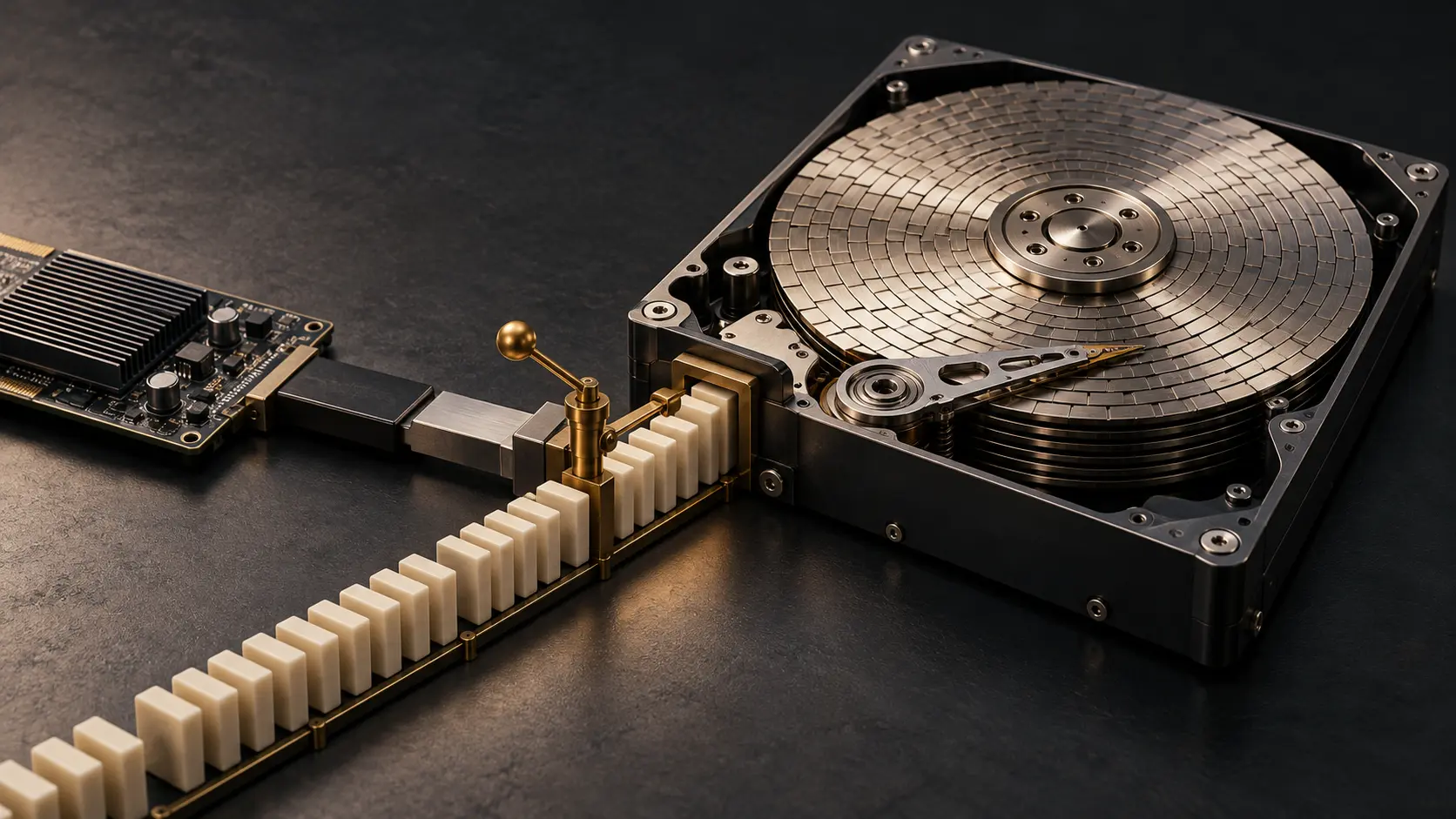
For host-managed SMR, the buyer needs control over zone management, write ordering and filesystem selection. The software must understand how the device organises writes. Someone must also maintain that understanding as data arrives, storage is reused and the system changes. A purchase order can buy a disk faster than it can create that team.
This puts the commercial question in an unusual place. The person buying hardware may approve the capacity. A different team, or an outside supplier, may own the software that makes it useful. The density gain becomes an investment proposition when those two decisions meet in one funded deployment.
The adapter gets a place in the deal
Seagate's 26 October announcement reports that Mozaic drives combining heat-assisted magnetic recording with shingled magnetic recording have joined Broadcom's approved vendor list for its host bus adapter. Microsoft Azure Storage has completed qualification of the Broadcom HBA with the Seagate configuration.
An HBA provides the communication path between the server and storage devices. It lets a host connect, address and manage drives. Recognition at that connection matters commercially: an impressive piece of media becomes easier to consider as part of a fleet when a named adapter-and-drive combination has passed qualification.
The milestone changes the starting point for a buyer's work. It supplies a known integration reference and a named large-scale customer qualification. The software owner can begin from that evidence while assessing the particular application. The catalogue's capacity table and the announcement's qualified configuration remain separate pieces of evidence.
Dense tracks prefer orderly customers
SMR packs tracks more closely by overlapping them. Seagate's guide points to sequential or readily sequentialised work: media repositories, backup tiers, archives and certain object-storage patterns. For these uses, arranging writes into an orderly flow can match the work the system already wants to do.
Other storage demand arrives with a different temperament. The useful buying question is how much of the intended workload can actually follow the required order. Seagate describes batching, caching and metadata design among the skills needed to make that happen. Those activities consume engineering attention even when the hardware connection has already been qualified.
Its guide also names zone resets, garbage collection, monitoring and diagnostics. In business terms, the extra capacity has a maintenance account. The important budget can sit in software operations rather than in the line for physical drives. Giving that work a cost centre and an owner makes the offer easier to price honestly.
The customer with the keys can keep more of the benefit
A business that controls its storage software can choose how writes are organised and fund the changes directly. It can compare the implementation burden with the value of fitting more data into its available footprint. Its ability to make that choice is part of the asset's usefulness.
A buyer whose storage layer is managed elsewhere needs an answer from the party holding those controls. Who will adapt the software? Who will keep it aligned with the workload? How is that work priced? A capacity discount on the hardware quotation has little meaning until the operating arrangement can deliver the advertised use.
That gives an implementation provider a useful commercial role. A supplier able to turn density into a working service can charge for coordination and retained expertise. The customer can then compare a complete service proposition with the cost of maintaining the capability internally. The argument is about the cost of using the capacity, with ownership of the necessary work made explicit.
Seagate offers two routes to the same buying meeting
The company's guide presents CMR as its path for capacity with plug-and-play interoperability and without architectural change. It says those drives are prioritised on product pages and available through its distributor network. SMR asks for more architectural control in exchange for access to the higher capacities listed in its own range.
That creates two commercially intelligible choices. One buyer pays to preserve an established software approach. Another has sufficient control and suitable data flows to pursue the denser path. The number printed beside a drive cannot decide which organisation they have.
The announcement omits exact qualified model and firmware details and comparable deployment costs; those details would establish who can reproduce the configuration and how much remains after implementation. The visible development is already useful: the connection has gained a qualification reference, while Seagate's own guidance puts the software responsibility plainly on the table.
Seagate can sell more terabytes in a drive. The customer has to buy the organisation capable of using them, whether it builds that capability or hires it. The purchasing meeting needs the person who owns the writes. Leaving that chair empty is an expensive way to admire a large number.
Sources
Member Briefing
Deeper Profile Context
Sign in with the right membership level to unlock the full briefing and source notes.
Only for Strategic Circle
Strategic Circle
Open to all readers. Unlock profile briefings after joining and signing in.
Join Strategic CircleOnly for Leadership Alliance
Leadership Alliance
For qualified IP-asset owners and management; sign in to unlock alliance briefings.
Join Leadership Alliance