Summary
- The consent is real; the power is prospective.
- The next proof is physical: finished cable, converters and grid interfaces, followed by measured transfer capability.
Planning permission is a milestone, not a switch. On 30 October 2026, the UK Department for Energy Security and Net Zero granted development consent for Sea Link, a proposed 138 km high-voltage connection between Kent and Suffolk. The project is designed to transfer up to 2 GW. That is the link’s planned capability, not electricity already moving through it.
The timetable makes the distinction hard to miss. National Grid says construction is expected to begin in early 2027, subject to detailed construction planning, and the project is expected to be complete by 2031. Its project page calls 2027–2031 the construction period. A consent announcement and a five-year construction window sit in the same news cycle; they describe different states of the asset.
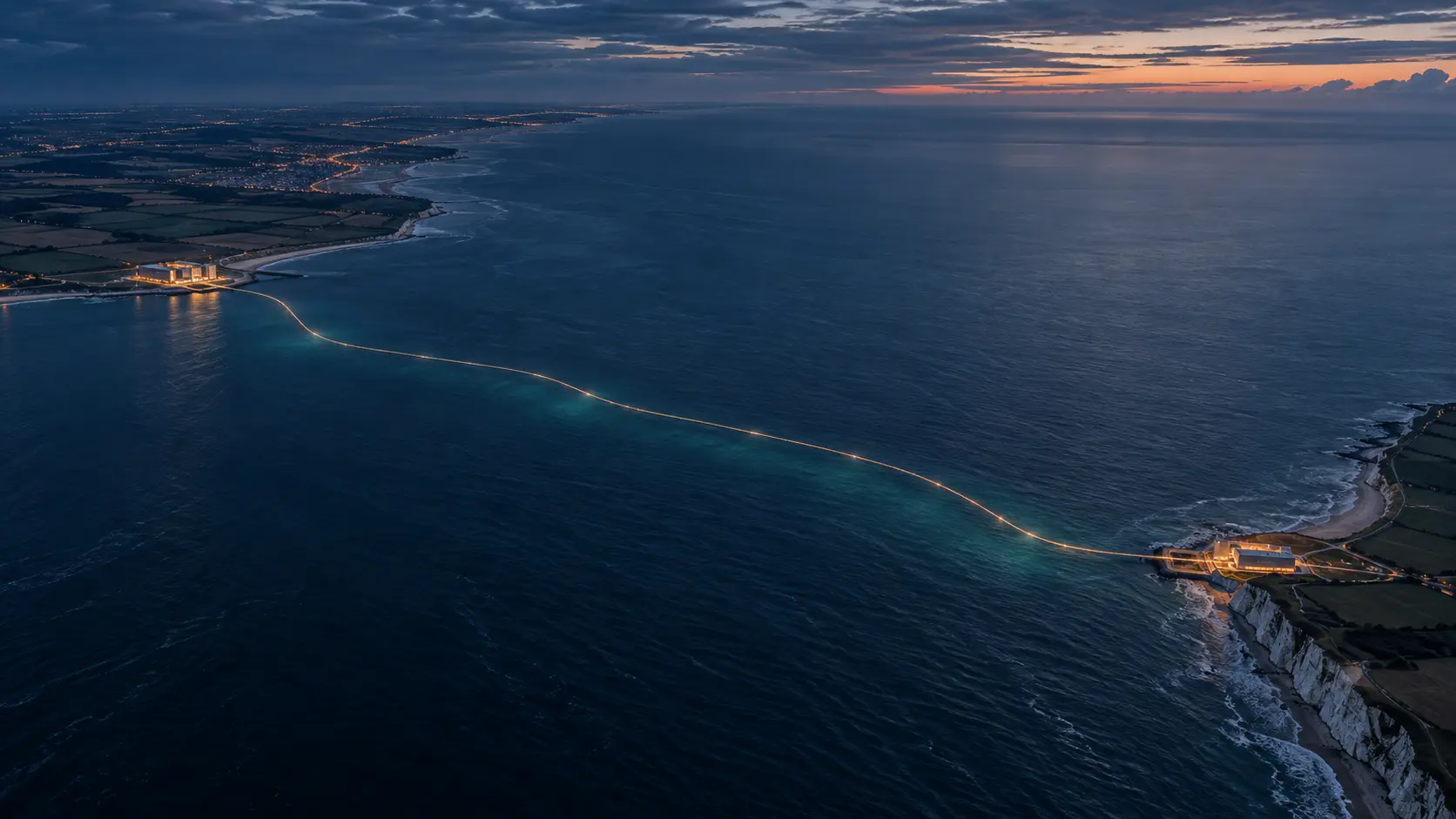
The route is not a cable dropped into the sea and plugged in at each end. National Grid’s proposal includes a 122 km subsea high-voltage direct-current cable, landfalls at Pegwell Bay in Kent and north of Aldeburgh in Suffolk, converter stations near Minster and Saxmundham, and onshore connections into the transmission network. The converters and shore connections are part of the transfer system. A marine cable alone cannot deliver the project’s rated function.
The planning file also has an afterlife. National Grid says it will review the consent, continue construction planning and meet environmental commitments. It must work with local authorities and other stakeholders on detailed technical requirements, including traffic and environmental measures. The company calls that process “discharging requirements.” Consent has settled a major public decision; it has not settled every construction obligation.
There is a dependency at the Suffolk end. National Grid says the Kiln Lane substation is being built separately under other consents, and Sea Link would deliver it only if those works are not completed separately. That split matters to schedule accountability: progress on a related substation is not automatically progress on the cable package, and the Sea Link project may not own every element its final connection relies on.
The project is sold in a useful round number: 2 GW, described by government as capable of carrying enough electricity for the equivalent of two million homes. The number tells readers what the connection is designed to handle. It says nothing by itself about when the whole route, converters and grid interfaces will be ready, how much power will flow at any moment, or whether the completed network will relieve the constraints cited by its sponsors.
National Grid says power could travel in either direction between Kent and Suffolk, depending on where generation is available and where demand sits. That flexibility is the operating proposition. To show it has become real, the evidence must move from consent and contractor milestones to installation, testing, grid connection and recorded transfer capability.
For now, the firmest new fact is the legal one: the consent was granted on 30 October. The delivery clock is National Grid’s forecast—early 2027 to start, 2031 to complete—while the remaining requirements and interfaces turn a permitted route into working infrastructure. Britain has approved the build. Britain still has to build it.
The public records cited here do not set a commercial-operation date or publish a commissioning test for delivered capacity. Those two facts would change the assessment.
Sources
Planning Inspectorate, 30 October 2026 National Grid, consent and delivery forecast National Grid, project update and requirements National Grid, project proposals and route components UK Department for Energy Security and Net Zero, 2 GW project description
Member Briefing
Deeper Profile Context
Sign in with the right membership level to unlock the full briefing and source notes.
Only for Strategic Circle
Strategic Circle
Open to all readers. Unlock profile briefings after joining and signing in.
Join Strategic CircleOnly for Leadership Alliance
Leadership Alliance
For qualified IP-asset owners and management; sign in to unlock alliance briefings.
Join Leadership Alliance