Summary
- RFC 1209 defined initial IP and ARP operation over SMDS logical IP subnetworks in March 1991. It allowed several independently administered LISs to use the same SMDS service, but made direct host-to-host communication a property of membership in one LIS, not of merely sharing the service.
- The document requires traffic outside an individual LIS to pass through an IP router. That router can itself be an SMDS station belonging to more than one LIS. The RFC says an intermediate router is used between different IP networks even when a direct physical path over SMDS may be possible.
A shared service did not settle who was local
SMDS was a service underneath the IP arrangement described by RFC 1209. The RFC's useful historical move was not to deny that many parties could be present on that service. It was to say that presence did not, by itself, make every party an IP neighbor. Each separate administrative entity configured its hosts into a closed logical IP subnetwork. More than one such LIS could operate over the same SMDS service and communicate independently.
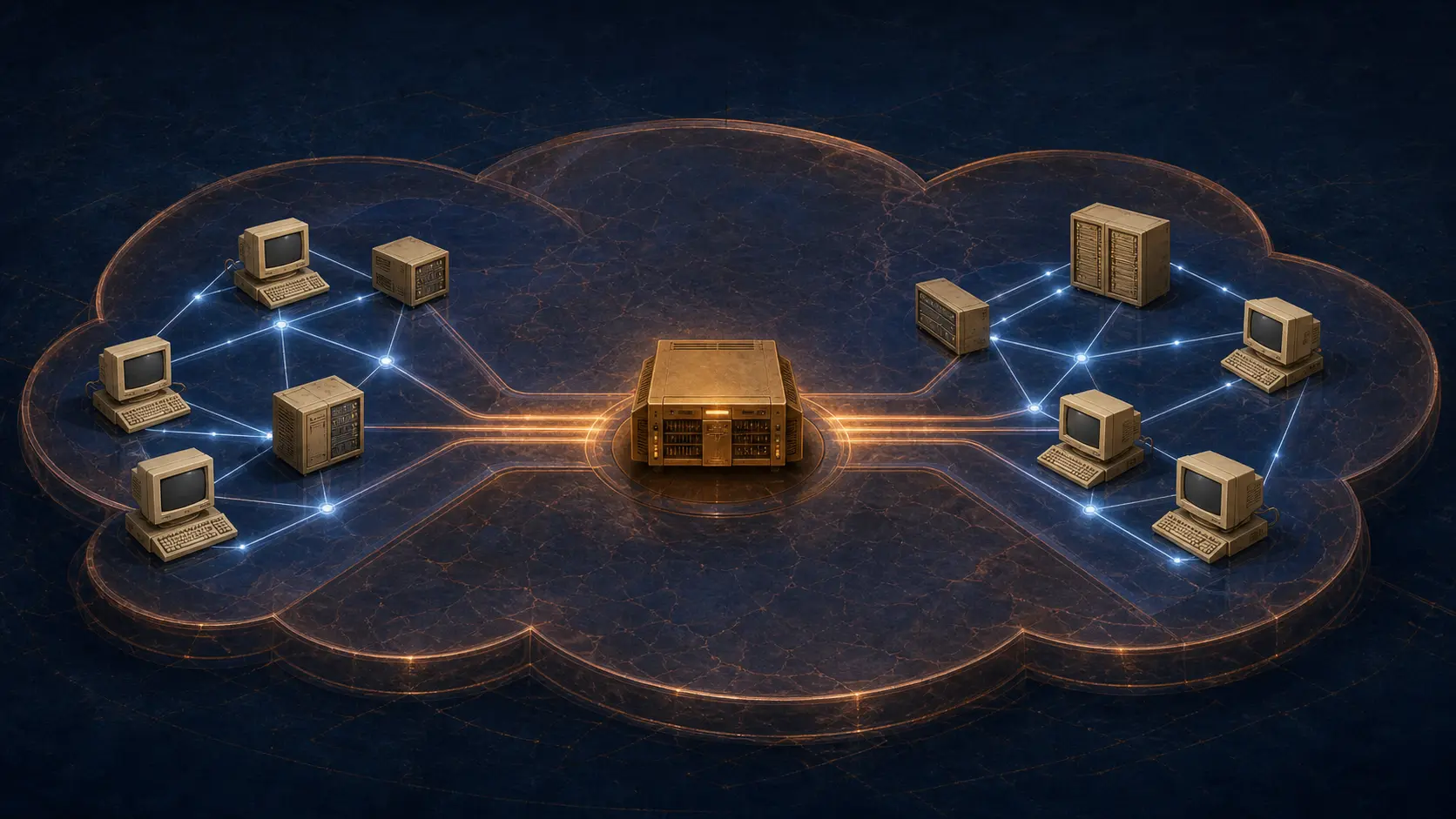
That language draws a boundary that is easy to miss when a diagram shows one cloud. A cloud answers questions about transport reach. A logical IP subnetwork answers a different question: which hosts are permitted to use direct IP delivery and ARP with one another under a single configured local rule. A line to the same service therefore did not establish a universal local broadcast or neighbor domain.
The RFC was intentionally limited. It described an initial configuration for IP and ARP over SMDS LISs and said that other public, inter-company or inter-enterprise configurations might be used in the future, but were outside its scope. It does not claim that every SMDS customer used this arrangement, that any named provider deployed it, or that one configuration was commercially superior. Its value lies in the explicit boundary it specified.
The router preserved the boundary
RFC 1209 states the operational consequence plainly: hosts in a given LIS communicate directly only with other hosts in that LIS. To reach hosts outside it, traffic goes through an IP router. A router interconnecting multiple LISs can be an SMDS station that belongs to all of them. It must support multiple parameter sets and associate each set with its particular IP network or subnet.
This is more than a rule for drawing boxes. It separates an available path from a permitted local relationship. Suppose two organisations subscribe to the same SMDS service and the service could technically carry a direct path between their stations. RFC 1209 still places an intermediate router between different IP networks. The router is where the transition between local IP scopes occurs. It supplies a point at which one can make routing, address-plan and interconnection decisions instead of allowing the common underlay to decide them implicitly.
The same distinction appears in the configuration details. All members of an LIS use the same IP network number and subnet number. A single SMDS group address is configured for the LIS. Subscription-time parameters may differ from one LIS to another and have to be user-configurable. These facts make the LIS a coherent operating group, not an incidental collection of endpoints that happen to purchase the same service.
Directness had a contract, not a geography
The word “direct” can quietly accumulate claims it cannot support. In this RFC it is a scoped forwarding relationship: hosts inside one LIS can communicate directly under the configuration described. It does not prove a bilateral business relationship, ownership of the carrier, permission to administer another host, authentication of a user, confidentiality of traffic, performance, or the existence of an end-to-end application session. Those are separate questions, and RFC 1209 does not answer them.
Nor should the router be romanticised as a complete security or governance solution. The RFC says what role the router plays between LISs and what configuration association it must maintain. It does not provide a deployment audit, a current security design, a procurement record, or proof that policies at the router were correctly implemented. A control point is valuable because it makes a boundary operationally expressible; it is not proof that every decision made there was good.
Why an old service rule still reads clearly
The durable lesson is about abstraction discipline. Engineers often inherit a shared service, a virtual fabric, a common exchange, or a broad cloud and then have to decide what counts as a local domain. RFC 1209 shows one answer: define the local group explicitly, bind its parameters to that group, and require a router when traffic crosses to another group. The substrate may be common without making the operating boundary common.
That decision also creates better evidence. A network record can identify an LIS, its associated IP network and its configured group address; a router can be associated with multiple parameter sets; a path crossing the boundary is visible as routed rather than silently assumed to be local. None of those records settles every operational dispute. Together, they distinguish a shared transport fact from an IP-neighbor fact.
Sources and evidence limits
The closed source set for this article is RFC 1209, The Transmission of IP Datagrams over the SMDS Service. It supports the RFC's date, scope, LIS membership model, router requirement, configuration parameters and stated limits. It does not establish current SMDS use, market share, real-world topology, performance, service ownership, security quality or the conduct of any named organisation.
Member Briefing
Deeper Profile Context
Sign in with the right membership level to unlock the full briefing and source notes.
Only for Strategic Circle
Strategic Circle
Open to all readers. Unlock profile briefings after joining and signing in.
Join Strategic CircleOnly for Leadership Alliance
Leadership Alliance
For qualified IP-asset owners and management; sign in to unlock alliance briefings.
Join Leadership Alliance