Summary
- Canada became the EuroHPC Joint Undertaking’s 39th participating state at the EU–Canada summit in Montréal on 30 October 2026. Its live governance roster lists Nipun Vats as Canada’s board member and Sheila Kennedy as substitute.
- The Union holds an indivisible 50% of EuroHPC Governing Board voting rights. How the other half is distributed depends on the decision; for some tasks, only EU member states hold it.
- Canadian researchers already had a route to apply for the Union’s share of post-2020 supercomputer time through Canada’s Horizon Europe association. Membership adds a governing role; the public accession notice gives no Canadian contribution or compute-hours award.
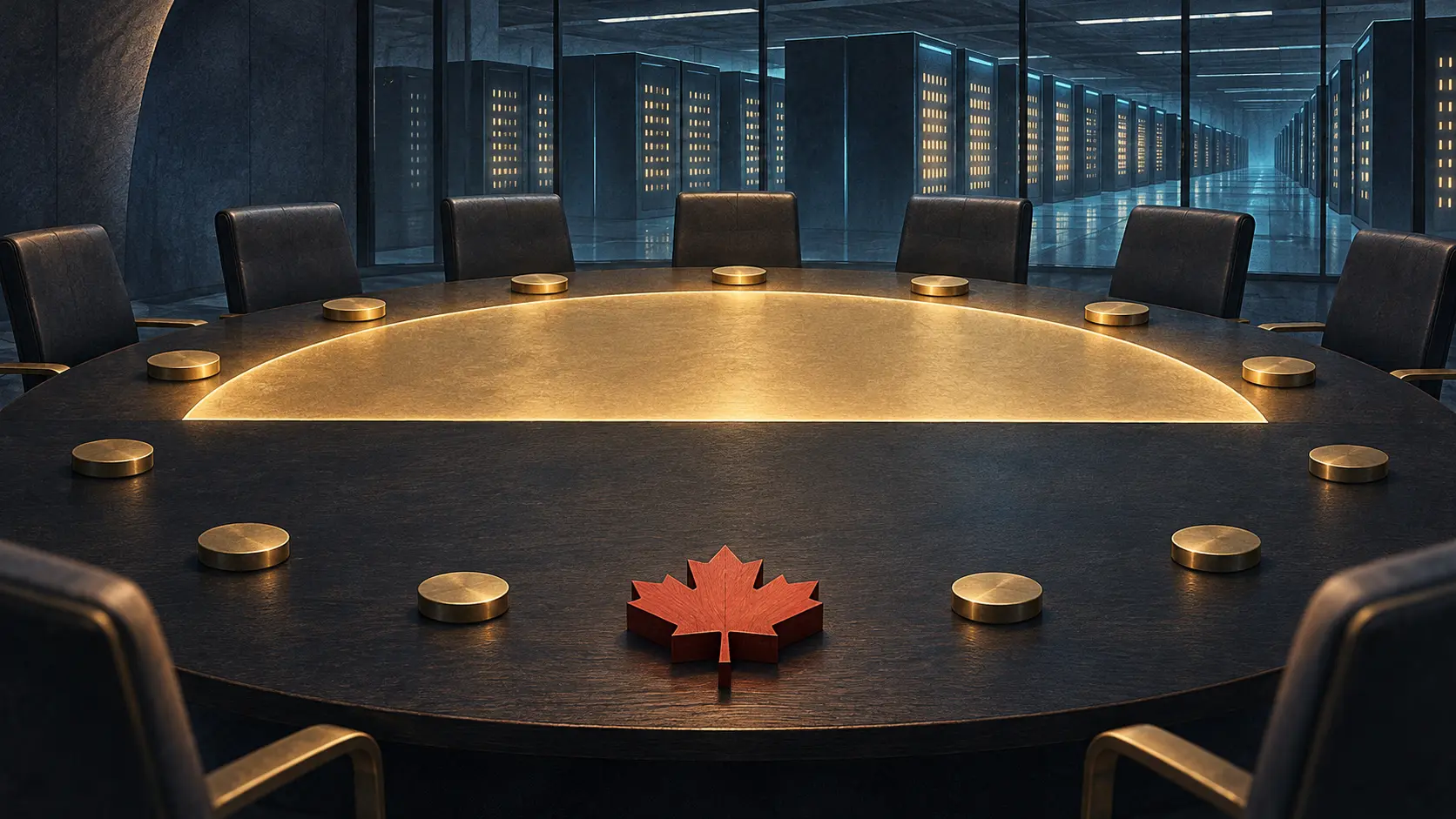
Canada has taken a chair in the room that decides which machines EuroHPC buys and how public compute is allocated. The Joint Undertaking announced the country’s accession on 30 October and called it its 39th participating state. Its governance page already names a Canadian member and substitute. That is a more concrete institutional change than a summit photograph of two flags beside a server rack.
The marketing line is compute access. Canada’s researchers, however, did not need a board seat to apply for the Union’s share of post-2020 machine time. The governing regulation gives users in countries associated with Horizon Europe a path to the Union’s share of time on machines acquired after 2020. Canada has held that association since 2024. Eligibility still runs through access rules and calls; the public record cited here does not show a Canadian award or machine-hour total.
Membership changes who is inside the decision process. Each participating state appoints a representative. EuroHPC’s Governing Board sets strategy, funding and procurement. Its votes are not a simple roll call of 39 equal sovereigns. The Union holds half the voting rights as one block. For general administrative tasks, the states share the other half equally, and a decision needs the Union and at least half the states’ votes. For several procurement and AI-gigafactory decisions, the relevant state vote belongs only to EU member states. Machine-specific votes can depend on committed contributions.
The statute therefore gives Canada a voice with a map of its limits. A new member may argue over priorities and scrutinise the public investment programme; it does not acquire a fixed slice of every supercomputer by walking through the door. Hosting arrangements, Union access rules and individual allocations determine who gets time on which machine. The accession announcement does not publish Canada’s contribution, any machine-specific voting weight or a first allocation. Those records would show how far the new seat reaches.
This matters beyond one country. As EuroHPC expands into AI infrastructure and quantum technology, it invites more partners into a venture built to advance European capacity. The board’s arithmetic is the price tag on that invitation: participation widens, while the Union keeps its half of the lever. Canada is now at the table. The next consequential document is a decision, budget or access award carrying its name.
Sources
Member Briefing
Deeper Profile Context
Sign in with the right membership level to unlock the full briefing and source notes.
Only for Strategic Circle
Strategic Circle
Open to all readers. Unlock profile briefings after joining and signing in.
Join Strategic CircleOnly for Leadership Alliance
Leadership Alliance
For qualified IP-asset owners and management; sign in to unlock alliance briefings.
Join Leadership Alliance