Summary
- RFC 1437, dated 1 April 1993, proposed the MIME type
matter-transport/sentient-life-formfor emailing an entire person. Its dimensions, molecular encoding, gateway advice and failure stories were a deliberate engineering joke. - RFC 9694 later recorded the archival consequence: the proposed top-level type was never registered. It identifies the 1993 document as an April Fools RFC published for entertainment.
The attachment that needed legroom
A message arrives with an attachment. The recipient checks its type, opens the file and wishes the sender had named it more helpfully. By 1992, MIME had given Internet mail a way to describe body parts beyond flat ASCII: text in other character sets, images, audio, video and multipart packages. Nathaniel Borenstein, one of MIME's authors, and Mark Linimon looked at that useful vocabulary and asked a question with impeccable bureaucratic form and catastrophic biological implications: what if the body part were the sender?
Their RFC 1437 appeared on 1 April 1993. It proposed a new top-level MIME type called matter-transport and a subtype called sentient-life-form. The title, The Extension of MIME Content-Types to a New Medium, sounded plausible enough for a filing cabinet. The abstract offered email interoperability for whole sentient creatures. The calendar supplied the first clue; the RFC's straight-faced handling of dolphins, Klingons and politicians supplied the rest.
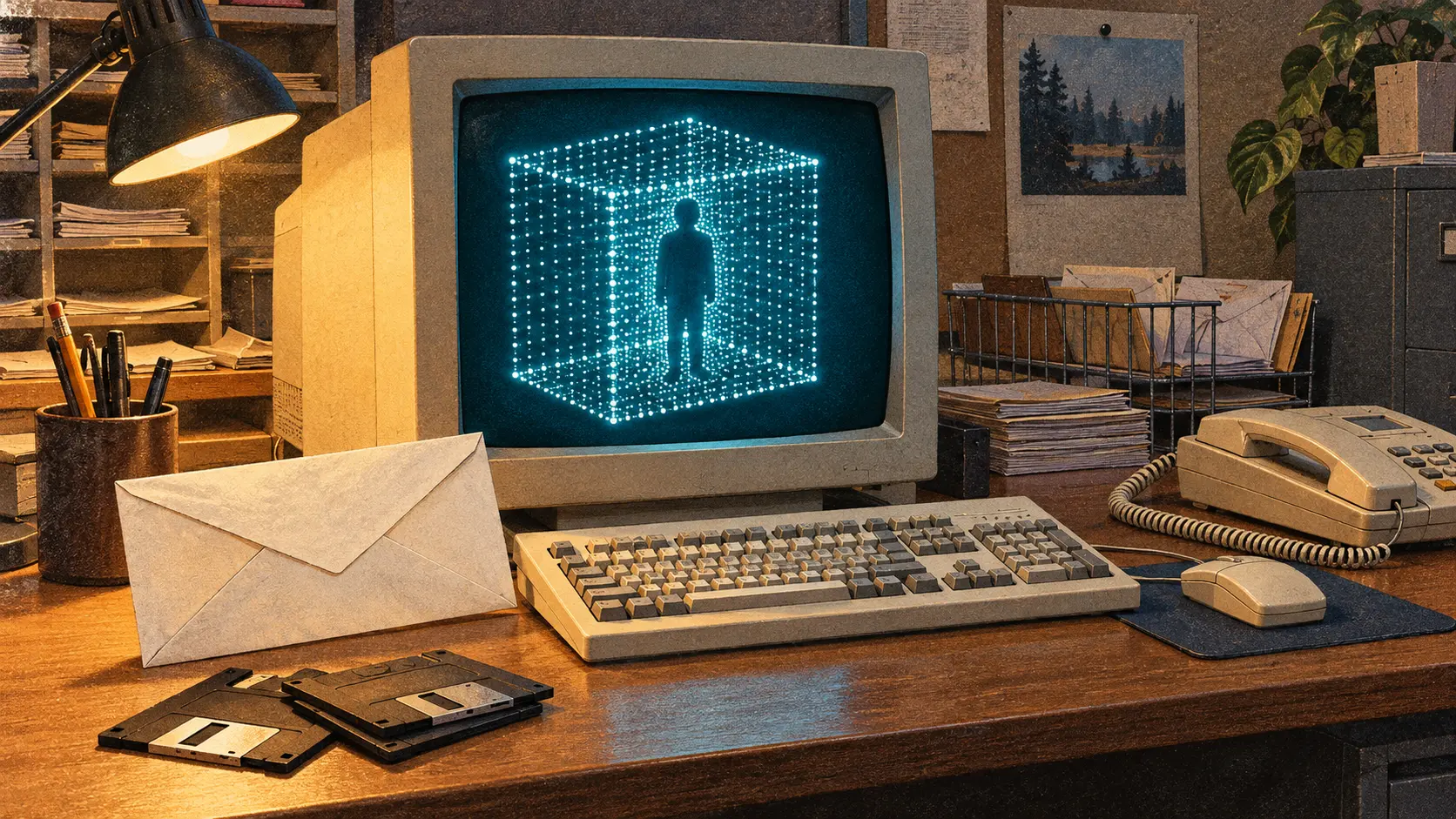
The authors did the work a convincing parody requires. A Content-Type line carries height, width and depth in centimeters and a scan resolution in ångströms. Inside the declared box, the message body supposedly lists the molecule at each position, using ASCII formulas separated by spaces. For an overlong molecule, the text considers quoted-printable encoding so a line-wrapping mail system will not break a protein. A photograph would have been the easy joke. Here, the person becomes a data-format problem with a cube and a character set.
That specificity matters. RFC 1341 had addressed the real difficulty of moving different kinds of content through mail software and gateways built around earlier text conventions. RFC 1437 borrowed the parts of that problem an engineer would recognize: type declaration, transfer encoding, intermediary behavior and recipient interpretation. Then it raised the stakes until a malformed line could cost someone an arm. Its comedy comes from using a serious protocol's concerns at an absurd scale, without changing the tone of the specification writer.
Consider the gateway section. Real mail might pass between MIME and X.400 systems whose handling of unfamiliar content differed. The joke asks what happens when an opaque gateway rejects an email containing a person and the recipient deletes the error without discovering the passenger. It proposes future X.400 study, with dates stretching comfortably into the next century. The bureaucratic postponement lands as neatly as the technical one: human transport is waiting in a standards queue.
The implementation section becomes more mischievous. A supposed disk-space failure truncates a laboratory rat to a zero-length file; the writers regret having neglected a “scratch rat.” Byte order can turn the arrival upside down. Backups tempt management with virtual immortality. Duplicate mail, normally an irritation, might produce extra relatives. Each gag starts with a real class of computing failure—storage exhaustion, representation mismatch, recovery, duplicate delivery—and assigns it a bodily consequence. The rat is a punchline, not a report of a laboratory experiment.
The final security discussion extends the same method to law and geography. The authors imagine a criminal mailing himself out of a jurisdiction or spending the limitation period in transit. No working machine is hiding between the lines. The joke is that once a standards document accepts the impossible premise, every ordinary operational question becomes grotesquely reasonable. Even the authors' addresses arrive as MIME parts, ready for hypothetical reconstruction. The RFC format lets the bit continue through its own end matter.
An official archive can preserve a joke without turning the joke into a deployment. RFC 9694, published in March 2025, says RFC 1437 defined the first additional top-level type but that matter-transport was never registered: the document was an April Fools RFC issued for entertainment. That later statement gives the story a particularly clean ending. The 1993 text entered the RFC record. The registry still kept the proposed medium outside its operational vocabulary.
RFC 1437 earns its place in Internet history because the engineers knew exactly what they were teasing. MIME made a capacious mail system possible. The parody showed how quickly the language of extensibility could sound like permission to solve a problem no computer had solved. For a few pages, the Internet appeared ready to mail a person. The envelope looked official. The passenger remained imaginary.
Member Briefing
Deeper Profile Context
Sign in with the right membership level to unlock the full briefing and source notes.
Only for Strategic Circle
Strategic Circle
Open to all readers. Unlock profile briefings after joining and signing in.
Join Strategic CircleOnly for Leadership Alliance
Leadership Alliance
For qualified IP-asset owners and management; sign in to unlock alliance briefings.
Join Leadership Alliance