Summary
- Licence register P1191-01 counts 95 diesel generators at 1.29 to 7.51 MWth each, 579.28 MWth in total, and binds them to 200 hours a year in the data halls and 100 in administration, with one hour per generator per week of testing.
- The endurance figure appears in the applicant's operational report, not the permit: the belly tanks give roughly 48 hours at 75 percent of nameplate, and three documents on three dates print three different stored inventories.
The permit counts hours of combustion
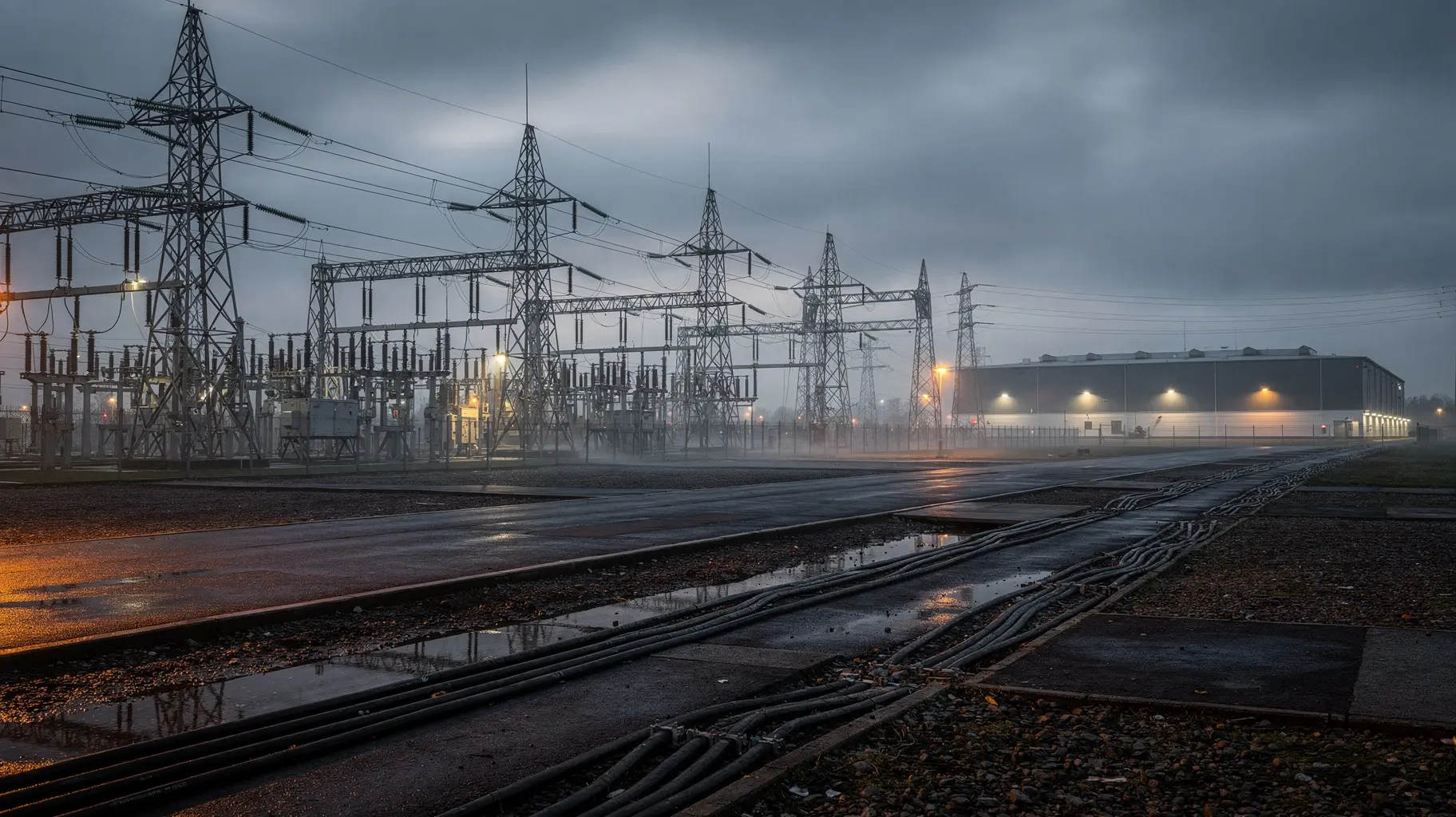
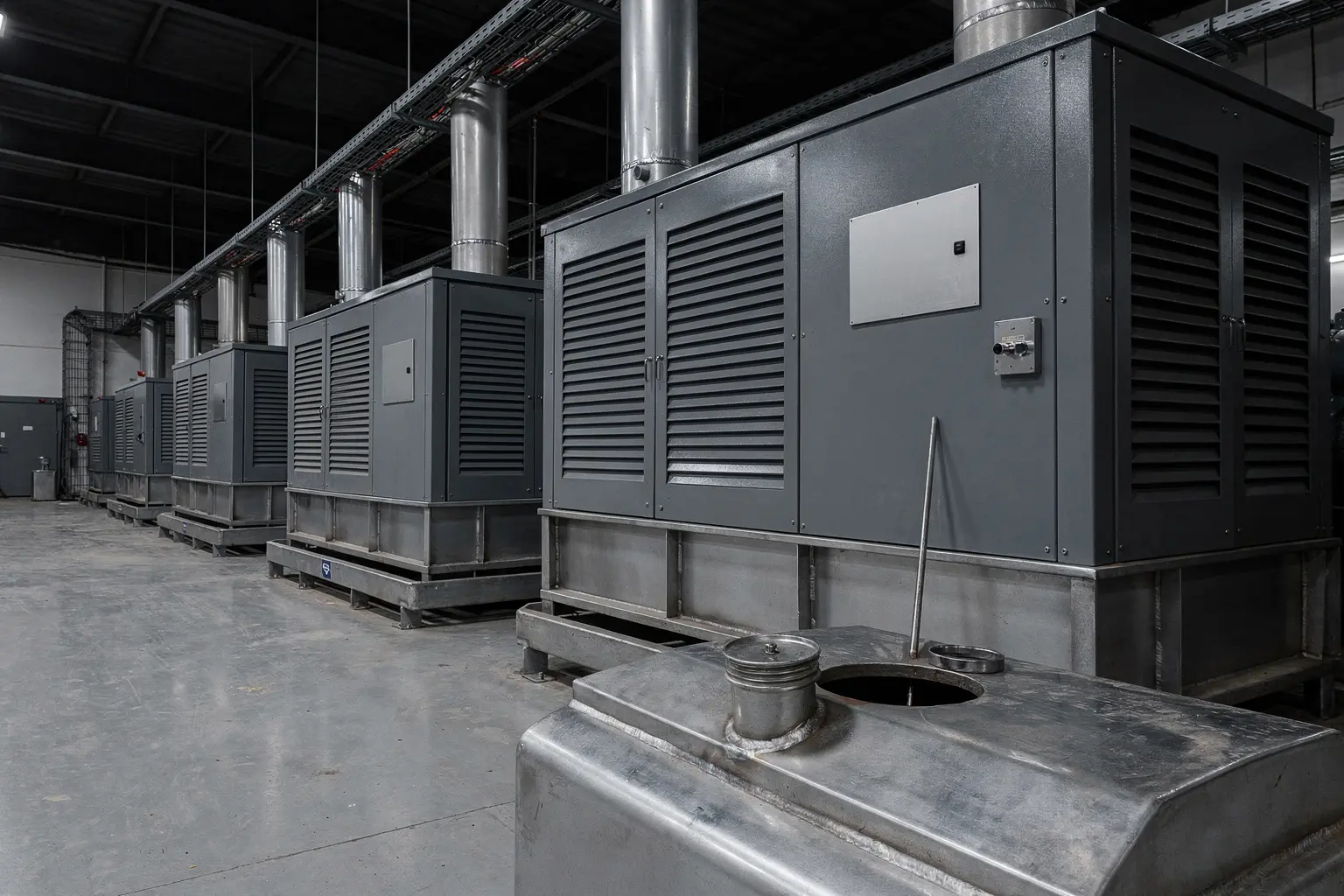
The inspector's report on the application is dated 26 May 2023 and concerns licence register number P1191-01, held by Microsoft Ireland Operations Limited for its data-centre installation in Dublin. Its description of the standby fleet is flat and complete: "There are 95 diesel generators and associated sub-station infrastructure. The generators are medium combustion plant and range in capacity from 1.29 to 7.51 MWth (mega watt thermal input). The total capacity is 579.28 MWth." (EPA inspector's report, P1191-01)
Those generators do one job. They carry the site during a loss or reduction of grid supply, and they are not planned to export anything back. What the file then fixes is not how long they can run. It is how long they may run: 200 hours a year for the generators serving the data halls, 100 hours a year for the administrative generators, never more than 579.28 MWth operating at once, and testing capped at a maximum of one hour per generator per week, run sequentially.
That is an emissions instrument doing emissions work. A thermal-input rating decides which permit category an installation falls into — above 50 MWth of combined thermal input, an Irish data centre with on-site generation needs an Industrial Emissions licence at all — and an annual hours budget decides how much combustion the surrounding air is asked to absorb. The Oireachtas research service put the underlying logic plainly in July 2024: such generators "are usually designed for emergency and backup electricity generation rather than to operate for a length of time." (Oireachtas Library & Research Service, Spotlight: Data centres and energy)
An engineer who works on permits learns from this file what the site may burn. A reader asking whether the campus stays up through a three-day outage learns nothing at all, because 200 hours a year is a permission, not a tank.
The applicant counts hours of fuel
Attachment 4.8.1 to licence application LA010454 is the applicant's operational report, dated December 2022 and updated in March 2023, and it contains the sentence the permit does not: "These belly tanks provide approximately 48 hours fuel storage at 75 percent of the generators nameplate kW rating." (Microsoft Operations Ireland Ltd, Operational Report, Attachment 4.8.1)
Read the qualifier twice. The figure holds at 75 percent of nameplate, which is a load assumption, not a worst case. Scale it, and you are doing my arithmetic and not theirs: 48 hours at 75 percent becomes roughly 36 hours at 100 percent if fuel consumption rises linearly with load, and generator fuel curves are not exactly linear. No document in this file set states a full-load endurance figure, so the 36 is mine, offered as a scale marker and nothing more.
Two clocks are now visible, and they are measured on the same object — one generator running. The permit allows 200 hours of it a year. The belly tank under that generator holds something like 36 hours at full load by my multiplication. Divide one by the other and you get about 5.6 refuelling cycles' worth of permitted running per tankful, a ratio that tells you the two numbers answer different questions rather than contradicting each other.
There is a units boundary here that the file never crosses. The endurance statement is written against nameplate kW, an electrical output rating. The licence's fleet arithmetic is written in MWth, a thermal input rating. Nothing I retrieved converts one into the other for this site, and I have not done it either. Anyone who divides 579.28 MWth by the tank inventory and publishes hours is inventing a heat rate.
Where the tanks are counted, and how many times
The same operational report itemises the fuel storage rather than summarising it: 44 tanks at 40 m3, 43 at 25 m3, three at 20 m3, two at 18 m3, two at 7.8 m3 and one at 8.7 m3, plus 1.6 m3 for fire pumps and 0.2 m3 for a substation backup generator. The tank list sums to the stated total of 2,957.1 m3 — that addition is my arithmetic and it reproduces the report's own figure exactly. At the specific gravity the report itself supplies, 0.845, that is 2,498.75 tonnes.
Two cross-checks land cleanly. The generator tanks number 44 plus 43 plus 3 plus 2 plus 2 plus 1, which is 95, matching the fleet count in the inspector's report; the fire-pump and substation tanks serve no generator and sit outside that sum. And the inspector's report reaches the same tonnage from its own direction, in a different argument entirely: "The total amount of diesel that is stored at the installation is 2,498 tonnes", a figure it needs because 2,500 tonnes is the lower-tier COMAH threshold and the installation sits just under it. (EPA inspector's report, P1191-01)
So a regulator's safety-threshold calculation and an applicant's endurance calculation arrive at the same mass by different roads. That coincidence is the most reassuring thing in the file set, and it is worth naming as a coincidence rather than as a validation.
Three printings, four years, one site
By 2026 the inventory has moved. A response to an EPA letter dated 24 August 2026, published through the LEAP register on 22 September 2026, states that the site's fuel storage exceeds 2,500 tonnes with approximately 2,700 tonnes maximum fill capacity, that the largest individual bunded belly tank holds 40,000 litres, and that a generator yard of up to 12 generators holds at most 480,000 litres. (P1191-01 Response to EPA Letter dated 24th Aug 2026)
The same filing records a physical change that matters more than the arithmetic: diesel was replaced by HVO in all backup generators in 2024, gas oil remains only in the fire-pump tanks at 1.7 tonnes, and the site keeps its lower-tier COMAH notification although the substances now stored do not meet the qualifying criteria.
Three printings of one quantity now exist on three dates — 2,498 tonnes in the 2023 inspector's report, 2,957.1 m3 or approximately 2,498.75 tonnes in the 2023 applicant report, approximately 2,700 tonnes maximum fill in the 2026 filing. I print all three and adopt none. They may describe different measurement conventions, a tank farm that changed, or simply fill against capacity. What I will not do is pick the largest, call it the site's fuel, and divide.
What the file is for, and what it is not
The honest summary of this document set is that Ireland's permit file tells you a great deal about combustion and almost nothing about autonomy, because autonomy was never the question the permit was asked. Nobody in these pages claims the site runs for a specific number of days. Nobody claims it does not. The endurance number exists, it is stated once, it is qualified to a load assumption, and the qualifier travelled with it out of the applicant's engineering report and into the public register without ever entering a licence condition.
That is not a scandal. It is a filing convention, and it is worth knowing before you read a permit and mistake a permission for a specification. The number that governs what may be emitted and the number that governs what survives an outage live in different documents, written by different parties, for different purposes. A reader who takes the hours budget for an endurance figure has read the file backwards.
Boundaries
- Everything here is a reading of four documents retrieved on 19 November 2026 between 14:20 and 14:36 UTC. A limit on my retrieval is an access fact about me, never a fact about the publisher.
- All four PDFs reached me through search-index extracted text for the exact URLs cited, not by opening and paginating the files. Tables, annexes and schedules may be under-represented, and a figure's absence from the passages I recovered is not proof that it appears nowhere in the file.
- The approximately 48-hour statement is a design and modelling basis, expressly qualified as applying at 75 percent of the generators' nameplate kW rating for the belly tanks. It is not a site-wide, full-load endurance guarantee.
- Three printings of the stored inventory exist on three dates: 2,498 tonnes in the 2023 inspector's report, 2,957.1 m3 or approximately 2,498.75 tonnes in the 2023 applicant operational report, and approximately 2,700 tonnes maximum fill in the 2026 filing. All three are printed, none is adopted, and the differences are described rather than adjudicated.
- The endurance figure is stated against nameplate kW, an electrical output rating; the licence's fleet totals are MWth, a thermal input rating. No conversion between the two appears in the passages I read, and none is computed here.
- The approximately 36-hour full-load figure is my own arithmetic from the 48-hour-at-75-percent statement, assuming fuel consumption scales linearly with load. Every multiplication and division offered here is labelled as mine and is never attributed to the regulator or the applicant.
- The inspector's report contains both a description of testing once a month per generator in practice and a weekly one-hour-per-generator basis used in the dispersion modelling and imposed as the weekly maximum. Both are printed, and neither is adopted as a statement of what the site actually does.
- What I read is the inspector's report on the application. Whether the sealed final licence restates the 200-hour and 100-hour figures, or states any fuel-storage or endurance figure in its schedules, was not confirmed.
- The 2026 filing describes a later physical state of the same installation, after the 2024 switch of every backup generator to HVO. It does not retroactively describe the diesel-era documents of 2023, and neither document is read as a correction of the other.
- The COMAH threshold material is reported exactly as each document prints it. No conclusion is drawn about classification, compliance, notification duty or the adequacy of any safety arrangement.
- Nothing here asserts that any installation is unsafe, non-compliant or inadequately resilient, that any operator's figures are wrong, or anything about the conduct of any company, officer or official beyond what a document I read states.
- No site visit, meter reading, generator test, dispatch record or independent inspection was performed. The 579.28 MWth is a rated or permitted figure, not a measured output, and no load has been observed at this installation.
- The Oireachtas note is a secondary research paper dated 23 July 2024, and its figure of 13 energy-related licences issued to data centres in 2023 is an aggregate across sites, not a condition attached to this or any named installation.
- The directory card for this article is Microsoft Corporation, an existing directory entity. The licensee named throughout the body is Microsoft Ireland Operations Limited, because that is the name on the licence file, and the two names are never used interchangeably.
Member Briefing
Read the full trend briefing
Members read the full briefing with the source notes behind every finding.
Strategic Circle
A daily briefing in your language, built from changes we have verified.
Join for USD 20/monthCancel anytime.
Members also get the full research library, a daily briefing on the networks they follow and the private forum.