
Summary
- Oregon’s governor directed the Department of Administrative Services to terminate the state land-sale contract associated with Verrus’s Salem proposal.
- The site was state-owned land at Mill Creek Corporate Center in southeast Salem.
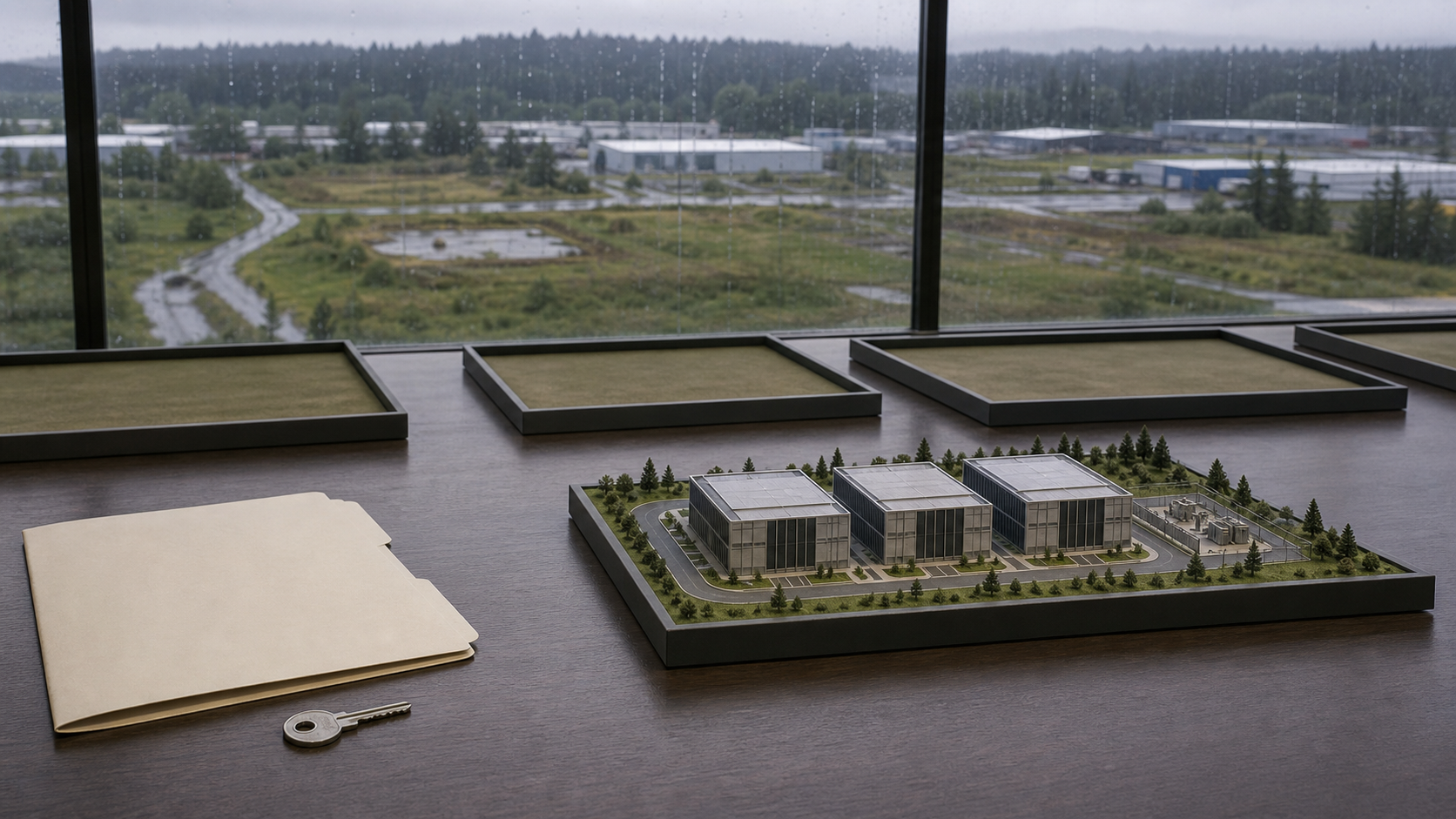
- The proposal was described at roughly $5.1bn, with three data-centre buildings and a substation on about 75 acres.
- Salem said the project was at an early stage and no formal development application had been submitted.
- Data centres were an allowed use in the Employment Center zone at the time of the city FAQ, separate from the state’s role as land seller.
- Verrus said the action might not stop the project, but no replacement site-control or application route was public at cutoff.
Site control fails before zoning is tested
Large infrastructure needs both a lawful use and control of the land. Salem’s zoning position addressed the first in general terms. The state sale addressed the second for a particular parcel. The governor’s direction removes the contractual path to that site even though the city had not rejected an application.
This sequencing matters. A developer can spend on concept design, utility studies and negotiations before it owns the land or files plans. Cancelling the sale at this stage may prevent deeper sunk costs, but it can also invalidate work designed around the parcel’s geometry and connections.
The legal completion of termination should be documented. Direction to terminate and a fully closed contract are related but not identical moments; notice requirements, deposits or remedies may still matter.
The project was public only after a confidentiality period
Salem says the city operated under a nondisclosure agreement, was released on 8 July and disclosed the proposal to the council on 13 July. The chronology left residents with a compressed period to understand a project of unusual scale.
Confidentiality can protect a land negotiation or unnamed customer. It should not withhold public-service assumptions until the transaction is nearly fixed. Power, water, roads, emergency planning and tax exposure are public questions even when a tenant is private.
Future proposals should use a staged disclosure rule: confidential commercial identity can remain protected, while maximum load, water method, backup generation, parcel, public incentives and decision dates become visible before binding public action.
A $5.1bn label does not prove committed capital
The reported value describes the proposal, not a financing close. No formal development application, final utility agreement, construction notice or customer commitment was identified in the city record reviewed.
Three buildings and a substation describe the physical concept. They do not reveal initial MW, final MW, phasing or ownership of computing equipment. A different site may change each figure and invalidate the headline total.
Investors and residents should treat the number as an order-of-magnitude plan until contracts identify committed spending. The cancelled land route may reduce option value without generating a $5.1bn realised loss.
The developer’s claim is possible but unproven
Verrus says the governor’s action may not stop the project. In principle, it could negotiate another parcel, restructure site control or submit a different plan. Because no formal city application existed, the public proposal was not tied to an approved entitlement.
Possibility is not continuity. A substitute location would need land control, zoning, power, water, fibre, access and community review. Moving even a short distance can change the utility interconnection and environmental record.
The correct status is therefore neither “project dead” nor “project unaffected”. The documented state-land route is ending; any survival requires new evidence.
State land and city code are separate control surfaces
Oregon acted as landowner through the Department of Administrative Services. Salem controls development review and code. The Oregon Department of Energy and state data-centre advisory work occupy another policy layer.
These roles can produce different decisions without contradiction. The state may decline to sell while the city code still allows the use. The city may later change conditions without reviving the land contract.
A public decision map should show parcel owner, zoning authority, utility, energy regulator and incentive authority. Readers can then see which approval has changed and which remains hypothetical.
The next evidence should identify a parcel and a process
First, Oregon should publish the termination record and disposition of the land. Second, Verrus should identify whether it is abandoning the Salem concept, seeking another state arrangement or controlling a different parcel.
Any new route should restart disclosure with a formal application, utility status and phased operating assumptions. Separate planning discussions about making data centres conditional should be reported only when a rule is actually enacted.
The governor’s action is already material because land is not replaceable by a press statement. Yet precision prevents overreach. One contract is being terminated. The fate of Project Oakline remains open, but it now carries the burden of proving where and under what authority it could continue.
Sources
- KGW — Gov. Kotek orders state to cancel land sale for proposed Salem data center
- City of Salem — Project Oakline FAQ
- Oregon Department of Administrative Services — surplus real property
- Salem Reporter — public comment and project background
- Oregon Department of Energy — Data Center Advisory Committee