Summary
- Open Fiber's 2025 sustainability report prints 20.2 million unità immobiliari connesse at 31 December 2025 — over 17.0 million FTTH and 3.2 million FWA — and 18.4 million in sellability, while the company's own home-page footnote defines the metric as units reached by the FTTH network rather than lines sold.
- The Italia a 1 Giga target was switched from real estate units to street numbers in November 2023: 3,400,000 civici, of which 450,000 in areas ISTAT calls case sparse. Infratel made every beneficiary hand over a per-civico count of units called the Civico base. None of the twelve documents read on 25 November 2026 prints that count as a factor a reader can divide with.
The four counts
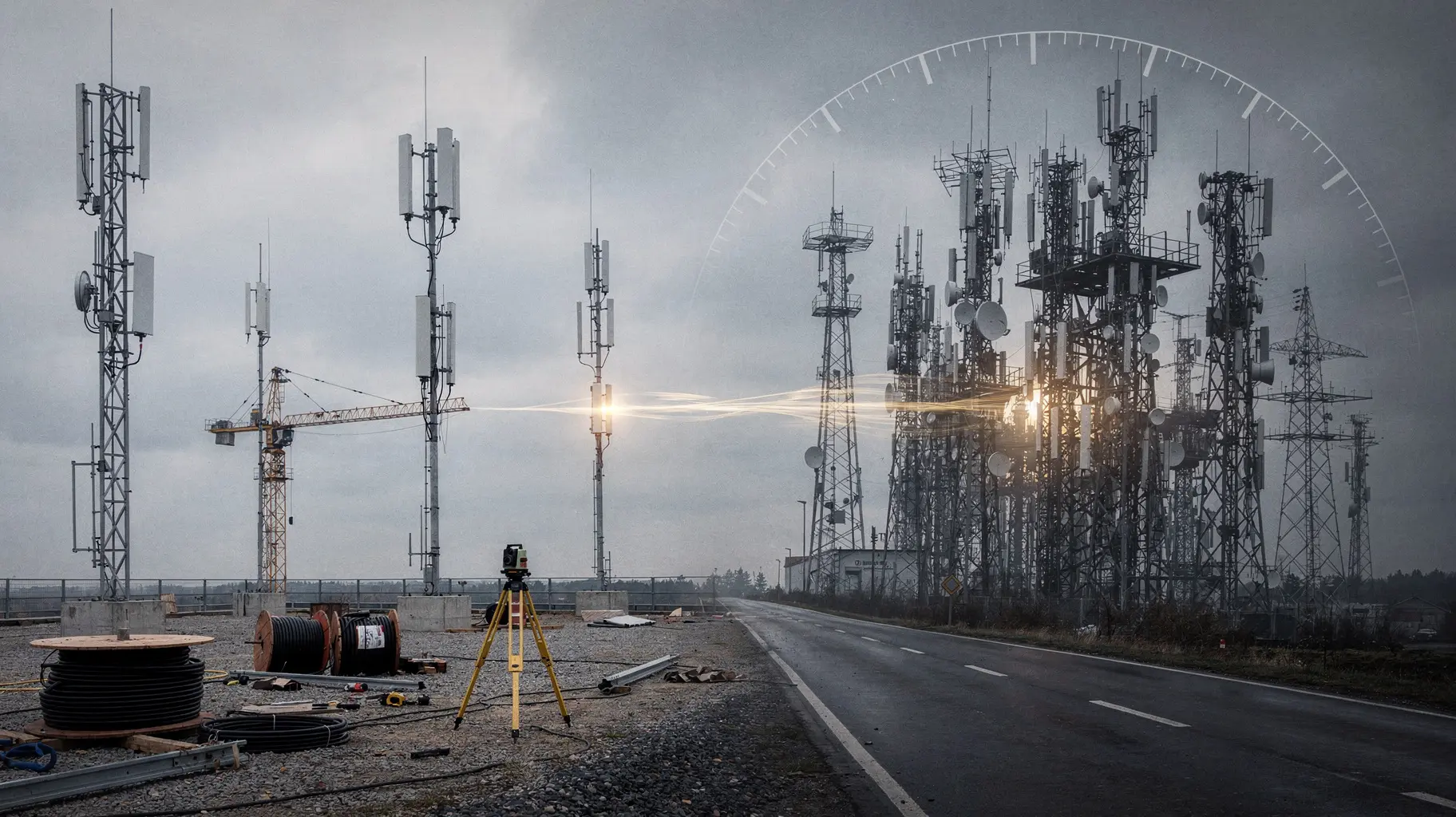
Open Fiber sells only wholesale, and it reports the size of its network in a unit that is neither a customer nor a building. The 2025 sustainability report puts the total at 20.2 million unità immobiliari connesse at 31 December 2025, of which over 17.0 million in FTTH technology and 3.2 million in FWA; the same report calls the figure a totale di copertura and separately prints 18.4 million unità immobiliari in vendibilità (Report di Sostenibilità 2025). During 2025 the company connected 1.5 million units, an 8 per cent increase, and its multi-year plan targets more than 21 million units and about 170,000 km of network. The 25 March 2026 accounts release supplies the human figure and the money: about 3.8 million active users and revenue of 798.1 million euro (2025 accounts release).
The home page is the only surface in the set that defines the word. Its dashboard, updated to 31 October 2026, prints 17.550 million unità immobiliari connesse in FTTH, 6,485 thousand comuni in FTTH sellability and 169,276 km of network, and a footnote says the metric counts unità immobiliari raggiunte dalla rete in fibra ottica FTTH — units reached, not lines activated (Open Fiber home page). The footnote defines reached; the sustainability report prints connesse for a figure it also calls copertura, and its own footnote splits that total into FTTH and FWA without ever using the word passed.
The programme that paid for part of the network counts something else. The Italia a 1 Giga page prints 2,692,905 civici da connettere with data updated to September 2026 and a maximum payable contribution of 2,857,345,756 euro; an earlier passage on the same page rounds the same intervention to oltre 2,6 milioni di civici and about 2.8 billion euro, and records 15 lots, 8 to Open Fiber and 7 to FiberCop, lot 15 included (Italia a 1 Giga programme page). Open Fiber's own works page narrows to its eight lots in nine regions and reports 1.284 million civici connessi in FTTH and 231 thousand in FWA at 30 September 2026 (Open Fiber works progress). A civico is a street number. It is not a unit, and that page does not say how many units stand behind the numbers it counts.
The concession's accounting counts units again, and keeps four states of them apart inside one document: 6,301,451 unità immobiliari in the total perimeter of design, works and testing at 31 December 2025, of which 5,347,338 testable, 5,055,026 tested and 292,312 under testing; and separately 789,015 unità immobiliari with activated services, 5,962 comuni with FTTH works completed with CUIR, services available in 6,884 comuni and 6,074 comuni covered by the FTTH intervention (BUL progress report). The regulator counts neither object: at September 2025 AGCOM puts total fixed access at 20.49 million lines, with FTTH at 32.9 per cent of them, FTTC at 41.6 per cent and FWA estimated at 2.56 million (AGCOM Osservatorio 4/2025), and its tables give 6.74 million FTTH lines, up 22.0 per cent year on year (AGCOM tables).
Four counts, four objects, four dates: units reached at 31 December 2025 and again at 31 October 2026, civici at 30 September 2026, units inside a concession perimeter at 31 December 2025, access lines at September 2025. They are never added here, because they do not add.
What my own arithmetic makes of them, labelled as mine. 3.8 million active users over 17.0 million FTTH units is 22.4 per cent, and over 20.2 million units 18.8 per cent — a user-to-premises ratio, not a take-up rate. 20.2 million units over 20.49 million national lines is 98.6 per cent, a coincidence of two different objects on two dates and worth nothing as a share. 169,276 km over 17.550 million FTTH units is about 9.6 metres of network per reached unit, both printed on one page for one date.
The Italy a 1 Giga pair is the useful one: 2.3 million units at 31 December 2025 over 1.515 million civici at 30 September 2026 gives 1.52 units per street number, and over the 1.284 million FTTH civici alone 1.79. Because those two counts sit nine months apart, both are bounds on a factor and not the factor.
Who defines the unit
The only definition in the reviewed set belongs to Infratel's mapping manual. Per unità immobiliari si intendono le abitazioni e le sedi d'impresa (profit e no-profit) e della pubblica amministrazione: dwellings, business premises of any legal form, and public administration offices. The same manual says a civico is covered by NGA networks if at least one corresponding unità immobiliare is passed, and defines passed as activation on request, as a rule within four weeks, without additional or extraordinary costs (Infratel mapping manual).
Read those two sentences together and the asymmetry appears. One street number can carry twelve flats and count once, provided one of them is reachable. A count of units therefore grows with the number of premises behind each address; a count of civici does not. Neither is a household count, because the definition includes offices and town halls; neither is a customer count, because Open Fiber sells wholesale only. And the manual is a mapping instrument — it binds the public exercise, not necessarily the operator's internal books.
The same asymmetry runs through the technology split. The 3.2 million FWA units sit inside the 20.2 million total beside the FTTH units, and no reviewed page states how a radio footprint becomes a count of reached real estate units, or whether the four-week activation test applies to it at all.
The database the state asked for
Infratel's report on the civici di prossimità says what the exercise was to produce. Each beneficiary had to carry out field checks and deliver a complete database of the civici to be connected, giving for every civico the corresponding number of unità immobiliari present, called the Civico base (2024 civici di prossimità report). The 2025 consultation repeats the requirement for the FiberCop perimeter and describes a civico di prossimità as one sharing a street name with a Civico base or lying within 300 metres of one (2025 civici di prossimità consultation).
That file is the divisor. Multiply civici by the units behind each one and the reported unit count should follow; divide units by civici instead and the build rate in addresses follows. The same 2025 document records why the unit is political: in November 2023, with the PNRR revision, the Italia a 1 Giga target changed from unità immobiliari to numeri civici, and the commitment became 3,400,000 civici, of which 450,000 in areas ISTAT defines as case sparse.
Divided, that is 7.56 ordinary-territory civici for every scattered one, my arithmetic — which is a decent account of why the unit changed: addresses in thin areas are a harder promise than dwellings.
Now the absence. The twelve documents read on 25 November 2026 print the requirement, print aggregate civici and aggregate units, and print no per-civico unit count in any form a reader can divide with. The programme page's 2,692,905 civici against the 3,400,000 committed gives 79.2 per cent, a quotient with a real unit and nothing in it about what was built. The mapping report supplies the universe — 35,545,128 addresses in the questionnaires, 28,714,637 civici after revisions — and records Open Fiber's own integration of 278,012 civici, 228,703 FTTH and 49,309 FWA, with 331,030 civici removed from its private plan (2025 mapping report). It does not publish units per address. Infratel also stated that operator mapping data may be made available in aggregate and disaggregated form on its websites, so a dataset outside this set may exist; the honest form of the finding is narrower and harder: no reviewed page prints the factor.
What the money cannot buy
The 2025 money is printed to the tenth of a million and carries no quantity beside it. Revenue 798.1 million euro, up 18 per cent; EBITDA 409.5 million, up 53 per cent; net result minus 336.7 million; investment about 1.6 billion euro in the year and 11.8 billion cumulated. Divide revenue by active users and each user brings about 210 euro. Divide the year's investment by the 1.5 million units connected during it and a unit added in 2025 cost about 1,067 euro — both operands are 2025 flows.
Divide the 11.8 billion cumulated by 17.0 million FTTH units and the answer, about 694 euro, marries years of spending to one day's stock; offered and refused. So is 798.1 million over 20.2 million units, 39.5 euro, because the revenue is wholesale and the count includes units nobody can buy yet.
In the concession the money and the build can at least be stood side by side in one unit. 789,015 activated units over 5,055,026 tested is 15.61 per cent; over the 6,301,451-unit perimeter, 12.52 per cent. Both are unit-over-unit, both are mine, and neither is the ratio in addresses that the programme was written in.
Two further differences are printed and go unremarked. 20.2 million units reached against 18.4 million in sellability leaves 1.8 million units that exist in the count and cannot be sold on the same day. And 17.0 million FTTH units at 31 December 2025 against 17.550 million at 31 October 2026 is 0.55 million added in ten months on one metric and one technology — 3.2 per cent, from a company that connected 1.5 million units in 2025. The reading grades differ and so do the perimeters; the figures are the company's own.
The 2025 numbers come from the accounts release of 25 March 2026. The audited statements were not among the documents read.
What a reader should ask
Ask which unit the answer is in, and who defined it. Ask whether a coverage claim is in civici or in units, because one can rise while the other stalls, and whether the money was committed to the same object as the count. Ask for the Civico base, or for any table that gives units per address; if the party being audited holds that file and the auditor does not, the audit is of money only.
Italy's record is not dishonest arithmetic. Every column closes inside itself: 17.0 plus 3.2 is 20.2. 2,692,905 is under 3,400,000. 5,055,026 is under 6,301,451. It is arithmetic in four units, and the exchange rate between them is a database one party owed another and that no reviewed page prints as a factor. That is the finding, and it will stand until someone publishes the column that joins them.
Member Briefing
Read the full trend briefing
Members read the full briefing with the source notes behind every finding.
Strategic Circle
A daily briefing in your language, built from changes we have verified.
Join for USD 20/monthCancel anytime.
Members also get the full research library, a daily briefing on the networks they follow and the private forum.