Summary
- The German Energy Efficiency Act defines "Rechenzentrum" only from a non-redundant electrical nominal connection power of 300 kW, so the efficiency ceilings of 1.5 from 1 July 2027, 1.3 from 1 July 2030 and 1.2 for new sites all begin with a figure the operator alone reports.
- In fourteen documents read on 20 November 2026 between 09:54 and 10:02 UTC, no page printed that figure, the floor area, the rack count, the installed load or the efficiency ratio for Rechenzentrum Haßfurt GmbH. The one technical number its own terms print is a 42-unit cabinet with a 230 V/16 A socket strip as the handover point.
A statute that wants to measure buildings has to decide what counts as a building. Germany's Energieeffizienzgesetz, in force since 2023, took an unusual route: it put the measurement into the noun. Read the definitions in the order the numbering gives you and the surprise arrives at number 24, where "Rechenzentrum" is defined as
eine Struktur oder eine Gruppe von Strukturen für die zentrale Unterbringung, die zentrale Verbindung und den zentralen Betrieb von Informationstechnologie- und Netzwerk-Telekommunikationsausrüstungen zur Erbringung von Datenspeicher-, Datenverarbeitungs- und Datentransportdiensten mit einer nicht redundanten elektrischen Nennanschlussleistung ab 300 Kilowatt (§ 3 EnEfG)
Everything the rest of the act does to data centres happens to things that satisfy that sentence. A hall full of servers below the threshold is not a lesser data centre; on this drafting, it is not a data centre at all, at least not for the purposes of §§ 11 to 13. The same definition carves out the buildings that exist to connect other buildings:
ausgenommen von den Regelungen sind Rechenzentren, die dem Anschluss oder der Verbindung von anderen Rechenzentren dienen und die überwiegend keine Verarbeitung der Daten vornehmen (Netzknoten)
That exclusion is not applied to any facility in this article. It is quoted because it shows how the drafters think: the regulated object is a processing building of a certain electrical size, and a switching site is something else.
The ceilings, and the two dates that make them real
The most quoted provision is § 11, headed "Klimaneutrale Rechenzentren". It does not itself say which data centres it binds; it speaks only of "Rechenzentren", and inherits its object from the definition above. What it sets is a ratio and a calendar:
Rechenzentren, die vor dem 1. Juli 2026 den Betrieb aufnehmen oder aufgenommen haben, sind so zu errichten und zu betreiben, dass sie 1. ab dem 1. Juli 2027 eine Energieverbrauchseffektivität von kleiner oder gleich 1,5 und 2. ab dem 1. Juli 2030 eine Energieverbrauchseffektivität von kleiner oder gleich 1,3 im Jahresdurchschnitt dauerhaft erreichen. (§ 11 EnEfG)
and, for anything that starts later,
Rechenzentren, die ab dem 1. Juli 2026 den Betrieb aufnehmen, sind so zu errichten und zu betreiben, dass sie 1. eine Energieverbrauchseffektivität von kleiner oder gleich 1,2 erreichen
The word the statute uses is not efficiency in the abstract. It is a defined ratio, and the definition is worth reading in full because it fixes both the numerator and the denominator:
Energieverbrauchseffektivität: eine Kennzahl für die Energieeffektivität der Infrastruktur eines Rechenzentrums, das das Verhältnis des jährlichen Energiebedarfs des gesamten Rechenzentrums zum Energiebedarf der Informationstechnik beschreibt, im Sinne der DIN EN 50600-4-2, Ausgabe August 2019
Total annual energy demand of the whole facility, over the energy demand of the information technology, measured to a named standard in a named edition. Anyone who has argued about power usage effectiveness will recognise the shape: it is the familiar ratio, given a legal home and a standard's edition number so that two operators cannot mean two different things by it.
Three features of § 11 deserve to be said plainly, because they are routinely blurred in summaries. First, the ceilings are annual averages, and the text says they must be reached "dauerhaft" — permanently, not in a good year. Second, the dates are staggered by when a facility started operating, and 1 July 2026 is the hinge: a plant that was already running faces 1.5 in 2027 and 1.3 in 2030, while a plant commissioned after the hinge faces 1.2 with staged minimum shares of reused energy attached to later commissioning dates.
Third, and most consequentially for this article, none of those numbers has a subject until the 300 kW condition in § 3 is satisfied and can be stated.
The management system, and the discount for a public owner
§ 11 tells an operator what its ratio must eventually be. § 12 tells it to build the machinery that would know:
Unbeschadet von § 8 sind Betreiber von Rechenzentren verpflichtet, bis zum 1. Juli 2025 ein Energie- oder Umweltmanagementsystem einzurichten. (§ 12 EnEfG)
The same provision requires continuous measurement of the electrical power and energy demand of the essential components, and continuous improvement. Then comes the trigger that matters here. Validation or certification of that management system is required from 1 January 2026 at a non-redundant nominal connection power of at least 1 MW — and, for a data centre that is publicly owned or publicly operated, at 300 kW.
Stop on that. The general certification threshold is a megawatt. For a facility in public ownership the threshold is a tenth of that, the same figure that makes the word apply at all. Whatever else the legislature intended, it did not intend town-owned computing to be the last place anyone looks. A municipal operator that crosses 300 kW is inside the definition, inside the ceilings and inside the certification duty at a size where a private operator would still be outside the certification duty.
What the annual filing asks, and what it never asks
§ 13 carries the publication duty, and its deadline is the one date a reader can diarise:
Betreiber von Rechenzentren sind verpflichtet, bis zum Ablauf des 31. März eines jeden Jahres Informationen über ihr Rechenzentrum nach Maßgabe der Anlage 3 für das vorangegangene Kalenderjahr zu veröffentlichen und an den Bund zu übermitteln. (§ 13 EnEfG)
Publish, and transmit to the federal government, by the end of 31 March, for the preceding calendar year. The annex is where the interesting choices live. Among the data points it asks for are the size class by IT connection power, the total building area, and — in the same breath as the IT figure —
Nennanschlussleistung der Informationstechnik und die nicht redundante Nennanschlussleistung des Rechenzentrums (Anlage 3 EnEfG)
The size class is banded in seven steps:
Größenklasse nach Informationstechnik-Anschlussleistung (< 500 kW, < 1 MW, < 5 MW, < 10 MW, < 50 MW, < 100 MW, > = 100 MW)
The annex also asks for total electricity consumption, the renewable share, waste-heat quantity and temperature, stored or processed data volume, the ratio under DIN EN 50600-4-2, the reused-energy share, cooling efficiency and water-use efficiency. It is a serious instrument. What it does not ask for, in the list as read, is a count of installed racks, or the rated capacity of uninterruptible power supplies or generators.
That omission has a precise consequence. A reader who wanted to check the 300 kW claim against something physical — against hardware they could count, against nameplates they could read — is given no field in which the operator would have to state the count or the rating. The filing asks for the trigger quantity directly, and for the ratio computed from the whole-facility meter, but not for the components that a sceptical outsider could tally.
The register prints on request
The federal economics ministry's register guidance is where the 300 kW threshold is tied to the filing duty, and it also settles what the quantity means:
Gemäß § 13 Abs. 1 S. 1 EnEfG sind Betreiber von Rechenzentren ab einer nicht redundanten elektrischen Nennanschlussleistung von 300 kW zur jährlichen Veröffentlichung von Informationen gemäß Anlage 3 EnEfG verpflichtet, welche über die öffentliche Plattform des Rechenzentrumsregisters (Öffentliches RZReg) erfolgen kann. (BMWE register guidance)
The guidance states that the non-redundant electrical nominal connection power comprises the IT nominal connection power plus all the building-services systems necessary to operate the data centre. That is a generous definition and a demanding one: cooling, losses and auxiliary plant count towards the number that decides whether the statute applies. It is also a number that cannot be read off a rack, because it lives at the facility boundary, on the supply side of everything the building needs to stay on.
Then the publication surface. The public register has aggregate statistics and a map. Its per-facility layer is conditional:
In Jahresmeldungen sind die Jahresmeldungen der einzelnen Rechenzentren zu finden, sofern deren Betreiber eine Veröffentlichung über das Öffentliches RZReg gewählt haben. (published data of the RZReg)
So the annual reports of individual data centres are there if their operators have chosen publication through the public register. The platform itself came online with an announcement rather than a bang: the Bundesamt für Wirtschaft und Ausfuhrkontrolle stated that "[a]b sofort ist die öffentliche Plattform des Rechenzentrumsregisters (Öffentliches RZReg) online" on 14 August 2026 (BAFA notice).
Put those three provisions in sequence and the architecture is visible. The statute defines the object by a quantity; the filing duty asks the operator to state that quantity and its ratio; the public surface shows the result where the operator opts in. All three links in the chain are supplied by the party being measured. That is not an allegation about any operator's conduct. It is a description of where the control sits.
Haßfurt: one company, a long list of purposes, three prefixes
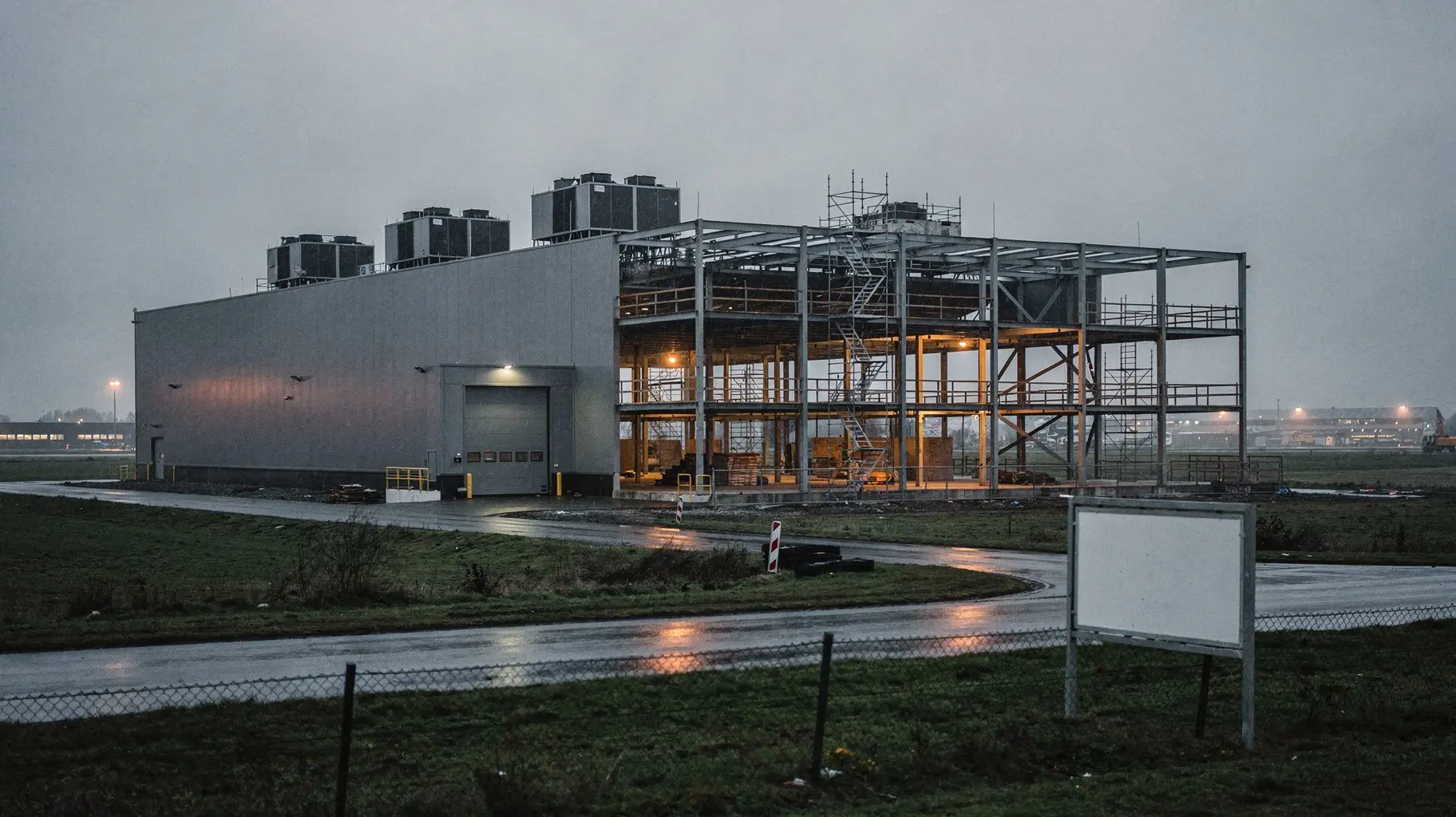
Rechenzentrum Haßfurt GmbH is not a shell. Its own imprint gives the operating address as Augsfelder Straße 6, 97437 Haßfurt, names Marco Firsching as managing director, and records the commercial register at Amtsgericht Bamberg under HRB 4159 (imprint). The city's participation report adds the corporate shape: share capital of 33,300 euros, founded on 1 April 2001, and a single holder — Städtische Betriebe Haßfurt GmbH, with 33,300 euros, or 100.0 per cent (Beteiligungsbericht 2022).
The registered purpose is broader than racks. It covers dedicated lines, internet access, hardware and software sales, webspace, email, server hosting and server housing. That list matters for reading the company correctly: this is a small regional service provider with a municipal shareholder, not a wholesale colocation platform, and nothing in the documents suggests otherwise.
The network layer is real and modest. A routing-toolkit snapshot for AS44973 records the autonomous system under the name RZHAS-AS, originating three prefixes — 93.88.224.0/22, 185.130.8.0/22 and 2a02:218::/29 — with a presence listed at DE-CIX Frankfurt (AS44973). Three prefixes and an exchange presence are the ordinary equipment of a regional hosting business. They establish that the company operates its own address space and its own routing; they establish nothing about how many kilowatts sit behind it.
The only technical number the operator prints
The company's homepage markets hosting, domains, housing, cloud and hybrid solutions, and describes the business as one of the region's leading hosting providers and IT service providers (rzhas.de). In the text read, it prints no floor area, no rack count, no installed load, no nominal connection power, no ratio, no cooling topology, no uninterruptible-power rating and no generator rating.
The terms and conditions are where the one number lives. In the operator's own words, a typical rental is
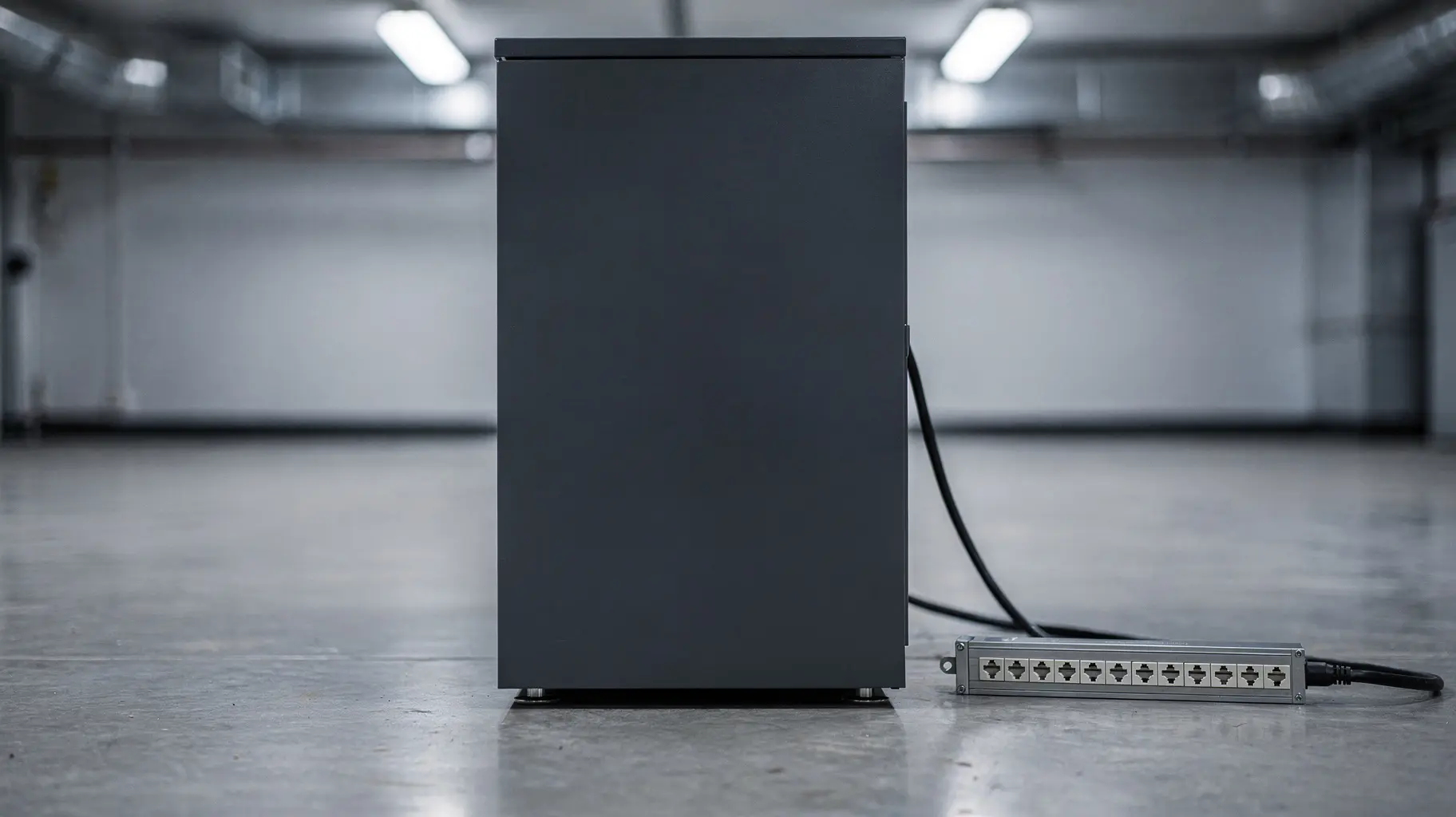
In der Regel handelt es sich hierbei um einen Serverschrank mit 42 Höheneinheiten, einer Steckdosenleiste (230V 16A) als Übergabepunkt und eine Netzwerkanbindung (ein Cat-5e Netzwerkkabel mit RJ45 Anschluss) mit 100 Mbit/s und öffentlichen IP-Adressen (IPv6-Subnetz der Größe /48). (AGB)
A 42-unit cabinet, a 230 V/16 A socket strip as the handover point, a 100 Mbit/s Cat-5e link, a /48 IPv6 subnet. The same terms say the operator provides cooling for customer IT systems and contracts for 99.5 per cent availability of the internet connection. That is a complete, honest description of what a customer buys. It is not a description of a building.
A third-party marketplace directory fills in the marketing vocabulary — rack space, shared racks, half racks, full racks, renewable electricity, a local microgrid design, redundant cooling — and prints none of the quantities either (directory copy). It is cited here as directory copy and nothing more; it is not the operator's technical disclosure, and it does not become one by being repeated.
An arithmetic I print in order to refuse it
Multiply the socket strip by nothing and you still have a socket strip. 230 V at 16 A is 3,680 W, or 3.68 kW, at one cabinet's socket. Divide the statutory threshold by that: 300 kW divided by 3.68 kW is about 81.5 cabinets. Both figures are mine, on two numbers the documents print, and both are useless as a measurement of this facility.
They are useless for three reasons that are worth naming, because each one is a way that readers mislead themselves about this statute. A cabinet's socket rating is not a load: nobody runs every circuit at its nameplate for a year. The statutory quantity includes building services, so a sum of customer sockets omits precisely the cooling and losses that make a facility's ratio what it is. And the rack count is not printed anywhere in the documents read, so the multiplication has no second factor to work with.
The arithmetic is printed here to show that it cannot be done from the published record, not to suggest what the answer would be.
The commission I brought here, and what the documents did with it
I reserved this subject on a thesis that the documents did not support, and the correction belongs in the text rather than in a footnote. The thesis was that a town-owned data-centre operator's civic mission and its commercial network footprint pull in different directions, and that running its own autonomous system and address space makes such a company a participant in address-market pressure.
Nothing I read supports a tension, a commercial conflict or any market participation. The company is wholly owned by the town's holding company, its purposes are ordinary regional hosting and connectivity services, and its routing footprint is three prefixes and an exchange presence. What the documents do support is a sharper and less moralistic question: this is a facility whose regulated status depends on one electrical figure that its operator is the only party able to state, and the public surface that would carry it is opt-in. The article follows that question instead.
What a reader can check without trusting the operator
Quite a lot, as long as the question is corporate rather than electrical. The name, address, managing director and register number come from the company's own imprint. The sole shareholder, the capital and the founding date come from the city's participation report. The autonomous system, the prefixes and the exchange presence come from a routing snapshot dated inside the retrieval window. The commercial handover point comes from the operator's own contract terms.
What a reader cannot check is the short list that decides everything else. There is no document in this set that states whether this facility sits above or below 300 kW of non-redundant nominal connection power. There is no floor area, no rack count, no installed load, no ratio. And because the register's per-facility layer depends on the operator's choice, a reader who wanted the annual figure would be relying on the measured party's decision to publish it.
One more absence belongs here, because it is the one most often assumed. No document read connects this site's heat to the municipal heat network of Haßfurt. The network exists and the corporate family is real, but the connection between the two is not in the record, so this article makes no waste-heat claim at all.
What the structural reading implies
The interpretive frame I bring to a control surface like this one is simple: ask who holds the number that makes an obligation real, and then watch whether the record of that number is produced by the same party. Here the answer is symmetrical to the point of elegance. The legislature holds the formal power to decide that a ceiling applies; the ministry's guidance holds the definition of the quantity; and the operator holds the figure, the meter, the ratio and the publication choice.
The reading that follows is mine, informed by a body of work on uniqueness coordination and the accountability of administrators, and it is a reading rather than a finding of fact. Where a regime's trigger, measurement and publication are all supplied by the measured party, the record stops being evidence of the world and becomes a statement about the operator. The remedy such a reading points to is not abolition but a thinner mandatory common layer: the trigger quantity and the ratio recorded in a shared, auditable register by default, so that publication tracks something a third party could check.
That is a design argument, and it is the reason this article spends its space on the definition rather than on the ceilings.
Boundaries
- The bounded absence in this article covers the documents read on 20 November 2026 between 09:54 and 10:02 UTC, listed in the sources, and is expressly not a claim that this operator publishes no such figure anywhere, or that no such figure exists in a filing, a customer offer or an unlinked page.
- The statute was read through the official single-provision pages of gesetze-im-internet.de; the consolidated PDF returned no readable text in this retrieval, so no sentence here rests on it.
- The 300 kW condition sits inside the statutory definition of the word, not in the ceiling provision: § 11 speaks only of "Rechenzentren". The reach of the ceilings follows from the definition and is reported as such.
- The network-node exclusion in the definition is reported as printed and is not applied to any facility in this article.
- No document read establishes whether this facility is above or below 300 kW of non-redundant nominal connection power; nothing here asserts either, and no size class is assigned to it.
- Nothing here alleges under-reporting, concealment or non-compliance by this operator or by any other. The subject is what a reader can verify, not who is at fault.
- The opt-in sentence is the register's own description of its publication surface. This article did not search the register for this operator's record; the absence of such a record from this reading is not evidence about the register.
- The composition of the non-redundant figure — IT load plus necessary building-services systems — is stated by the ministry's register guidance, not by the statutory text quoted here.
- The 230 V/16 A figure is a per-cabinet handover specification in the operator's contract terms, not a facility load and not a rated capacity.
- The conversion to 3,680 W and the division to about 81.5 cabinets are my arithmetic on two printed numbers, are labelled as mine, and are not a measurement of this facility.
- The autonomous-system and prefix facts come from a routing-toolkit snapshot within the stated window; routing data is mutable, and no BGP session, looking glass query or traffic measurement was run for this article.
- No waste-heat claim is made: no document read connects this site's heat to the Haßfurt network, and the network's own sources in the documents read are other installations.
- The share capital of 33,300 euros is a company-law quantity and nothing else: not a valuation, not revenue, not capacity and not a price.
- Readings drawn from the Lu Heng note corpus are interpretive and labelled as reading; the corpus records no official position for this subject, and the legal analysis here is not an official stance.
- The third-party directory entry is cited only as directory copy and is not treated as the operator's own technical disclosure.
- The structure of § 12's certification threshold is reported from the provision page's summary; its exact wording is not quoted here, and the quoted § 12 sentence is paragraph (1).
Member Briefing
Read the full trend briefing
Members read the full briefing with the source notes behind every finding.
Strategic Circle
A daily briefing in your language, built from changes we have verified.
Join for USD 20/monthCancel anytime.
Members also get the full research library, a daily briefing on the networks they follow and the private forum.