
Summary
- XCoffee first let Cambridge colleagues check a slow-changing coffee-pot image through a purpose-built client on their laboratory network.
- In November 1993, a Web-facing server let ordinary browsers request the latest still. That widened access without turning the camera into a video stream or replacing its local capture system.
A short walk became a small network problem
In late 1991, researchers in the University of Cambridge Computer Laboratory shared one coffee machine. Some worked several floors away. By the time they reached the corridor, colleagues closer to the pot might already have finished the fresh brew. A camera offered a modest fix: let people look before walking.
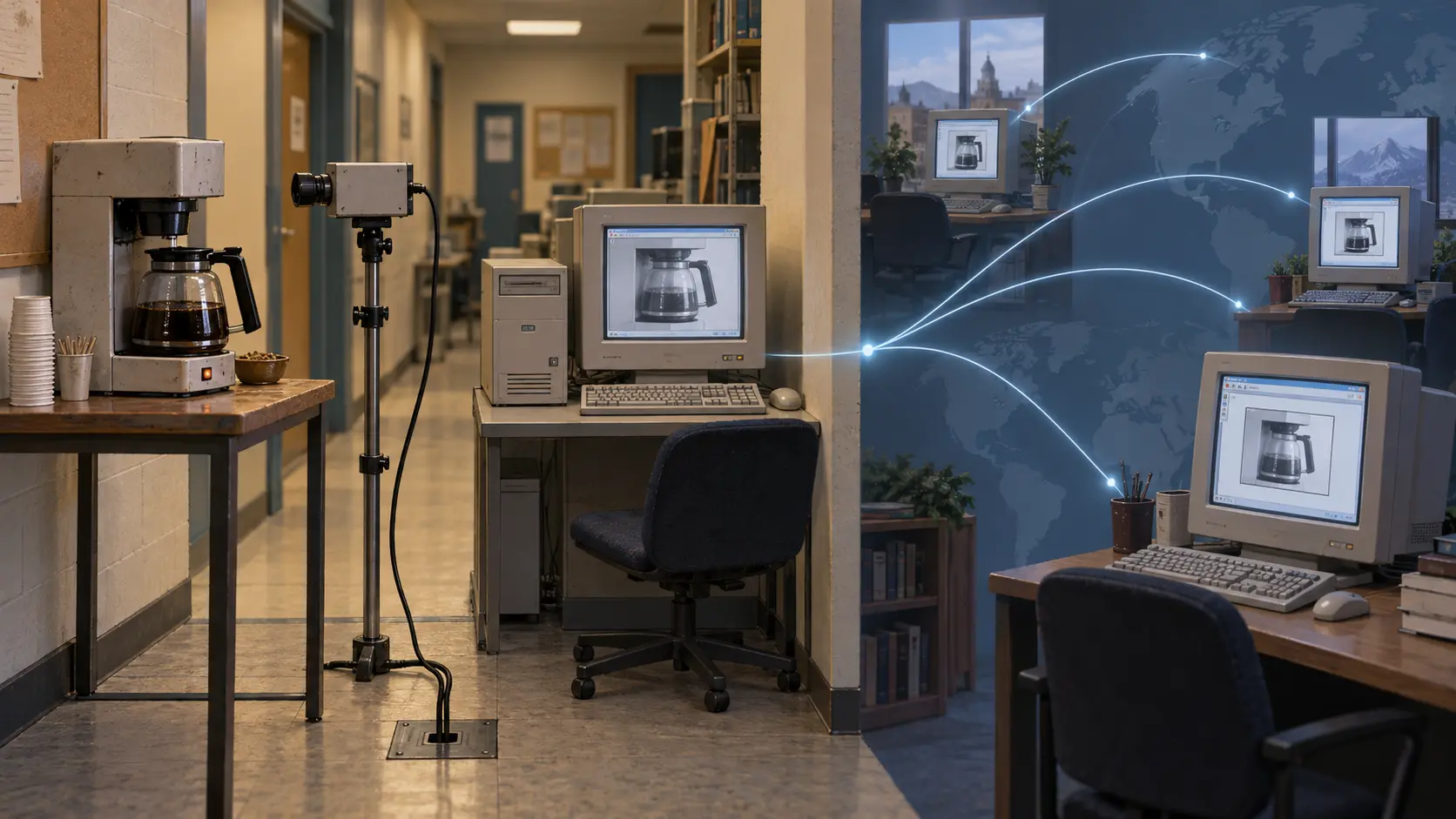
The first arrangement was not a website. A camera pointed at the pot sent its signal to a frame-grabber in the Trojan Room. A server captured stills every few seconds; a separate client displayed a small image on the researchers’ workstations. The image refreshed roughly three times a minute and was grayscale. Those limits suited the question the group needed to answer: was there coffee worth going downstairs for? Stafford-Fraser’s 1995 account describes the original setup and its practical purpose.
This first XCoffee system also belonged to a particular laboratory. Its users needed the client and the network that carried images between that client and the server. In his later technical account, Quentin Stafford-Fraser describes the software’s custom RPC protocols, the laboratory’s ATM network stack and networking hardware that the group had built largely for itself. The machine was a working local application, not a general camera service. The 2001 retrospective provides that architecture from a participant’s perspective.
The important change was at the other end
In 1993, Mosaic made it practical for a Web page to display an embedded image. That browser capability mattered, but it did not by itself publish the coffee pot. Cambridge’s timeline records that in November Dan Gordon modified the system to answer Web requests and, with Martyn Johnson, connected XCoffee to the Web. The university calls the result the first webcam. Its timeline places the browser change and the server conversion in the same sequence.
The shift was an interface change for viewers. Instead of installing XCoffee and joining the lab’s special network, a browser could request the image. The server could return a newer frame when the image was requested again. A useful local picture had acquired a standard Web route.
That route should not be mistaken for a live video feed. The sources describe a camera producing still frames and a server returning an image through a Web request. They do not describe continuous video, two-way communication with viewers or remote control of the camera. The “webcam” was a fresh photograph reached through a URL; the room, capture equipment and image-producing software remained at Cambridge.
The Web widened the audience, not the capture path
The distinction explains why the coffee pot became an early Web attraction. Anyone with a compatible browser could see the picture without receiving the custom client or understanding the laboratory’s ATM network. The viewing interface crossed a boundary that the camera itself did not cross. Stafford-Fraser later described the Web connection as making the image available to people around the world, while Cambridge’s timeline tracks image hits into the millions.
Those counters are not a census of people. A hit may reflect a reload, automated access or a visitor, and the published records do not supply a denominator for unique viewers. The sources also do not establish why particular people returned to the page. It is safer to say that the image drew sustained public attention than to convert a hit counter into an audience count.
A public URL could not maintain the machine
By 2001, the service’s limitation was no longer who could view it. Stafford-Fraser wrote that most of the old equipment still ran the system, that it had become the university’s only remaining segment of the network and that maintenance was getting harder. When the Computer Laboratory moved to a new building, the camera lost the room that had anchored its setup. Cambridge’s timeline records its final image and switch-off at 10:54 on 22 August 2001. The 2001 account and the timeline establish the stated maintenance and relocation context.
The service’s arc therefore had two different kinds of reach. HTTP let an ordinary browser reach the image. It did not make the local camera chain easy to replace, fund or move. A public endpoint can survive many viewers yet remain dependent on a very small system behind it.
Sources and limits
The principal evidence is Cambridge’s chronology, Stafford-Fraser’s 1995 biography and his 2001 technical retrospective. The preserved service page documents a later capture path; its exact frame rate and encoding should not be projected backward onto the earliest XCoffee versions.
The “first webcam” description is Cambridge’s own historical claim. The available accounts are participant recollections and institutional records, not a complete packet trace, server log or independent survey of every earlier network camera. They do not establish a unique visitor total, maintenance budget, privacy complaint record or a complete archive of the images.
Member Briefing
Deeper Profile Context
Sign in with the right membership level to unlock the full briefing and source notes.
Only for Strategic Circle
Strategic Circle
Open to all readers. Unlock profile briefings after joining and signing in.
Join Strategic CircleOnly for Leadership Alliance
Leadership Alliance
For qualified IP-asset owners and management; sign in to unlock alliance briefings.
Join Leadership Alliance