Summary
- NVIDIA reported US$279 billion of supply and capacity commitments at 26 July 2026, up from US$119 billion one quarter earlier. US$267 billion falls in the remainder of fiscal 2027 through fiscal 2029.
- The commitments primarily reserve memory and manufacturing facilities for data-centre systems. They are not current inventory, debt, capital expenditure or guaranteed revenue, and some arrangements may be changed before firm orders at an additional cost.
- Q2 revenue of US$96.2 billion, 75% gross margin and US$74.4 billion of first-half operating cash are strong counterevidence to a present liquidity problem. Inventory provisions and earlier H20/H200 charges show that timing, policy and architecture risk still have a price.
- The decisive conversion is not supplier output alone. Components must become usable Blackwell and Rubin systems, reach powered facilities, be accepted by concentrated customers and turn into collected cash before the demand cycle changes.
NVIDIA has placed a number on the industrial scale of its AI wager: US$279 billion.
That was the company’s supply and capacity commitment at 26 July, according to its fiscal-Q2 Form 10-Q. One quarter earlier, the figure was US$119 billion. The increase is US$160 billion, or about 134%, in three months.
The number needs a boundary before it needs a superlative. It is not US$279 billion already paid. It is not the inventory on NVIDIA’s balance sheet, the debt it has issued, its capital-expenditure budget or a backlog of customer orders. It is a schedule of future commitments made across suppliers and manufacturing capacity.
Most of the schedule arrives quickly. NVIDIA lists US$92 billion for the remainder of fiscal 2027, US$87 billion for 2028 and US$88 billion for 2029. Those three periods contain US$267 billion, about 96% of the total. Only US$12 billion sits in fiscal 2030 and beyond.
The market question is therefore not whether AI might require a large supply chain. It is whether NVIDIA can keep supplier capacity, product architecture, customer finance and physical data-centre delivery on the same clock.
A commitment is not the same as a purchase order
NVIDIA says the US$279 billion primarily covers memory and manufacturing facilities needed to produce data-centre infrastructure systems for current and future architectures. That description points to an upstream reservation of scarce industrial capacity, not a warehouse full of completed GPUs.
The contract perimeter matters. Suppliers may procure inventory against NVIDIA-defined criteria. In certain instances, the agreements can be cancelled, rescheduled or adjusted for business needs before NVIDIA places firm orders. Changes may create additional costs.
The filing does not quantify how much of the US$279 billion is firm, adjustable or conditional. It does not identify suppliers, unit prices, volumes, reservation payments or cancellation economics. Calling the whole amount non-cancellable would overstate the obligation; calling it a free option would ignore both the committed table and the cost of change.
The amount also belongs to one row in a wider US$366 billion commitment table. Cloud-service agreements add US$29 billion, data-centre leases not yet commenced add US$25 billion, equity investments add US$25 billion and capital expenditures add US$8 billion. Those categories have different counterparties and economic purposes. They should not be folded into the supply figure.
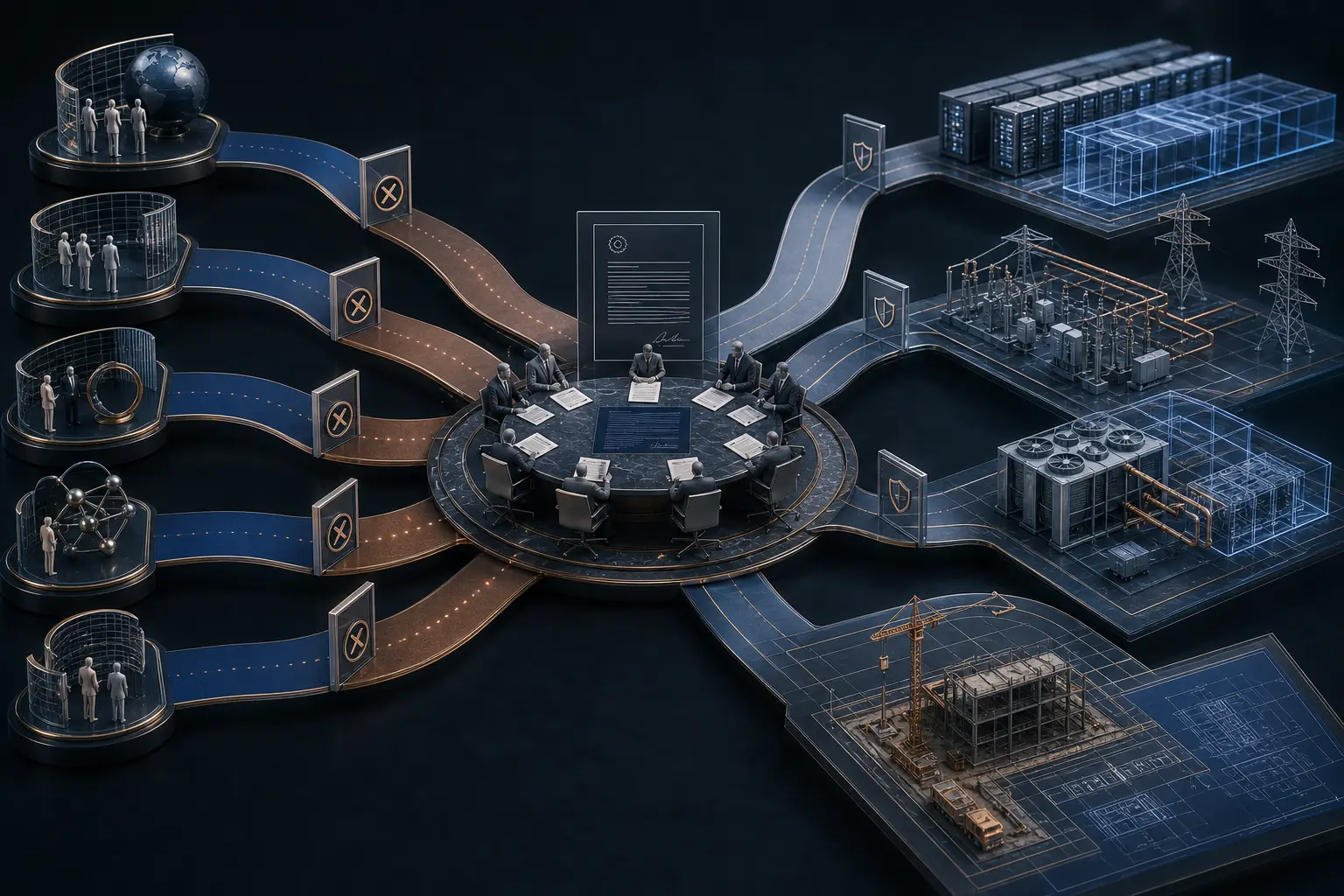
The distinction from NVIDIA’s Ohio guarantee is equally important. Credit support for land, power and shell at PORTS-Pike sits downstream, where a customer needs a functioning site. The US$279 billion sits upstream, where NVIDIA needs memory and manufacturing capacity. One supports deployment; the other supports production.
Current growth makes the reservation credible
The Q2 results provide a powerful case for securing supply. Revenue reached US$96.221 billion, up 106% from a year earlier. Data Center revenue was US$89.0 billion, up 117%, and GAAP gross margin was 75.0%.
NVIDIA guides to US$108 billion of Q3 revenue, plus or minus 2%, without assuming China Data Center compute revenue. Blackwell represented the majority of Q2 system shipments, while Vera Rubin began production shipments in fiscal Q3. Management says it will ship both architectures and is already experiencing selected supply constraints.
That is the positive mechanism. Reserved memory and factory capacity can prevent a scarce component from becoming the limiting factor just as a new architecture enters production. If demand, yields and system integration hold, an upstream commitment becomes faster delivery and revenue rather than idle capacity.
But guidance is not conversion. Customers still need land, power, shells, networking, cooling and capital. NVIDIA itself warns that customers may postpone a new architecture when deployment infrastructure is unavailable, financing is constrained or adoption is slower than expected.
The company can reserve an input. It cannot unilaterally make a customer’s substation ready, complete a building, approve a grid connection or produce the return that allows an AI cloud to keep spending.
Inventory shows where the clock has started
Inventory rose from US$21.403 billion at the January year-end to US$31.575 billion in July. The composition is more informative than the total.
Raw materials nearly tripled from US$3.807 billion to US$11.341 billion. Work in process increased from US$8.822 billion to US$13.377 billion. Finished goods fell from US$8.774 billion to US$6.857 billion.
That pattern is consistent with a production system carrying more early-stage material through a rapid architecture ramp. It does not prove every input will convert on time, but it also does not resemble a simple pile-up of completed systems waiting for buyers.
The cost boundary is already visible. NVIDIA recorded US$2.1 billion of first-half provisions for inventory and excess purchase obligations, while sales of previously reserved inventory and settlements released US$280 million. The net effect reduced first-half gross margin by one percentage point.
Export policy supplies a concrete failure case. The company recorded a US$0.4 billion H200 charge in the first half after demand diminished under US licensing and PRC restrictions. A year earlier, the first half included a US$4.5 billion H20 charge. A product can be technically ready and commercially wanted, yet regulation can still break the conversion path.
The US$279 billion commitment increases the importance of that lesson. A larger reservation improves access to supply, but it also enlarges the surface on which forecast error, yield loss, product transition or policy change can become a provision.
Cash strength does not settle the return
NVIDIA generated US$74.421 billion of operating cash in the first half. It held US$56.586 billion of cash, cash equivalents and marketable debt securities, plus US$42.783 billion of marketable equity securities, at quarter-end.
These figures argue strongly against describing the commitment as an immediate liquidity crisis. The company also issued US$25 billion of senior notes in June, with no commercial paper outstanding at quarter-end.
Capital allocation still matters. NVIDIA spent US$39.8 billion on share repurchases and US$6.3 billion on cash dividends in the same six months. Reserving supply, buying stock, paying dividends and making strategic investments all compete for financial flexibility, even when current cash generation is exceptional.
Working capital shows that customer funding is not one-directional. NVIDIA recorded US$15.6 billion of customer advances during the half and associated US$13.0 billion with recognized revenue. Separately, it may give investment-grade customers 90 days to one year to pay for large data-centre builds.
Accounts receivable used US$24.590 billion of first-half operating cash. The filing does not identify the advance counterparties or link them to customers receiving longer terms. The safe conclusion is narrower: NVIDIA can collect cash before delivery in some contracts and finance customer timing in others.
Concentration turns timing into bargaining power
One direct customer supplied 16% of Q2 revenue. Three direct customers supplied 16%, 15% and 13% of first-half revenue. Five direct customers represented 22%, 14%, 13%, 11% and 10% of quarter-end receivables.
This concentration does not prove weak demand. It shows that the conversion of a very large supplier commitment depends on a relatively small set of purchasing and payment decisions. A delay by one major customer can move shipment, acceptance, receivable and cash dates even if aggregate AI demand remains strong.
NVIDIA’s control is strongest before the order: it chooses architecture cadence, supplier criteria, capacity reservations and allocation. Control becomes shared after that. Suppliers control yields and delivery; integrators control completed systems; customers control acceptance and spending; utilities and authorities control physical readiness.
That is why the US$279 billion figure should be read as an industrial coordination position. It is evidence that NVIDIA is preparing for demand at extraordinary scale. It is not evidence that every required party has already synchronized.
Sources
Member Briefing
Deeper Profile Context
Sign in with the right membership level to unlock the full briefing and source notes.
Only for Strategic Circle
Strategic Circle
Open to all readers. Unlock profile briefings after joining and signing in.
Join Strategic CircleOnly for Leadership Alliance
Leadership Alliance
For qualified IP-asset owners and management; sign in to unlock alliance briefings.
Join Leadership Alliance