
Summary
- NVIDIA signed memorandums of understanding with Apollo, BlackRock, Blackstone, Brookfield, Goldman Sachs and KKR.
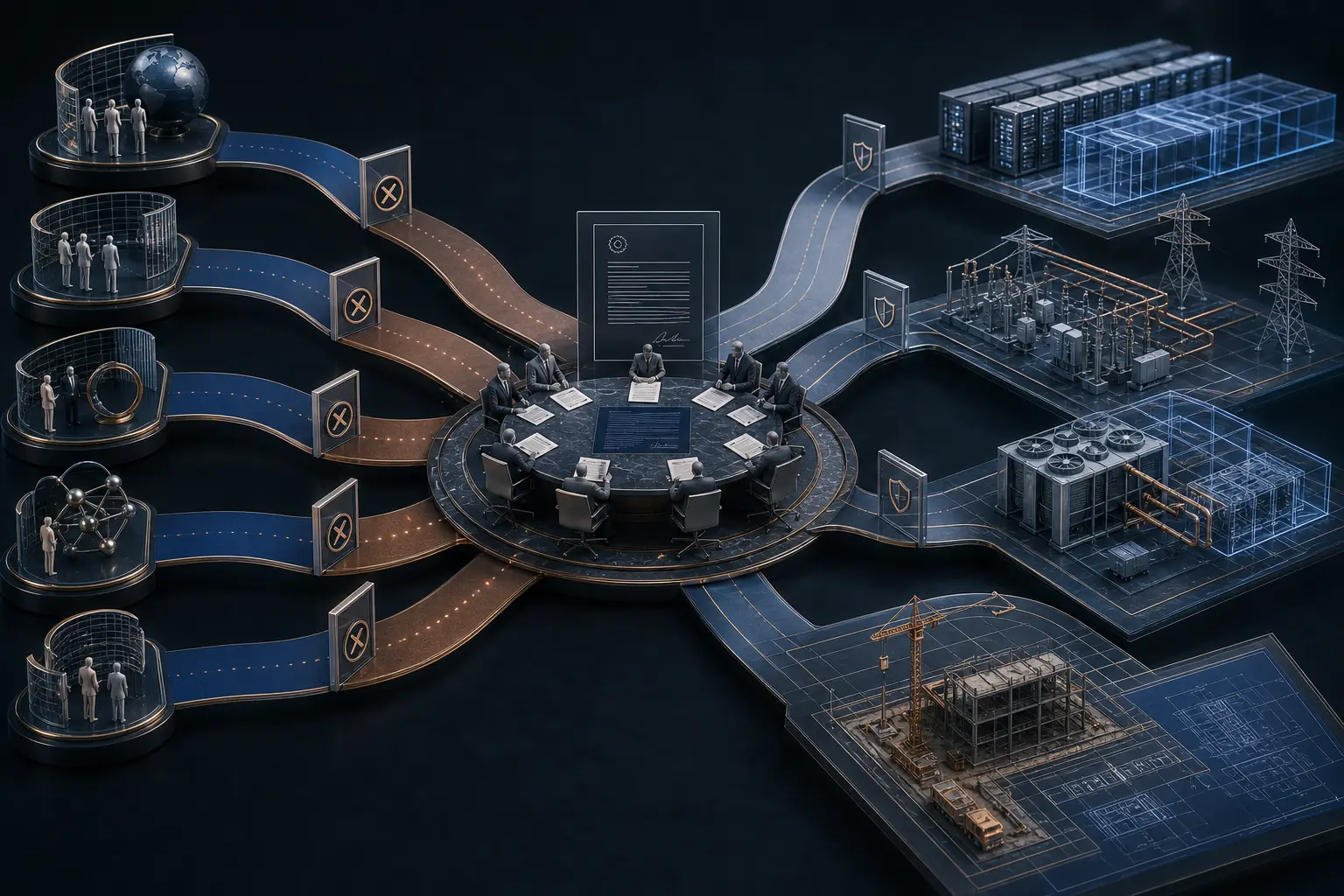
- The six relationships are intended to create independent compute-financing platforms, not one pooled fund managed by NVIDIA.
- NVIDIA says the platforms aim to mobilise more than $500 billion of third-party capital for AI infrastructure over time.
- The proposed pools would finance NVIDIA customers, including a wider ecosystem of AI labs, enterprises and AI clouds, but no beneficiary allocation is disclosed.
- The partnerships remain subject to execution of final agreements, and the announcement gives no rates, leverage, collateral tests, maturities or drawdown schedule.
- No project, site, GPU quantity, power reservation, energised capacity or occupied customer load accompanies the headline target.
Start with what the headline has not financed
More than $500 billion is a mobilisation objective. It is not cash already raised, NVIDIA revenue, NVIDIA balance-sheet spending or an approved portfolio of projects. The phrase “over time” also leaves the accumulation period open.
That boundary is essential because a capital target can precede legally committed vehicles, credit documentation and individual loans by several stages.
Six counterparties mean six underwriting decisions
Apollo, BlackRock, Blackstone, Brookfield, Goldman Sachs and KKR bring different pools of insurance, credit, infrastructure and institutional capital. NVIDIA describes the future platforms as independent. There is no disclosed common fund in which the full target sits.
Execution therefore depends on multiple investment committees, liability profiles and risk limits. Aggregating them creates a large headline, but it does not remove platform-by-platform underwriting.
Compute must become a financeable asset, not a slogan
NVIDIA argues that its systems are transferable, broadly used and economically prolonged by CUDA software. Those are promoter claims about asset quality, not audited loss, utilisation or residual-value data.
Lenders will still need to price equipment obsolescence, customer concentration, power availability, construction delay, remarketing, software dependency and the gap between contracted and actual utilisation.
Capital availability does not create sites or power
A financing vehicle can lower the cost or widen the supply of capital, but it cannot substitute for land, interconnection, permits, cooling, network routes, construction capacity or customer contracts. None of those denominators appears in the announcement.
The credible conversion chain is executed agreements, funded vehicles, named assets, committed borrowers, equipment orders, construction and then energised, occupied compute.
The customer benefit is still undefined
NVIDIA says dedicated capital pools would offer attractive rates to its customers. The release does not define attractive, identify eligible customers or say whether financing would take the form of secured debt, leases, project finance or another structure.
Without price, tenor and recourse terms, readers cannot assess whether the programme reduces customer capital cost or merely expands leverage around expensive assets.
NVIDIA gains demand support without disclosing direct funding
If the platforms materialise, they could help customers buy NVIDIA systems while allowing financial institutions to hold the credit or asset exposure. That aligns financing supply with the vendor’s ecosystem.
The announcement does not say NVIDIA guarantees loans, absorbs residual-value losses, contributes equity or commits purchase obligations. Any such risk transfer must wait for final agreements.
The first real denominator will be drawdown
Signed final documents will establish legal intent, but capital drawn against a named asset is the first measure that converts the target into financing. Delivery and energisation are later tests; customer utilisation and repayment performance come later still.
Until those stages are reported, the $500 billion figure should be monitored as an ambition across financing platforms, not counted as built AI infrastructure.
Sources
Member Briefing
Deeper Profile Context
Sign in with the right membership level to unlock the full briefing and source notes.
Only for Strategic Circle
Strategic Circle
Open to all readers. Unlock profile briefings after joining and signing in.
Join Strategic CircleOnly for Leadership Alliance
Leadership Alliance
For qualified IP-asset owners and management; sign in to unlock alliance briefings.
Join Leadership Alliance