
Summary
- Malta’s commercial Internet market had multiple providers from late 1995, but different local ISPs used separate international IP suppliers.
- A University of Malta announcement said that traffic between customers of different local ISPs therefore passed through routers and lines outside Malta, increasing cost and degrading performance.
- The Malta Internet Exchange (MIX) was introduced in 1999 as a neutral local IP backbone intended to connect providers while preserving a pluralistic market; the announcement is not proof of measured results or universal participation.
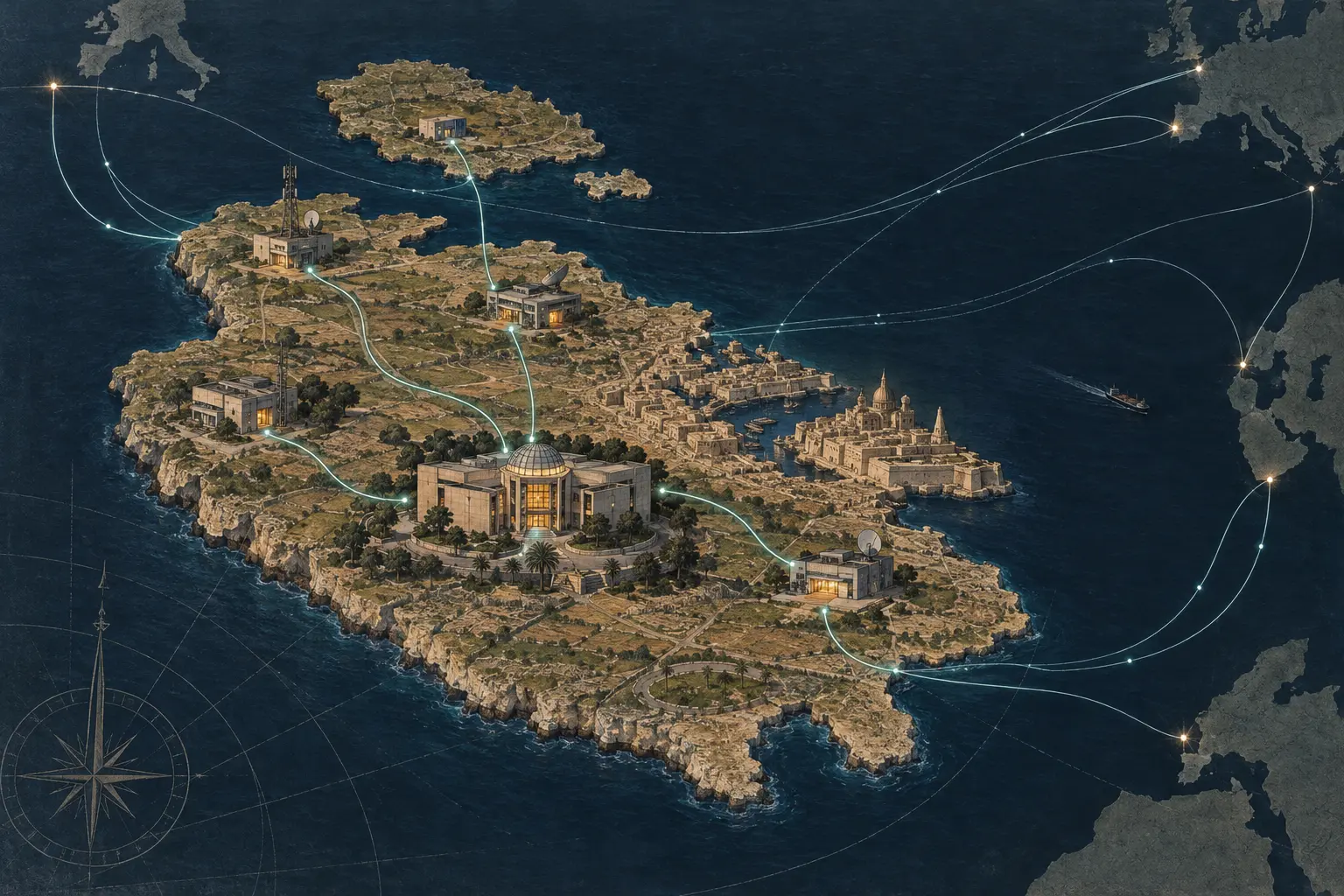
The route between two Maltese Internet users could leave Malta before returning. That was the problem the University of Malta described when it announced the Malta Internet Exchange on 7 September 1999. It said the country’s commercial Internet service had begun in late 1995 with several providers. They all relied on Telemalta’s physical infrastructure, but could choose their own international IP-service providers. Competition had created separate external routes without a common national backbone. University of Malta, “The Malta Internet Exchange” (1999)
The announcement’s diagnosis was specific: communication between users of different local ISPs had to pass through routers and lines outside the country. The University said that made local communication slower and more costly than direct connections between local providers would have been. This is a contemporary institutional account of the routing arrangement. It does not include packet traces, traffic totals, latency measurements, or a breakdown of which ISPs and destinations followed the detour. The evidence supports the existence of a perceived interconnection problem, not a quantified national performance penalty.
The proposed response was not to merge ISPs or assign every customer to one network. The Malta Internet Foundation, the University’s Computing Services Centre and the ISP subsection of the Chamber of Commerce collaborated on MIX. NIC(Malta), as the Foundation was also known, described itself as an independent nonprofit with a commercially neutral position. University staff were to provide operational and technical support, while participating ISPs supplied the link between their customers and the exchange. The design sought to add a domestic meeting point to a market that remained divided among competing providers.
MIX was announced as a national IP backbone connecting service and content providers. The 1999 release said it offered IP connectivity from 64 to 512 Kbit/s and that participating ISPs could obtain connections at stated rates. It also framed ISP participation as the condition for broad coverage. Those details document the announced service and its operating model; they do not show how many providers actually joined, how much traffic they exchanged, or whether the route became local for every Maltese customer.
The distinction between a backbone offer and a demonstrated routing outcome matters: a new exchange point only changes paths when networks connect to it and advertise or carry the relevant routes.
Institutional timing can otherwise make Malta’s Internet history look contradictory. A Mediterranean regional study lists 1994 as the year of Malta’s first Internet connection. The University’s 1999 account dates the start of commercial Internet provision to late 1995. The two claims concern different milestones: an initial connection and a commercial multi-provider market. NIC(Malta)’s own history places the University’s .mt delegation in 1992 and the Foundation’s formal inauguration in January 1999. Domain administration, an initial academic connection, retail service and an Internet exchange were related parts of Malta’s network history, but they were not the same institution or event. Mediterranean Internet study · NIC(Malta) institutional history
The exchange therefore addressed a boundary between local competition and local reachability. Telemalta’s shared physical network did not itself make independent IP networks exchange traffic locally. Nor did an ISP’s international connection guarantee efficient communication with another Maltese ISP. MIX proposed a place where the providers could interconnect without surrendering their separate customer relationships or upstream choices. The surviving press release records that proposal, its rationale and its technical offer. It does not establish adoption or performance. The historical lesson is narrower and more useful: an Internet market can be plural at the retail and transit layers while still needing shared local infrastructure to keep local paths local. A later Government of Malta programming document independently records Internet service provision beginning in 1995. Government of Malta, Single Programming Document
Member Briefing
Deeper Profile Context
Sign in with the right membership level to unlock the full briefing and source notes.
Only for Strategic Circle
Strategic Circle
Open to all readers. Unlock profile briefings after joining and signing in.
Join Strategic CircleOnly for Leadership Alliance
Leadership Alliance
For qualified IP-asset owners and management; sign in to unlock alliance briefings.
Join Leadership Alliance