Summary
- At a 10 January 1979 BBN meeting, ARPANET mail participants concluded that incompatible local extensions and partial implementations were damaging the shared service. They barred spaces in interhost user names and multiple
@signs in mailboxes, set aside generally unimplemented RFC 733 Include and Postal address types, and froze MAIL/MLFL FTP reply-code changes. - The working remedy was to stabilize the existing service under Duane Adams's arbitration while building a separate, structured next-generation mail system for voice, fax and graphics. Jon Postel recorded the meeting only on 1 March 1982; he says the missing documentation and unrevised specifications caused continuing trouble.
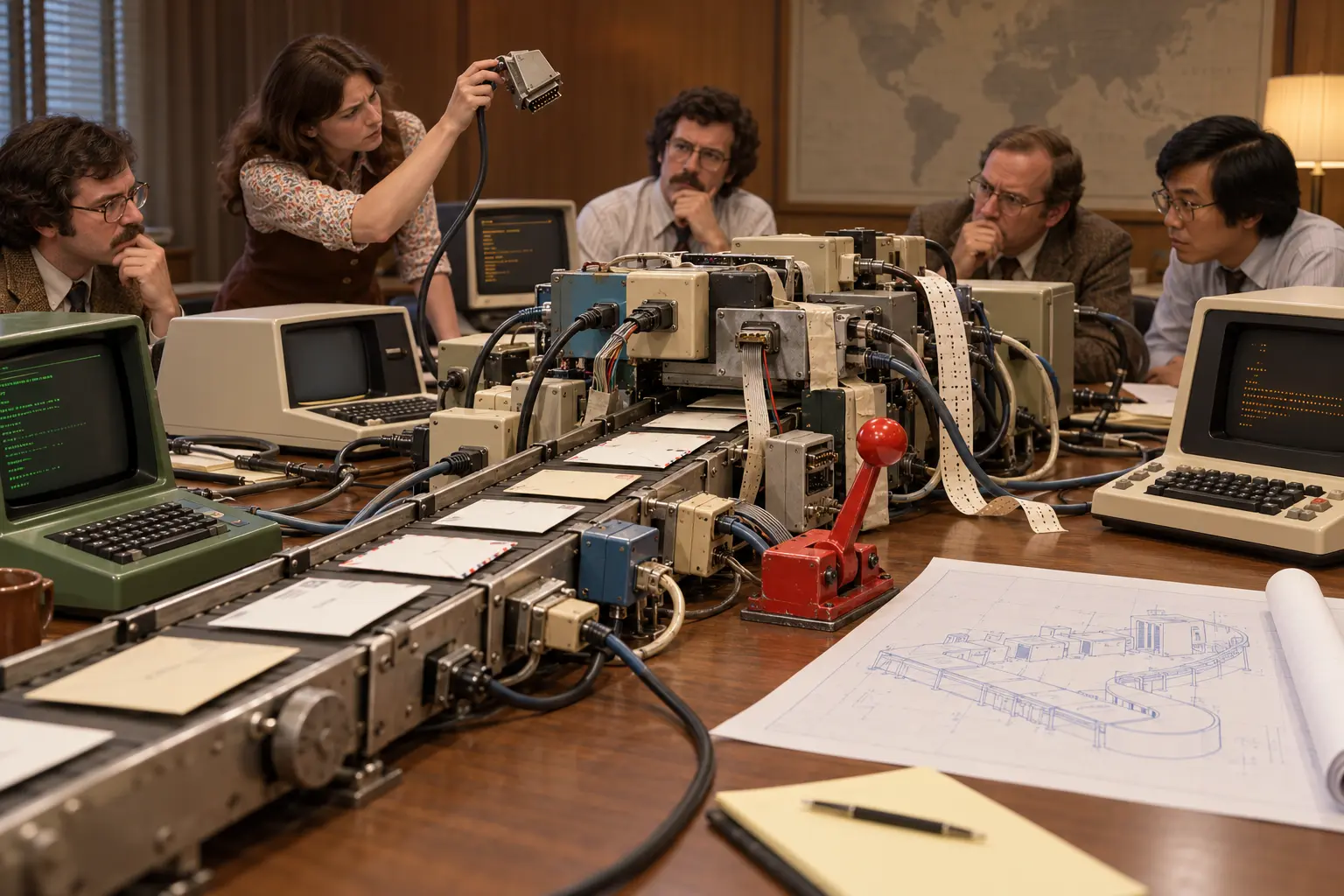
Imagine a common mail conveyor joining many computer rooms. Each room adds a clever attachment. One attachment works locally and jams the next room's sorter; another assumes a feature that the sorter never built. By January 1979, ARPANET mail had acquired enough such ingenuity for engineers to meet at BBN and consider pulling the stop lever. Jon Postel's RFC 808, issued three years later, records their choice. The conveyor is my picture of the system. The surprising part is in Postel's opening: the meeting reached important conclusions, but nobody documented them or revised the specifications at the time.
The old mail service was a patchwork of programs, often created because somebody needed them rather than as a formal research project. The meeting's preliminary appendix names many senders, readers, servers and delivery systems on different machines. Its purpose was not to count the entire network. It showed why a message that looked legal to one program could puzzle the next. Participants complained about host-table updates, odd FTP replies, address handling and the difference between an immediate “no such mailbox” and a rejection that came later. Their interest was the total message service, not just a handsome local user interface.
Postel's retrospective describes a damaging combination. The protocol allowed variations, and most systems implemented only part of it. A small change in one mail program could create an unexpected failure elsewhere. The group therefore chose to stabilize what already ran. A few minor changes could still be admitted; Duane Adams would decide disputed cases. The common service would not suddenly demand the full implementation of every RFC 733 feature just because the prose described it.
The prohibitions were wonderfully concrete. Do not send interhost mail with spaces in user names if that breaks existing programs. Do not put multiple @ signs in a mailbox. RFC 733's generally unimplemented Include and Postal address forms were decommitted. Changes to MAIL/MLFL FTP reply codes would stop. These were not aesthetic objections to adventurous punctuation. They marked the points where one sender's freedom turned into another site's broken mail. The standard had promised room that the deployed system could not safely occupy.
The freeze was paired with a different ambition. Several participants said more additions would amount to patches on patches and called for a version-two service. The meeting approved structured data for a next-generation mail system that could handle voice, fax and graphics. Jack Haverty pointed to RFC 713's MSDTP language as a possible way to define such a protocol. Postel was assigned a draft by 15 February 1979; his later note says it became IEN-85 in March and was superseded by RFCs 759 and 767. The live mail system got a smaller contract.
The experiments got room to think bigger without treating every half-built feature as a requirement for everyone else.
The next generation had other pressures besides pictures. Personal computers might be off when mail arrived. The meeting expected their users to keep mailboxes on larger, more continuously available machines and check them later. NSW users were not tied to one host, so the tidy user@host model missed their situation; Bob Thomas suggested thinking of NSW as a virtual host. Addressing, availability and forwarding were already pulling mail identity away from a single always-on terminal. Those were reasons to design a new service deliberately, rather than smuggle every new assumption into old software.
Then came the administrative irony. The meeting had decided that ambiguous permissions and partial implementations were hurting the service. Yet its own decision remained unwritten, and the specifications stayed unrevised. When Postel finally published RFC 808 on 1 March 1982, he called the account incomplete because three years had passed. He explicitly connected the documentation gap to continuing mail problems. A rule known in a meeting room but absent from the shared text could not reliably constrain a sender written elsewhere.
RFC 808 is memorable because its restraint was technical, not nostalgic. The participants wanted richer mail, but they separated experiments from the common service on which everyone depended. A sender's new syntax was not free if the next program could not parse it. A feature in a specification was not useful if most mail systems had never implemented it. And a freeze that lived only in people's memories left the conveyor exposed to the next well-meaning attachment. The most important patch in 1979 may have been the one they forgot to publish.
Member Briefing
Deeper Profile Context
Sign in with the right membership level to unlock the full briefing and source notes.
Only for Strategic Circle
Strategic Circle
Open to all readers. Unlock profile briefings after joining and signing in.
Join Strategic CircleOnly for Leadership Alliance
Leadership Alliance
For qualified IP-asset owners and management; sign in to unlock alliance briefings.
Join Leadership Alliance