Summary
- The gap was the interval
- Recurrence is evidence, not a verdict
The gap was the interval
APNIC 42 ran in Colombo from 28 September to 5 October 2016. Its presence mattered, but the public evidence does not support a simple origin story in which one regional conference directly created a national operator group. The stronger evidence is about cadence. In a 2017 account published by APNIC, then-LKNOG President Champika Wijayatunga wrote that in-country training and international events, including APNIC 42, had helped the local community. They were also too few and far between for growing demand.
That distinction explains the institution LKNOG said it was building. It was not presented as a substitute for APNIC or as a body with a national mandate. It was described as a non-commercial community initiative: a local and regional platform where operators could exchange technical knowledge, develop capacity and give local talent a stage. The missing asset was therefore not another exceptional week. It was a venue that could return.
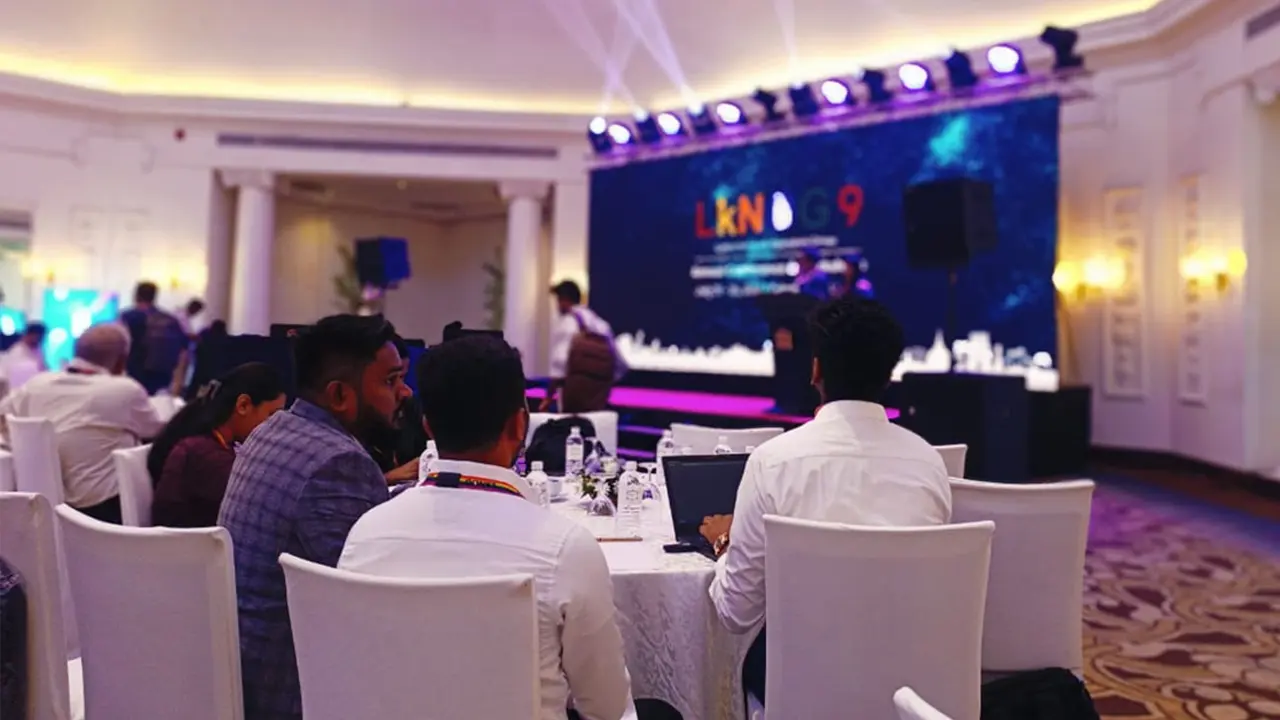
The first test came on 20 October 2017. LKNOG's inaugural conference at Colombo's Galle Face Hotel drew more than 100 people from internet service providers, telecommunications companies, universities, and public- and private-sector organisations. That turnout showed demand for a domestic forum. It did not show, by itself, that the forum would become an institution.
Recurrence supplies the next piece of evidence. LKNOG 2 ran across two days in November 2018 and again drew more than 100 attendees, combining talks with operational workshops. The official LKNOG 3 archive then shows a conference on 2 October 2019 followed by two workshop days; APNIC's event record counted 125 participants. Across three years, a one-day gathering became a repeat calendar with a larger practical-training surface.
That record is enough to say that LKNOG filled one part of the gap: Sri Lankan operators no longer had to wait for an occasional international event to have a locally organised forum. It is not enough to say who returned, whether the speaker base became more locally authored, or whether workshop lessons changed network operations. Attendance totals count presence, not institutional depth. The founding achievement was a cadence; the unresolved test is whether that cadence distributed authorship and produced traceable operational follow-through.
Recurrence is evidence, not a verdict
An annual sequence matters because it changes who can set the agenda. A regional conference arriving in Colombo can concentrate expertise for a week, but its location and timetable are regional decisions. A Sri Lankan forum can choose to return, select topics against local operating conditions and combine presentations with the practical work its organisers believe the community needs. LKNOG's first three editions show that this local scheduling capacity existed and persisted.
The format also became more substantial. The inaugural 2017 meeting was a one-day conference. The 2018 edition occupied two days and combined sessions with operational workshops. In 2019, the programme separated a conference day from two workshop days. APNIC recorded 33 participants in the RPKI workshop and 38 in the SDN tutorial. Those figures make the training surface visible. They do not establish that 71 different people attended, because the public report does not say whether the two groups overlapped.
The same restraint applies to the headline attendance counts. More than 100 people attended in 2017, more than 100 attended in 2018, and 125 attended in 2019. This is a consistent order of magnitude, not a retention series. Without participant-level continuity data, the figures could describe a stable returning core, three substantially different audiences, or a mixture of both. Each interpretation would say something different about whether LKNOG was accumulating a community or repeatedly assembling a crowd.
What the counts do prove is more modest and still important. The forum was not a launch-day artefact. It returned after its inaugural edition, continued in successive years and attracted enough participation to support both talks and hands-on sessions. That is institutional recurrence. It is not yet evidence of distributed ownership or operational effect.
Sources
Member Briefing
Deeper Profile Context
Sign in with the right membership level to unlock the full briefing and source notes.
Only for Strategic Circle
Strategic Circle
Open to all readers. Unlock profile briefings after joining and signing in.
Join Strategic CircleOnly for Leadership Alliance
Leadership Alliance
For qualified IP-asset owners and management; sign in to unlock alliance briefings.
Join Leadership Alliance