
Summary
- By 1993, NUL had a small dial-up UUCP email node. That was useful communication, but it was not a full Internet connection.
- A 1996 report put the online NUL host on a 9.6K terrestrial link to Bloemfontein; the university’s own update said campus distribution was still unfinished.
- By 1999, one reported Maseru cybercafé offered metered access. The route, campus network and public venue did not become operational at the same moment.
The first useful date in this record is not a national “Internet launch.” It is 12 May 1993, when a networking notice said a dial-up UUCP link had been set up to the National University of Lesotho (NUL) in Roma. The machine was a PC running UUPC, PMail and Snews. The notice warned correspondents that it was not a large multi-user platform. That is a precise description of an email service, not evidence that Lesotho could then reach the full Internet.
The distinction mattered three years later. In March 1996, NUL computer-services staff wrote that Lesotho still had no full Internet connection. They were working on a project document to persuade university management and other interested parties to support one. Their forecast was conditional: if the plan worked, full connectivity might arrive at the end of March or early April. A plan and an optimistic date are not an operating link.
On 16 December, Mike Jensen reported that thaba.nul.ls was finally online over a terrestrial link from Roma to Bloemfontein, roughly 30 kilometres from Maseru, at a reported 9.6K. He added that the name servers might not yet be synchronized. That small qualification captures the state of a connection: a host can become reachable before every supporting record has settled.
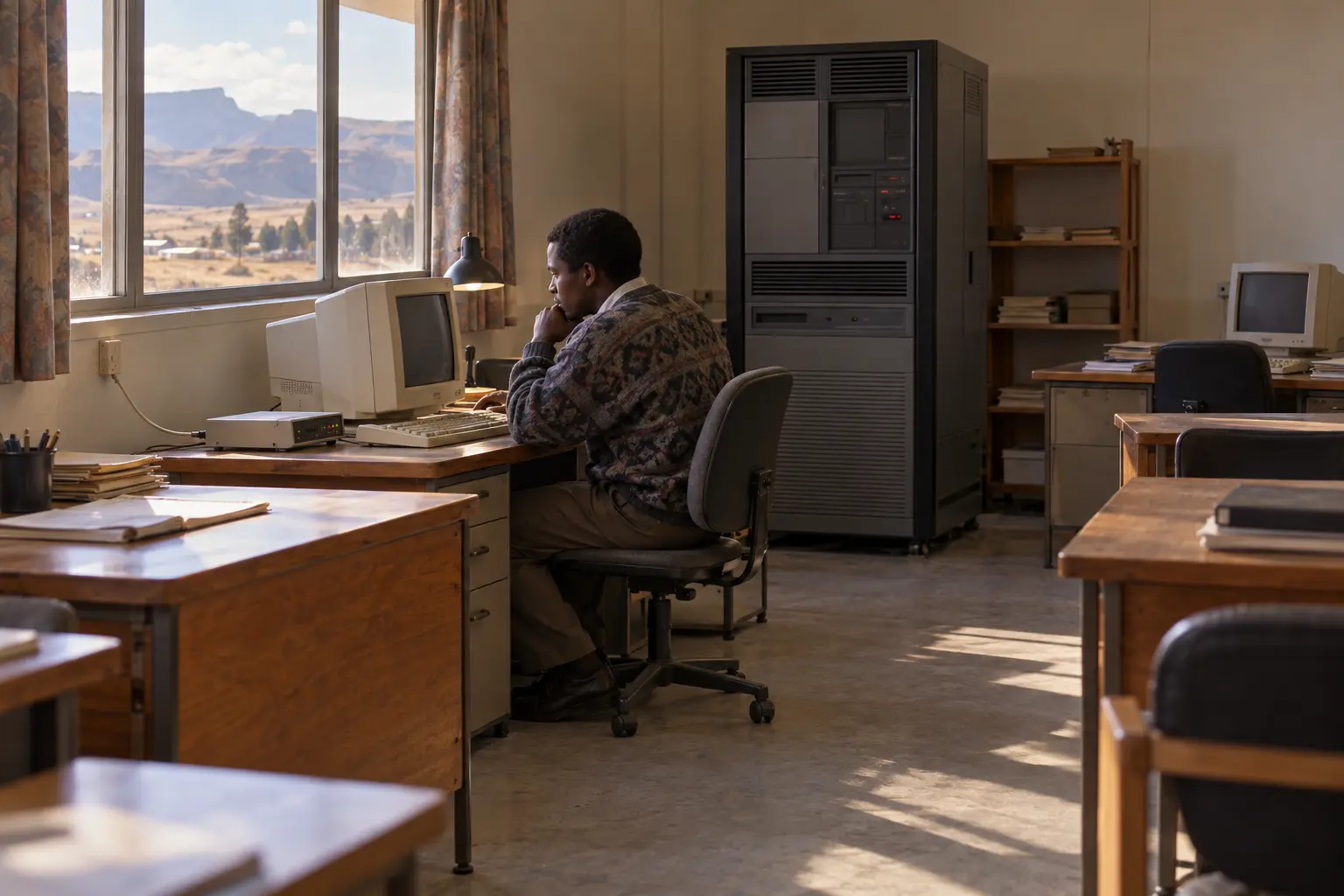
Two days later, NUL’s Computer Services Unit described the local side. A temporary ICL 486 running Linux was serving while the IBM mail server continued UUCP. The university had no campus network. Staff wanted to attach 14.4K modems to a Cisco 2511 so people across campus could dial in, but that arrangement was not working yet. NUL had a simple homepage, while the wider campus access plan remained prospective. The cross-border line, the host, the university’s internal distribution and a student’s working session were four different things.
A later NSRC provider record lists a 64K terrestrial Roma–Bloemfontein link and says it served the capital city. That entry was created in December 1996 and updated in August 1998. It does not say when the reported 9.6K became 64K, what upgrade occurred, or whether the two entries measured the same service at the same point. A clean chronology must keep the contemporary 9.6K report and later 64K snapshot side by side rather than invent an upgrade date.
The end-user picture was different again. A November 1999 Africanews report described one Internet café in Maseru with five computers. It charged R10 for 30 minutes online and R10 per month for an email mailbox. The café director estimated local people made up 15 to 20 percent of its customers; the journalist also quoted a teacher who used the café whenever she came to Maseru and a shopkeeper who said the required computer and connection remained unaffordable. Those accounts show how one venue mediated access. They do not measure the whole country or represent every user.
Lesotho’s early Internet is therefore best read as a chain of incomplete but meaningful services: email before full IP, a cross-border university link before a campus network, and a paid public venue before broad household access can be assumed. Calling all of this “connected in 1996” would erase which machine was online, who could reach it, and what still had to be built.
Sources
- F. Jacot Guillarmod, “Email to National University of Lesotho functional,” 12 May 1993, NSRC archive of the dial-up UUCP notice.
- NUL Computer Services, “SOS for Lesotho,” 11 March 1996, contemporaneous status and proposed project.
- Mike Jensen, “Lesotho on the Net,” 16 December 1996, contemporaneous Roma–Bloemfontein link report.
- Mariette van der Heijden, “Lesotho Update (12/96),” 18 December 1996, NUL server, campus network and modem status.
- NSRC, National University of Lesotho provider record, later 64K provider snapshot; update date is not a documented upgrade date.
- Thabo Motlamelle, Africanews, November 1999, reported the Maseru café’s access prices and user accounts.
- Lesotho Telecommunications Authority, 2004 Internet-service framework, later policy context only.
Member Briefing
Deeper Profile Context
Sign in with the right membership level to unlock the full briefing and source notes.
Only for Strategic Circle
Strategic Circle
Open to all readers. Unlock profile briefings after joining and signing in.
Join Strategic CircleOnly for Leadership Alliance
Leadership Alliance
For qualified IP-asset owners and management; sign in to unlock alliance briefings.
Join Leadership Alliance