
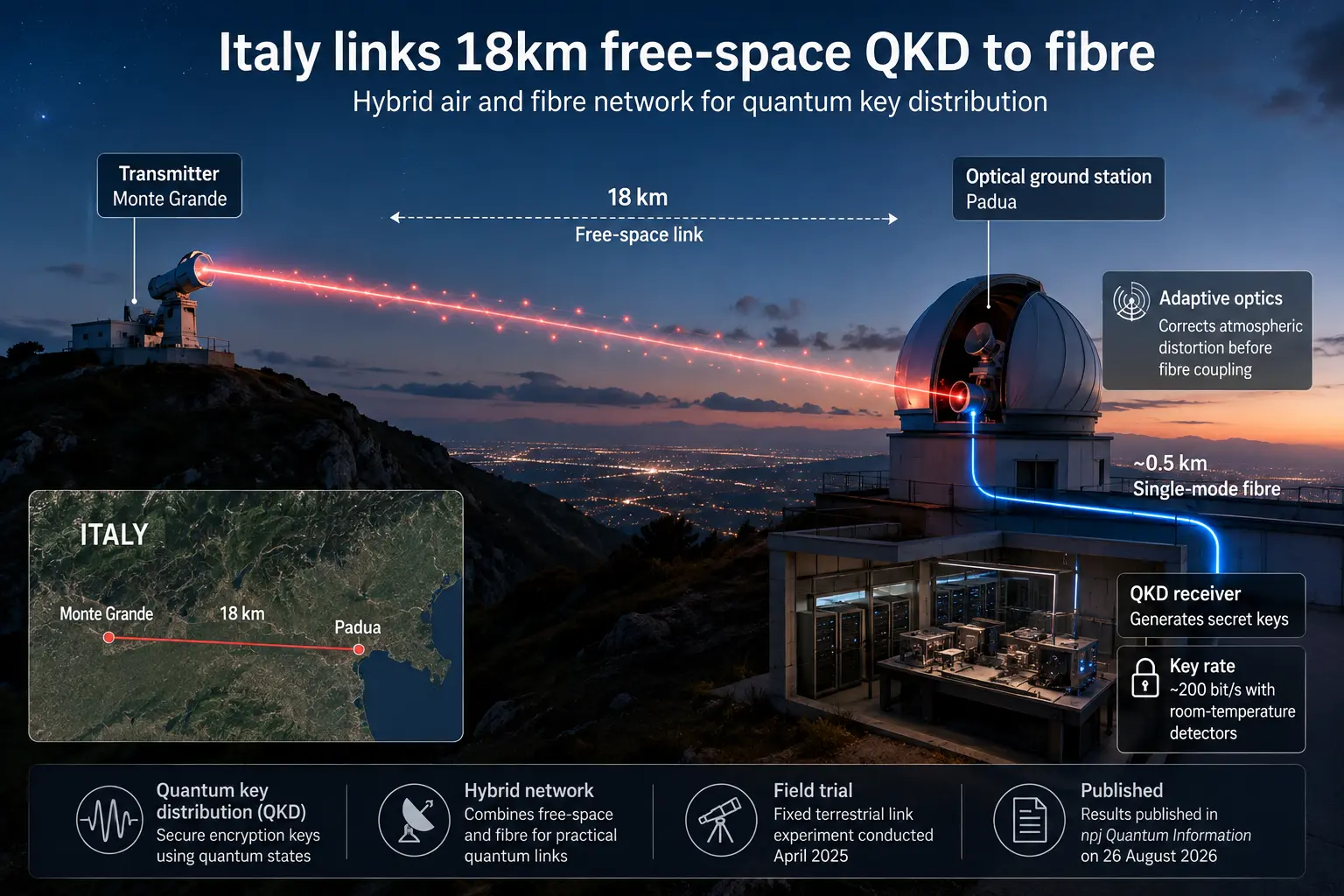
- Adaptive optics corrected atmospheric distortion before the quantum signal was coupled into single-mode fibre at an optical ground station in Padua
- The system generated secret keys at 200 bit/s with room-temperature detectors, but the experiment remains a fixed terrestrial field trial
The fact
Researchers from the University of Padua, ThinkQuantum, and Italy's National Research Council have demonstrated quantum key distribution across an 18-kilometre free-space link in northeastern Italy. The signal travelled from a remote terminal at Monte Grande to an optical ground station in Padua.
Atmospheric turbulence can distort an optical beam and make it difficult to couple into the narrow core of single-mode fibre. The researchers used adaptive optics at the receiving station to correct the incoming signal before sending it through fibre to the QKD receiver. The system generated secret keys at 200 bit/s using room-temperature detectors.
The peer-reviewed results were published in npj Quantum Information on 26 August. The experiment used a fixed terrestrial link rather than a moving satellite connection and was a field trial, not a commercial quantum network deployment.
The assessment
The difficult part of combining free-space and fibre QKD is not simply sending the signal over a long distance. At the receiving end, atmospheric turbulence changes the shape and position of the beam, while single-mode fibre accepts light through a very small core. Poor alignment can therefore reduce how much of the incoming signal reaches the fibre.
The Padua experiment shows that adaptive optics can correct that distortion well enough for an outdoor free-space link to feed a fibre-connected QKD receiver. It does not establish how well the same setup would perform with a moving satellite, during daytime turbulence or through changing weather, when tracking and alignment would be more demanding.
For BTW readers, the relevance is in that handover between air and fibre. A satellite QKD service would eventually need to move signals from a ground station into terrestrial networks. Repeating this result under changing conditions will matter more than simply extending the distance.
What to watch
Watch for trials using moving or satellite-based terminals, stronger atmospheric turbulence and daytime conditions. Sustained secret-key rates, automatic beam correction and reliable fibre coupling over repeated sessions would provide stronger evidence that the interface can support operational networks. Tests using deployed terrestrial fibre beyond the ground station would also move the architecture closer to real network conditions.
Member Briefing
Deeper Profile Context
Sign in with the right membership level to unlock the full briefing and source notes.
Only for Strategic Circle
Strategic Circle
Open to all readers. Unlock profile briefings after joining and signing in.
Join Strategic CircleOnly for Leadership Alliance
Leadership Alliance
For qualified IP-asset owners and management; sign in to unlock alliance briefings.
Join Leadership Alliance