Summary
- Ireland admits data-centre load by capacity band: at 1 MVA and above an applicant needs a credible plan for at least 80% of annual demand from additional Irish renewables within six years of energisation; at 10 MVA and above it needs new onsite or proximate dispatchable generation or storage at least matching maximum import capacity after de-rating.
- EirGrid's Version 3 process describes itself as first come, first served, then gives priority in a conflict to whichever applicant accepts first — inside a two-calendar-month window, with security due at signature and annual returns filed upward to the operator.
A data-centre campus in Ireland does not start with a planning permission. It starts with a connection offer, and that offer can be read like a contract because it largely is one. The interesting question is not whether the grid is tight. It is who holds the pen when a scarce position is handed out, and what record an outsider can check afterwards.
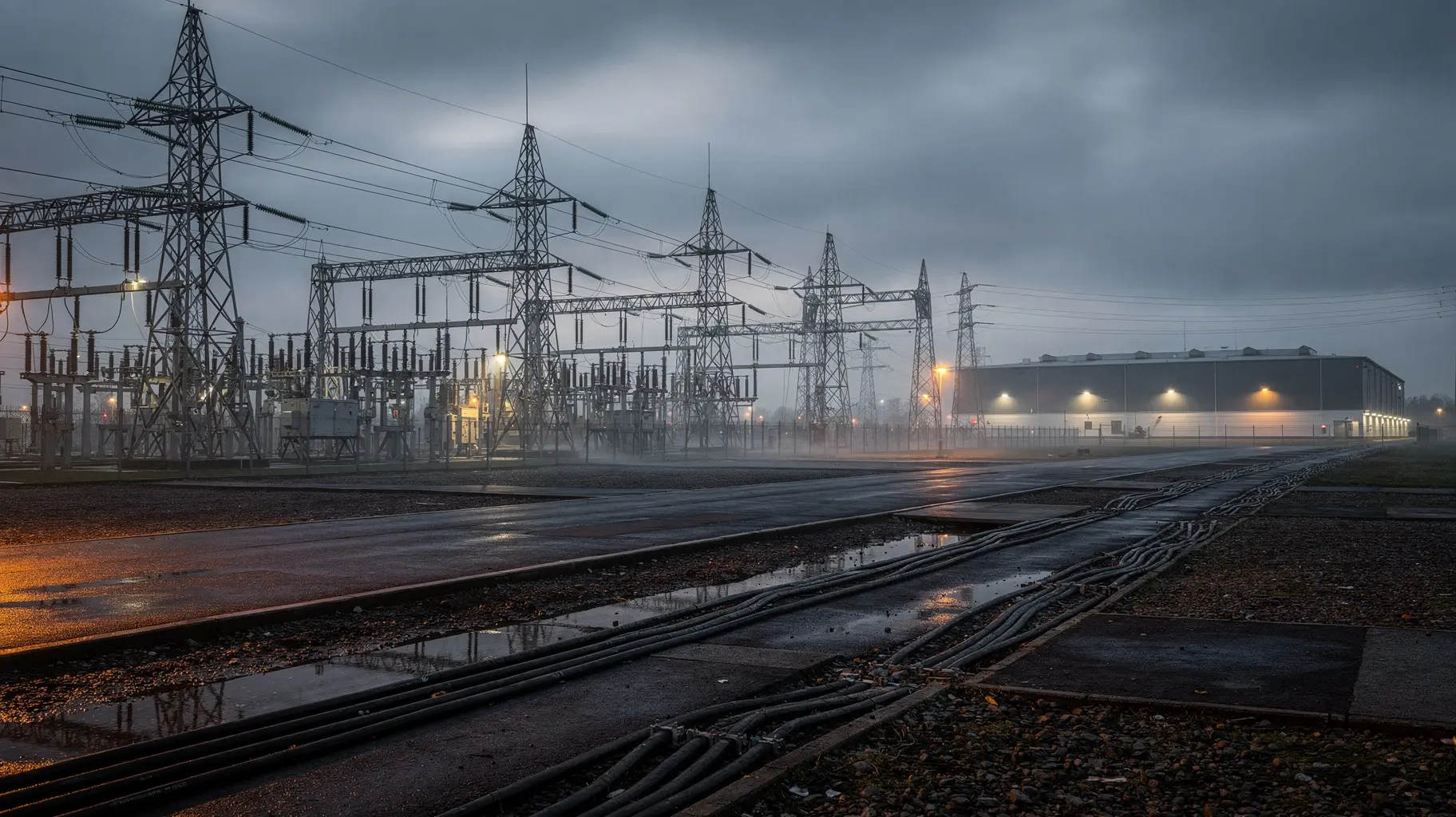
EirGrid is filed in this directory as the Irish transmission system operator (EirGrid, directory). The documents below are its process and the regulator's instructions to it. I read them on 13 November 2026.
The bands are written in megavolt-amperes
The Commission for Regulation of Utilities moved first on 23 November 2021. Its decision CRU/21/124 carries two direction letters dated the same day under section 34(1) of the Electricity Regulation Act 1999: one to EirGrid plc, reference D/21/25841, at Appendix 1, printed pages 39–40, and one to ESB Networks DAC, reference D/21/25842, at Appendix 2, printed pages 41–42 (CRU/21/124, decision).
The criteria it laid down for pending data-centre applications were not ranked. They asked whether the site sat in a constrained or an unconstrained part of the network; whether technically compliant onsite dispatchable generation and/or storage at least equal to demand was there; and whether the load could be reduced during system constraints, either through onsite assets or by switching demand off. Where the operator could not offer a connection consistent with system needs, the application terminated.
At publication those directions reached pending applications nationwide and stopped short of projects already connected or already contracted.
Four years later the bands became numbers. CRU/2025236, published 12 December 2025, states that it supersedes CRU/21/124, and its operative direction sits at section 6.2.1, printed pages 106–107 (CRU/2025236, decision paper). At a maximum import capacity of 1 MVA and above, an applicant must show a credible plan for at least 80% of annual demand to be met from additional renewable electricity generated in the Republic of Ireland, within six years of energisation. At 10 MVA and above, new onsite or proximate dispatchable generation and/or storage must at least match maximum import capacity after de-rating, be separately connected and metered, be capable of participating in wholesale markets, and meet the system operator's availability and technical requirements.
Two details matter more than the headline thresholds. First, a renewable contribution capped at 80% of annual demand can offset the dispatchable requirement on a de-rated basis, so the two obligations interact rather than stack. Second, generation need not sit exclusively onsite — the wording admits proximate plant. A developer reading only the summary would miss both.
And the refusal is explicit. Section 6.2.1, printed page 107, provides that failure of the assessment ends processing and terminates the application, with the system operator required to explain the refusal. Section 3.9.6, printed pages 89–90, preserves the older regime for applications already being processed when the decision was published.
The offer is a schedule of conditions
EirGrid's implementing document is Data Centre Connection Offer Process and Policy, reference IOO-CC-001-R3, dated 20 May 2026 — Version 3 (EirGrid DCCOPP V3). Section 1, printed page 8, applies the 2025 framework to new transmission-system data-centre applications at 1 MVA and above received on or after 12 December 2025, and keeps earlier applications on the 2021 rules.
What the offer contains is the part applicants should read twice. Section 3.3 and Table 7, printed page 20, list "MIC requested and any staged ramp up profile" among the terms, alongside generation and renewables, works, costs, payment schedules and milestones. The table also records a non-firm status attached to noncompliance. A staged ramp-up is not a formality: it means the capacity you are granted in year one may deliberately be less than the capacity the site was designed for.
Then the clock. Section 3.3 requires a signed agreement and conditions precedent within "two (2) calendar months" of issue. Where the offer names nominated generation, that generation accepts first. Without an agreed extension, a lapsed offer means reapplication and fresh fees.
Where two applications collide, the queue dissolves
Here is the sentence that reorganises everything above. Section 3.5.1, printed page 21, describes processing as first come, first served — and then grants priority in a conflict to the applicant who accepts first. Not the applicant who applied first. The one who signs first.
Run that against the two-month window and the practical picture changes. A contested position is decided by how fast a developer can convert an offer into an executed agreement with conditions precedent satisfied: planning clearance, an EPC arrangement, a financing package, and a security instrument. Section 2.9 and sections 3.3–3.4 place data-centre planning clearance before acceptance, which means the work has to be finished before the clock starts, not while it runs.
Speed becomes the allocation mechanism, and speed is not evenly distributed. The documents I read do not show any applicant being treated unequally, and I make no such finding. What they do show is that a rule described as chronological is not chronological in the case that matters.
What the security actually asks for
Section 4.3, printed page 23, requires MIC security at acceptance, plus connection-charge security by the Consents Issue Date where charges remain payable after that point. Bonds or alternatives are permitted.
Version 3 does not size the instrument. The only published formula I found sits in a much older template: EirGrid's General Conditions of Connection and Transmission Use of System, version 2.00, July 2013 (General Conditions, July 2013). Section 24.2.1, printed page 71, entitles the operator to draw down the specified amount under the MIC Bond where the customer terminates under clause 20. Sections 24.2.4–24.2.6, printed page 72, put the bond before execution as an acceptance precondition and give the formula as incremental MIC in MW multiplied by the monthly Demand Network Capacity Charge in euro per MW per month, multiplied by eighteen months. Section 24.12, printed page 77, allows a letter of credit, a qualifying guarantee, escrow cash or other acceptable deposit arrangements instead.
Two cautions on that formula. It is stated in MW, while CRU/2025236 and the Version 3 offer table state maximum import capacity in MVA; this article does not convert between them and assumes no power factor. And the July 2013 copy is not established as the instrument governing a 2026 offer, while the Demand Network Capacity Charge rate itself was not in front of me — so no euro exposure is asserted here.
One smaller number deserves separation from all of it. EirGrid's demand-connections page states that on submission of a complete application the customer should pay an instalment of €7,000 including VAT, with the balance depending on plant size and the CRU-approved Statement of Charges (EirGrid demand connections). That is an application-fee instalment. It is not a security, not a deposit and not a connection charge, and merging the two would misstate the risk a developer carries.
The returns travel one way
After energisation the obligations keep running. Section 2.2, printed pages 10–11, sets annual renewable reporting against a six-year glidepath; a shortfall permits reduction of maximum import capacity or termination, and missing reports themselves risk termination. Section 3.4 requires immediate notification where required generation is lost, with capacity reduced pending verified replacement and disconnection or termination risk on noncompliance. Section 3.2, in a footnote to printed page 18, bars reapplication for the same project for at least six months after an application is terminated.
Every reporting duty described in these documents runs from the customer to the operator. What I did not locate, in the five documents read on 13 November 2026, is any published return that would let a third party see how many offers were issued, how many were accepted, or how many maximum import capacities were cut. That is a statement about these instruments on that date. It is not proof that no publication, confidential regulatory return, audit or oversight channel exists, and it should not be read as one.
The absence still has a consequence. A developer, a lender or a competing jurisdiction's sales team can read the rule and cannot read the results. The rule says capacity is released conditionally and can be reduced. The record says nothing about how often that has happened.
The legal ground is not settled
Version 3's section 1 also records judicial-review proceedings concerning CRU/2025236 as at 20 May 2026 and warns that resulting changes could affect the process. My reading on 13 November 2026 established no later outcome, no stay and no amendment. Everything above describes the framework as published and administered at that date, not as finally adjudicated.
What this means if you are the one buying
The practical translation is blunt. An Irish connection offer is a conditional release of capacity, priced in conditions rather than in euros, and it must be re-earned every year of a six-year glidepath. It is not a settled entitlement, and it is not transferable by patience.
For a buyer of Irish compute capacity, the diligence question is not "is there a connection?" but "which cohort is this site in, what is the staged profile, and what milestones sit between signature and energisation?" For a lender, the question is what security has been posted and what triggers a drawdown. For a competitor pricing a site elsewhere, Ireland's real offer is not cheap power — it is a process that will terminate an application and then bar the same project from returning for six months.
The regulator designed the bands. The operator administers the gate, writes the offer, records the acceptance and receives the annual proof. That split is not a scandal; it is an ordinary division of labour between a rule-maker and a gatekeeper. But when the decisive event inside the gate is a signature timestamp, the accountability question stops being "was the criterion fair?" and becomes "can anyone outside the building see what happened?" On the documents I read, the answer to the second question is the unfinished part.
Member Briefing
Read the full trend briefing
Members read the full briefing with the source notes behind every finding.
Strategic Circle
A daily briefing in your language, built from changes we have verified.
Join for USD 20/monthCancel anytime.
Members also get the full research library, a daily briefing on the networks they follow and the private forum.