
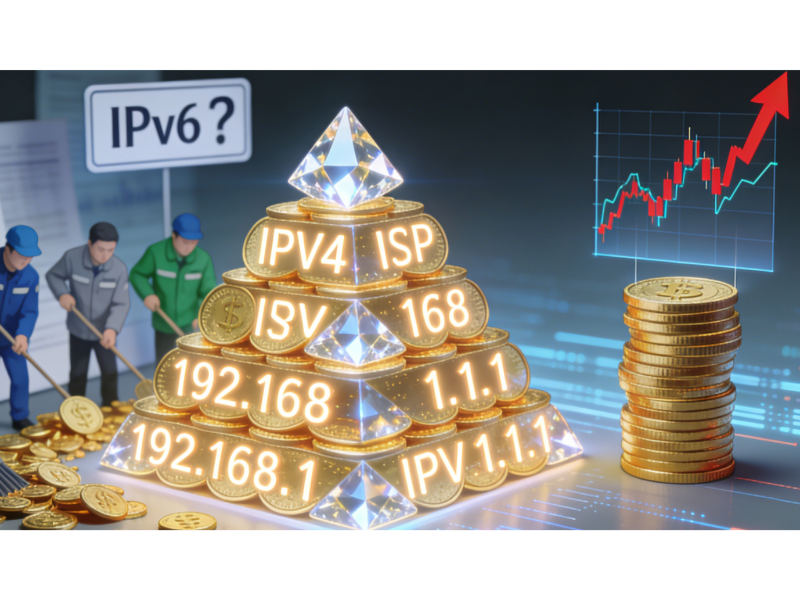
- IPv4 addresses have quietly become scarce capital assets, yet many internet service providers still treat them as routine infrastructure.
- Market, accounting and policy frictions raise questions about whether ISPs are undervaluing IP resources amid long-term uncertainty around IPv6.
‘IP Is Capital’: A Shift Many ISPs Have Not Fully Made
For decades, internet service providers viewed IP addresses as a basic technical input. They were allocated, deployed and rarely discussed beyond network engineering teams. That assumption no longer holds. The exhaustion of the IPv4 address pool has turned these numeric identifiers into scarce resources with measurable financial value. According to the Internet Assigned Numbers Authority, the global pool of unallocated IPv4 addresses was fully distributed by 2011, pushing scarcity down to the regional level and into secondary markets.
Despite this, many ISPs continue to manage IPv4 holdings as operational necessities rather than capital assets. Analysts argue that this mindset risks leaving value unrealised. IPv4 addresses can be sold, transferred or leased under regional internet registry policies, often at prices that rival other intangible assets on company balance sheets. Transactions over the past decade suggest that addresses can be monetised to fund network upgrades or offset rising infrastructure costs, yet disclosure around these holdings remains limited.
Also Read: IP address markets emerge as a new digital asset class
Also Read: What does ‘IP is capital’ really mean for internet addressing?
Markets, Monetisation and Missed Signals
The emergence of IPv4 transfer markets has been well documented. In North America, the American Registry for Internet Numbers permits address transfers without strict needs-based justification, helping to formalise trading activity. Europe and parts of Asia operate under more restrictive rules, shaping regional price differences and liquidity.
Specialist brokers and platforms now match buyers and sellers, while leasing arrangements allow address holders to generate recurring revenue. Some industry commentators have suggested that IPv4 behaves increasingly like a long-lived digital commodity rather than a consumable resource. However, financial reporting standards rarely require ISPs to value IP addresses explicitly, and many operators lack internal frameworks to track return on these assets.
There is also a strategic risk. ISPs that divest IPv4 space too aggressively may later face higher repurchase costs, while those that hold large unused blocks may attract scrutiny from regulators or peers questioning efficient use. The balance between monetisation and long-term operational resilience is still poorly defined.
Policy, IPv6 and the Limits of the Opportunity
The growing recognition of IP addresses as capital comes with caveats. IPv6, which offers a vastly larger address space, is designed to remove scarcity altogether. Major content platforms and mobile networks have made progress on IPv6 adoption, though global usage remains uneven. This raises a fundamental question: how durable is the IPv4 asset story?
Regional internet registries, including RIPE NCC, APNIC and LACNIC, have introduced transfer and policy frameworks to manage scarcity. While these systems add transparency, they also embed assumptions that IPv4 will retain long-term value. Critics argue that policy-driven markets risk reinforcing dependence on legacy protocols instead of accelerating transition.
For ISPs, the opportunity may therefore be time-bound. Treating IP addresses as capital could unlock short-term financial flexibility, but it also demands clearer governance, disclosure and strategic discipline. Whether IPv4 proves to be a once-in-a-lifetime asset or a transitional anomaly will depend on how quickly networks, regulators and customers move beyond scarcity.