Summary
- Internet Neutral Exchange Association Company Limited by Guarantee publishes full and associate membership at EUR 1,000 a year and Dublin port charges of EUR 2,400, EUR 11,400 and EUR 34,200 for 10Gb, 100Gb and 400Gb, valid until 31 December 2026.
- The constitution adopted on 11 December 2025 gives the board of directors the fee power in Article 13 and a discretionary power to waive or reduce fees in Article 14, so the printed rate is the beginning of an invoice and not the amount on it.
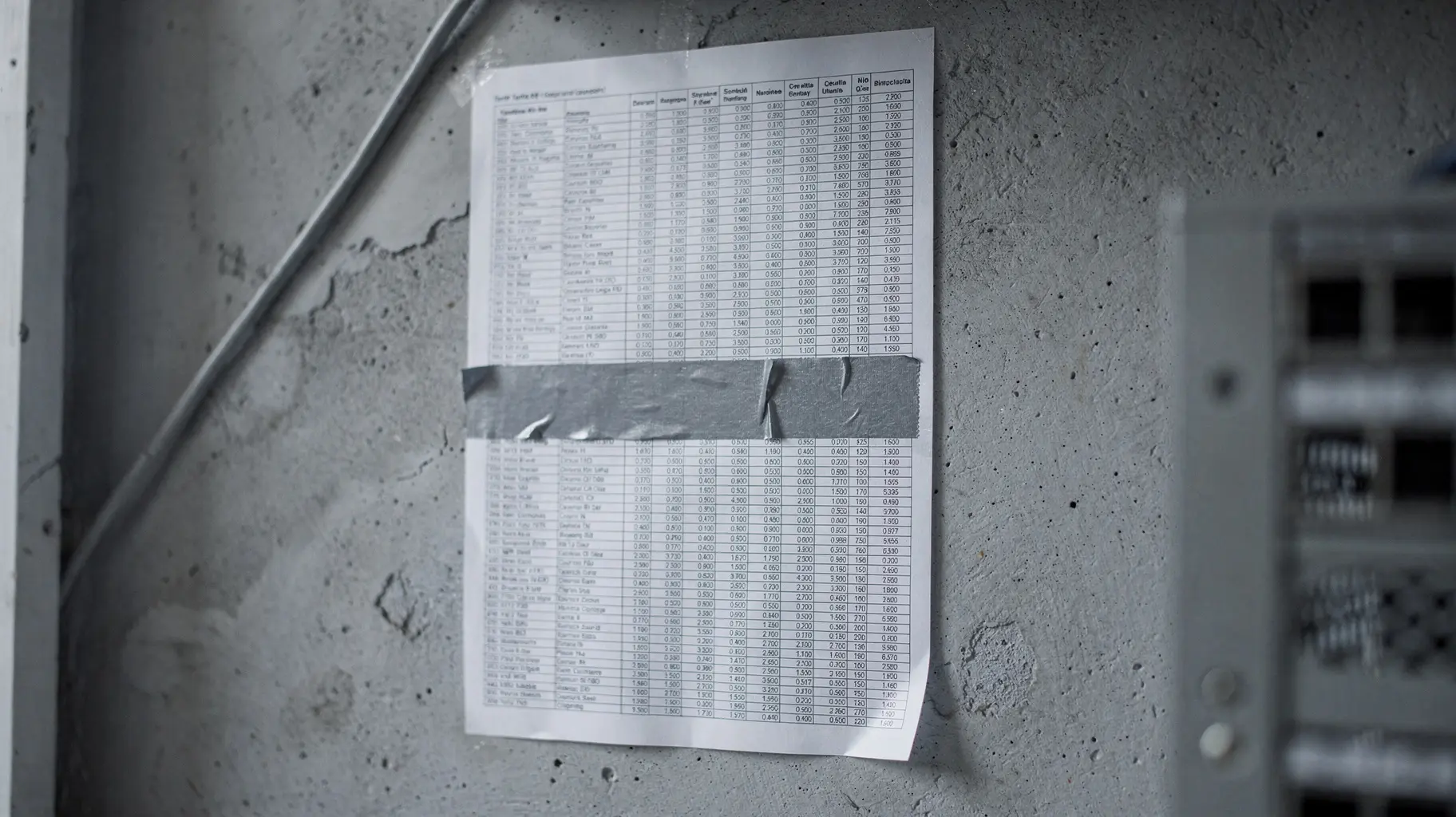
The price list is short and it is not shy. Full membership, EUR 1,000 a year. Associate membership, the same. Joining, free. Then the ports: on Dublin's LAN1 and LAN2, 10Gb at EUR 2,400 annually, 100Gb at EUR 11,400, 400Gb at EUR 34,200. Cork prices 10Gb free and the first 100Gb port free, with further 100Gb ports at EUR 11,400 and no 400Gb offering at all. The page states that these charges are valid until 31 December 2026 and that VAT applies to Irish-based companies at the prevailing rate, which it does not print (INEX Price List).
Most of what a network needs in order to plan is on that page. What the network will actually be billed is not.
Who holds the pen
The authority sits in the constitution adopted by special resolution on 11 December 2025 (INEX Constitution). Its memorandum identifies a company limited by guarantee under Part 18 of the Companies Act 2014, with each member's guarantee on a winding-up fixed at EUR 1.27. There are no shareholders taking a residual margin from the port charges.
Article 13, on printed page 10, reads in the publisher's text: "Every member shall pay to the Company such fees as determined by the board of directors". Not the members in general meeting. The board.
The MoU says the same thing operationally. INEX describes itself there as member-owned, limited by guarantee, without shareholders and not-for-profit, and states that the board determines setup and annual fees, publishes them in the membership-fee schedule and reviews them to cover projected costs. In the page's own words: "The fees will be reviewed at least once a year by the board of directors" (INEX MoU). Midyear joiners are prorated from the start of the joining month; existing members pay within 30 days of the due date.
That is a coherent design for a cost-recovery association. It is also a design in which the people who pay the fee do not vote the fee. A member-owned exchange is not the same as a member-priced one, and the difference between the two is the whole of this story.
There is a threshold, just not at the point a buyer would look for it. Article 9 lets supplementary MoU terms on fees and services be made without amending the constitution, but requires a Special Majority for them: at least 75% of eligible directors present, including alternates. So the number that carries fee terms needs three-quarters of the room, not half of it — a directors' threshold, not a members' one.
The free port has a condition attached
The Dublin sheet carries a discount that is easy to misread as an entitlement. The first LAN2 10Gb port is free — when it is held together with a matching-or-faster port on LAN1. The free port is not a standalone gift; it is the second half of a purchase, and it only exists if a faster or equal port already exists next to it. A network that wants one cheap port has to buy a dearer one first.
Cork is more generous on its face: 10Gb free, and the first 100Gb port free. Then the same page does something odd. A second table, the miscellaneous one, lists Cork 100G at EUR 11,400 without repeating the first-port waiver that the port table grants (INEX Price List).
I am not going to resolve that into a rule the document does not state. Two tables on one page treat the same Cork 100Gb port differently: one waives it, one prices it. A buyer pricing a second site in Cork has to ask which line governs, and the page as published does not answer.
Four times the speed, three times the money
Here is what the Dublin column does when divided out. The arithmetic is mine, on the publisher's printed rates, and it is not a published rate change.
EUR 34,200 divided by EUR 11,400 is exactly 3. A 400Gb port carries four times the speed of a 100Gb port and costs three times as much. Per gigabit per year, that is EUR 85.50 at 400Gb against EUR 114 at 100Gb — the larger port's unit rate is exactly 25% lower.
At the small end it runs the other way. EUR 2,400 for a 10Gb port is EUR 240 per gigabit per year, which is above the 100Gb unit rate and 2.8 times the 400Gb unit rate. And the annual membership charge of EUR 1,000 is 8.8% of a single Dublin 10Gb port charge.
So the rate card rewards capacity. The largest port is the cheapest capacity per gigabit and the smallest port is the most expensive, by a factor of nearly three. For a small Irish network deciding how much port to hold, the tariff itself is an argument for buying bigger than it currently needs — which is exactly what a capacity-based price schedule is designed to do.
The discretion that is not on the sheet
Article 14 permits the board of directors to waive or reduce members' fees at its discretion. The price list, for its part, publishes one rate per speed and carries no discount schedule.
A discretion is not a schedule, so there is no contradiction here. There is a gap, and it is the gap that matters to a buyer. The published page tells you the rate. The constitution tells you that the rate can be moved for a member by a board decision that is not published anywhere I read. Nothing in the documents establishes that a waiver has ever been granted or refused — and nothing in them would show it if one had been.
That is the difference between a tariff and a price. A tariff is what the seller charges. A price is what this buyer pays.
What the charging rule used to say
INEX also publishes an older memorandum and articles, a file labelled October 2016 (INEX Memorandum and Articles of Association, 2016 file). It is not the current constitution — the live MoU links the December 2025 text, not this one — and its article numbering is not today's numbering. I am reading it for one thing only: what the charging rule used to permit.
Article 8(B) assigned recurring membership charges to the Committee, and permitted rates to vary "according to the capacity of connectivity to the Company's switch(es) required by the Member". That is the ancestor of the column above: charge by the capacity of the port, not by the member.
And the older waiver rule was stricter than today's. In the 2016 text, a waiver or reduction required circumstances agreed in unison by all Committee members. The current Article 14 requires no unanimity at all; it requires a board exercising discretion. That is a change in the text between two documents published by the same association. What it has meant in practice is not established by either.
The directors are directors
The board page adds a fact that is easy to skip. All INEX board members are company directors under Irish company law, and they participate individually rather than as representatives of their employers (INEX Board of Directors).
That sentence matters precisely because the members here are the networks buying the ports. A person elected from a member company does not sit as that company's delegate when the fee question comes up. The page is undated and I did not check appointments against registry filings, so I am reporting what it states, not certifying who sits where.
Two kinds of member, one price
Associate membership costs the same EUR 1,000 and buys something different. It is aimed at organisations involved in IP and networking that do not have their own traffic to peer — fibre wholesalers, colocation and hosting facilities, technology suppliers, public-service organisations — and it comes with member meetings, industry events and mailing groups rather than connectivity (Associate Membership). Associate membership does not include connectivity services at all.
The application forms page links separate Word documents labelled Membership Application Form and Associate Membership Application Form, and the footer carries the association's name and Irish registration number 253804 (Application Forms). I did not retrieve or inspect those files, so I make no claim about what they require.
About Us describes INEX as a neutral, not-for-profit, industry-owned association founded in 1996 providing IP peering facilities for its members, with membership open to organisations that can benefit from peering their traffic (About Us). The page is undated and I have not used its membership or deployment figures as current; the association's public profile is in the BTW directory.
What I did not read
The constitution is published by the association and its own date of publication is unstated; I did not check it against a certified copy at the Companies Registration Office. The price list has no printed start date, only an end. The 2016 file's October date comes from its filename. No board minutes, fee resolutions, waiver decisions, AGM papers or member notices were inspected, and no traffic, port count, member count, capacity, latency or uptime figure is asserted here, because none was in these documents.
I have not compared these rates with any other exchange's, so nothing below says whether EUR 34,200 is high or low for the market. No VAT amount is calculated and no currency converted.
What a buyer can actually plan on
A network sizing a peering plan in Ireland can read the rate and budget to it. Dublin 400Gb at EUR 34,200, 100Gb at EUR 11,400, 10Gb at EUR 2,400, membership at EUR 1,000, all holding to 31 December 2026. That is more published price than most interconnection products offer.
What the network cannot read is the amount it will be invoiced, because the board holds a waiver power that no published document schedules, and because two tables on one page disagree about a free port in Cork. Budget at the printed rate and the plan is sound. Assume the waiver and the plan is built on a decision that has not been made and would not be visible if it had.
Member Briefing
Read the full trend briefing
Members read the full briefing with the source notes behind every finding.
Strategic Circle
A daily briefing in your language, built from changes we have verified.
Join for USD 20/monthCancel anytime.
Members also get the full research library, a daily briefing on the networks they follow and the private forum.