Summary
- Launched in 2002, ICDL involved children in designing ways to find books by attributes including colour and feeling.
- Its later redesign put books at the centre of the screen and flattened category menus; a 36-child study found faster searches, alongside a stubborn paging problem.
A red book is a perfectly respectable thing to want. So is a scary one. An adult catalogue may prefer a title, an author or a carefully spelt subject, but the child has already supplied useful information. The International Children's Digital Library gave that information a button. In the early web's long argument over what a search should look like, this was an unusually cheerful intervention: perhaps the reader could keep the preference and the institution could do the adapting.
The project launched on 18 November 2002. The Library of Congress account describes a collaboration between the University of Maryland's Human-Computer Interaction Lab and Internet Archive, with seven children aged seven to eleven helping design the site. Feelings, characters and settings mattered to these young book hunters. The library contributed digitised public-domain books, while the project assembled a collection from several countries. Reading across borders began with the smaller business of finding something worth opening.
First, get through the door
The first door was heavier than intended. In their initial-use report, the researchers calculated that only 12% of website visitors during the first seven weeks successfully ran the library software. Those logs covered visitors of unknown ages. The authors pointed to demanding requirements: a fast connection, 250 MB of memory, Java and Java Web Start. They began developing an HTML-only alternative after requests for easier access.
An international library had arrived with an installation chore. That mattered to the whole proposition. The server could hold an inviting book while the reader's machine remained outside the conversation. A service budget therefore had two jobs: bring books online and make the route to them tolerable. Attractive screens could consume effort on both sides of that ledger.
Please stop hiding the books
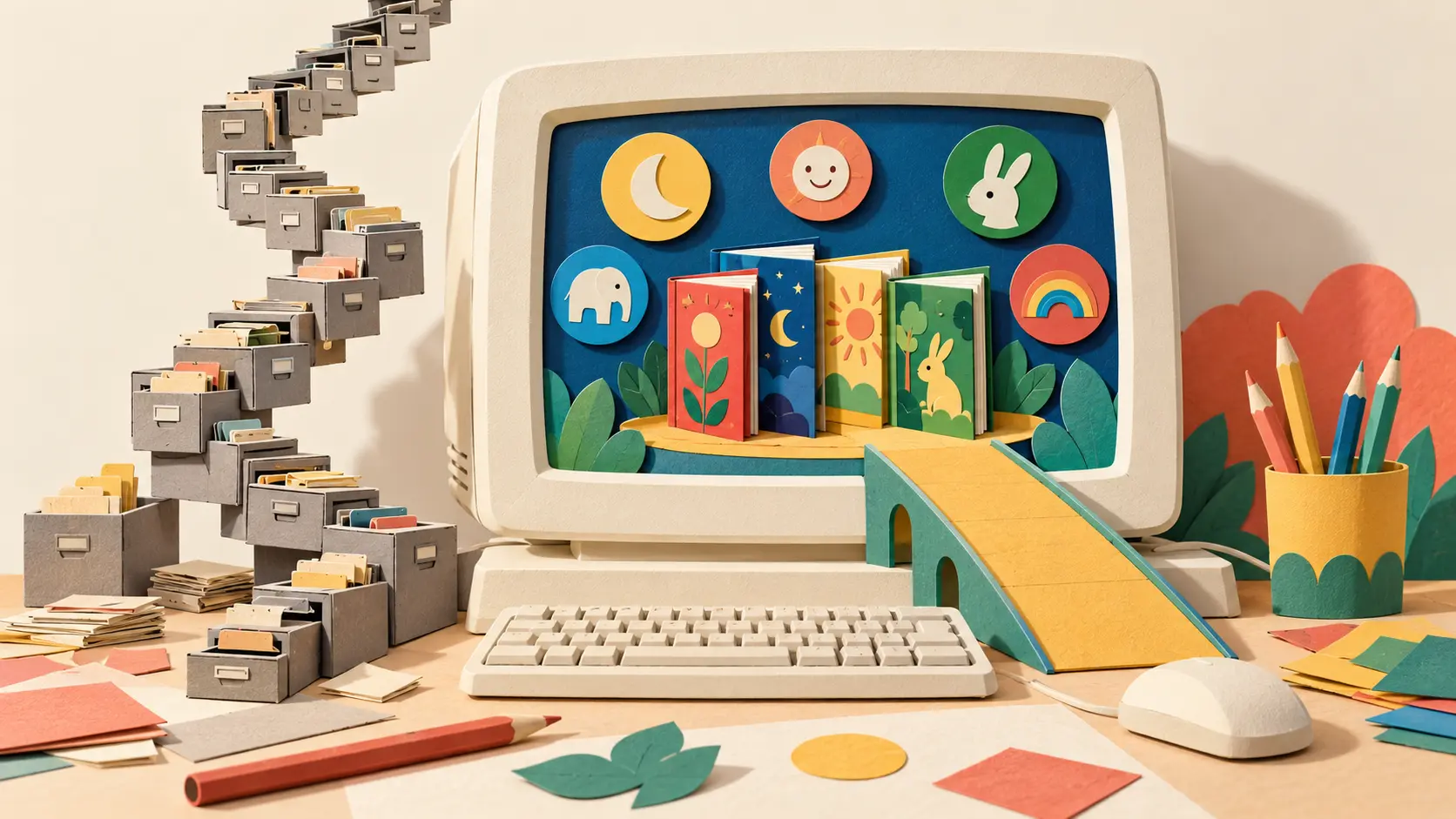
The team's 2006 paper describes another obstacle. Nested categories required backtracking, and children sometimes missed the results. An early revision allowed more categories to open together but kept the hierarchy; its animation also distracted users. In October 2004, the team replaced the browser with a flatter design: round category buttons surrounding books in the middle. The books had finally secured the best seats.
The researchers later compared flat and hierarchical category layouts with 36 children aged six to eleven from four Maryland schools. Both experimental layouts already put books centrally. Searches were faster with the flat version. Yet only twelve children used its extra-category paging buttons while browsing without instruction; twenty-four did not. The second page had become the library's quieter room.
That detail makes the history useful. The team could improve the journey and still discover another place where readers lost their way. Selecting categories, choosing their positions and deciding how many fit on a screen all shaped which books got attention. A small round button carried a substantial editorial decision.
ICDL's children helped turn a general promise of access into a series of practical demands. Let a reader ask for a colour. Make the result visible. Reduce the software chores. Watch what happens when nobody explains the interface. The child was entitled to judge a book by its cover; the library had to make sure the cover could be found.
Member Briefing
Deeper Profile Context
Sign in with the right membership level to unlock the full briefing and source notes.
Only for Strategic Circle
Strategic Circle
Open to all readers. Unlock profile briefings after joining and signing in.
Join Strategic CircleOnly for Leadership Alliance
Leadership Alliance
For qualified IP-asset owners and management; sign in to unlock alliance briefings.
Join Leadership Alliance