
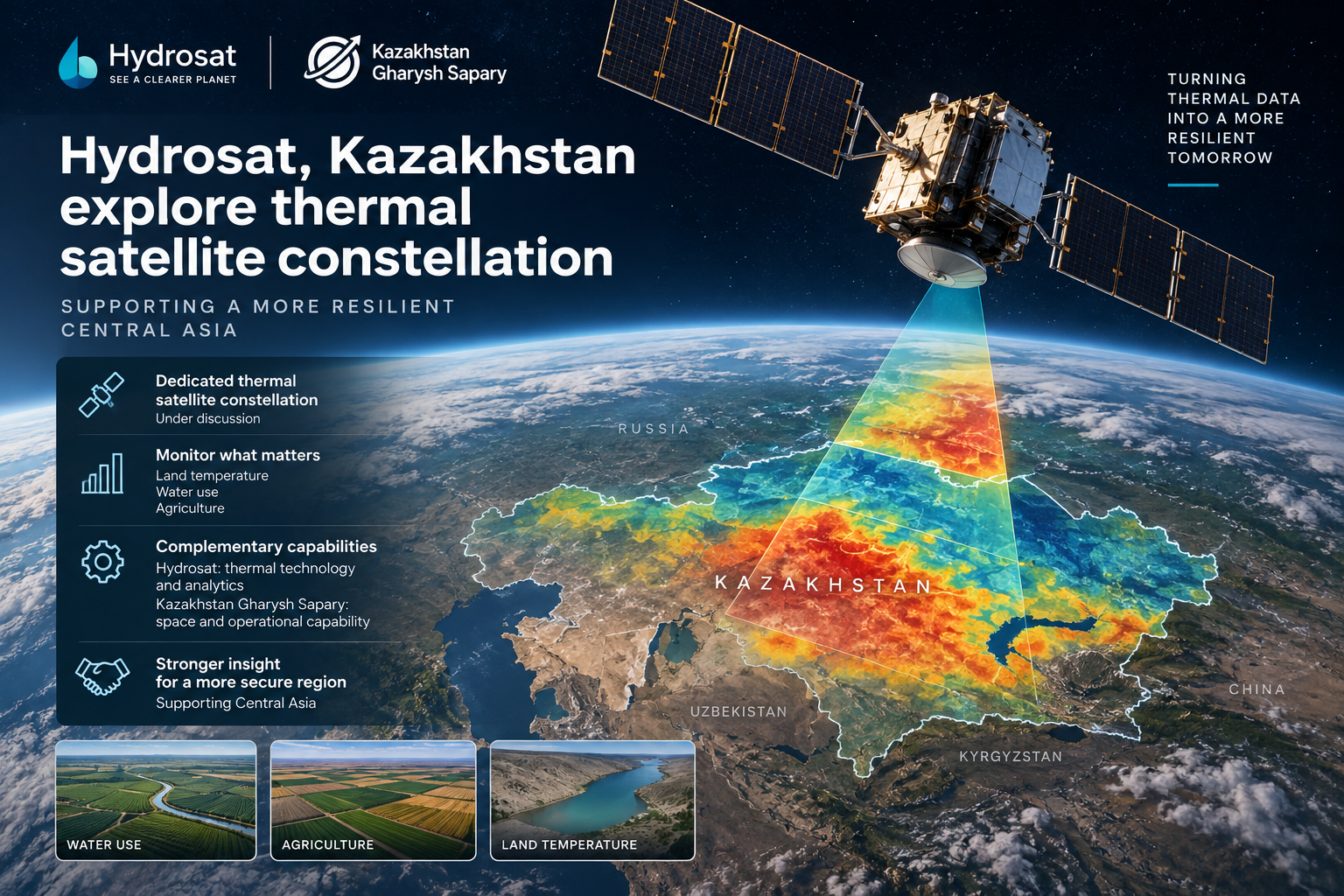
- Hydrosat and Kazakhstan Gharysh Sapary agreed to explore a dedicated thermal-infrared satellite constellation for monitoring in Central Asia
- Satellite numbers and launch dates remain undecided, while Hydrosat says it would retain its proprietary technology, algorithms and software
The fact
Hydrosat and Kazakhstan Gharysh Sapary announced an agreement on 7 September to explore a dedicated thermal-infrared satellite constellation for Central Asia. The memorandum was announced during Space Days in Astana and sets out a framework for technical, operational and commercial discussions.
Under the proposed arrangement, Hydrosat would contribute thermal-infrared technology and analytics, while Kazakhstan Gharysh Sapary would contribute spacecraft and regional operating capabilities. The companies say the system could support monitoring of land temperature, water use and agriculture.
The size and launch schedule of the constellation have not been decided. Hydrosat chief executive Pieter Fossel also said the company would retain its proprietary technology, algorithms and software.
The agreement follows a June collaboration on satellite-based water intelligence, which included local validation and integration with national systems. That earlier work concerned using satellite data rather than building a dedicated constellation.
The assessment
A dedicated constellation could give Kazakhstan more control over when and where thermal observations are collected. That is different from owning every part of the technology behind the service. Hydrosat says it would retain its proprietary payload technology, algorithms and software, so some important functions would continue to depend on the supplier.
That distinction matters when the imagery becomes part of regular water or agricultural monitoring. Kazakhstan would need reliable access to the processed data, the ability to combine it with local systems and clear support arrangements if the service is used for recurring public-sector work.
For BTW readers, the proposed constellation could increase Kazakhstan's control over observation priorities without making the service fully independent of Hydrosat. The eventual agreement needs to show which parts Kazakhstan can operate itself and which functions will continue to rely on Hydrosat's technology and support.
What to watch
Watch for a definitive agreement setting out the number of satellites, spacecraft responsibilities, launch schedule, data rights and access to Hydrosat's processing software. Details on ground infrastructure and integration with Kazakhstan's existing monitoring systems would show how much of the service will be operated locally.
Member Briefing
Deeper Profile Context
Sign in with the right membership level to unlock the full briefing and source notes.
Only for Strategic Circle
Strategic Circle
Open to all readers. Unlock profile briefings after joining and signing in.
Join Strategic CircleOnly for Leadership Alliance
Leadership Alliance
For qualified IP-asset owners and management; sign in to unlock alliance briefings.
Join Leadership Alliance