
Summary
- In 1992, Hungary’s roughly 250 public X.25 access points supported wide-area networking among small and medium-sized sites. The contemporary report does not count them as Internet endpoints.
- International IP was narrower: one 9.6 kbit/s Budapest–Linz line carried EARN, Internet and EUnet traffic, while HBONE, the countrywide IP backbone, was still expected to enter production in 1993.
A large access map, a different network layer
The number is striking because it sounds like a measure of Internet reach. A November 1992 account by Milan Sterba for RIPE described about 250 public X.25 access points in Hungary. It called that network the basis of wide-area networking between small and medium-sized sites. In the same section, however, it described a separate and much narrower international IP arrangement. The 250 figure measured access points in the public X.25 network; it did not say that 250 sites had Internet service, native IP, or a direct international circuit.
That distinction matters in a country where the network was being assembled in layers. X.25 supplied a public packet-switched service that could connect smaller sites without giving each one a dedicated long-distance IP line. The available report does not map how an individual institution moved traffic from an X.25 access point to another network, so it would be too strong to claim that every point acted as an Internet gateway. What the source does support is more modest and more useful: a national communications surface already existed, while IP reach and capacity were still being extended.
One shared route across the border
RIPE-074 recorded a 9.6 kbit/s IP line between Budapest and Linz, Austria. Hungary used that same line for EARN and, at the time of the report, for Internet and EUnet connections. This was not three independent routes. It was one constrained international path carrying several networking communities and services. The report said an upgrade to 64 kbit/s was planned for 1992, but the passage does not confirm that the upgrade had been completed.
High-energy physics had a distinct connection: a separate 9.6 kbit/s Budapest–CERN leased line, then running IP and providing access to HEPnet services. That specialist route should not be conflated with general Internet access. The report describes different communities, destinations and purposes, even though both lines used IP.
An earlier April 1992 RIPE report had already described Budapest–Linz IP connectivity and said a leased-line backbone for larger sites was foreseen. Read together, the April and November snapshots show the gap between an operational route and a national backbone. They do not supply traffic shares, uptime, a complete host count or a site-by-site map, so none can be inferred from the access-point total.
HBONE was the next layer, not a synonym for X.25
In November, RIPE described HBONE as a high-speed national IP backbone that would enter production in 1993, with the stated aim of countrywide IP connectivity and access to EBONE. This was a forward-looking schedule, not proof that all regions were already connected or that a particular commissioning date was met.
The institutional arrangement also had several layers. RIPE identified the R&D Information Infrastructure Program, IIF, as responsible for research networking. HUNGARNET coordinated user groups: HUNINET for universities and high schools, AKANET for research institutes, and a group for public collections such as libraries and museums. A later NJSZT iTF institutional history dates the HUNGARNET Association to 1991 and describes the gradual development of regional centres. That retrospective chronology complements, but does not erase, the contemporary RIPE forecast that HBONE would enter production in 1993.
One account marks a programme’s build phase; the other states an expected production milestone.
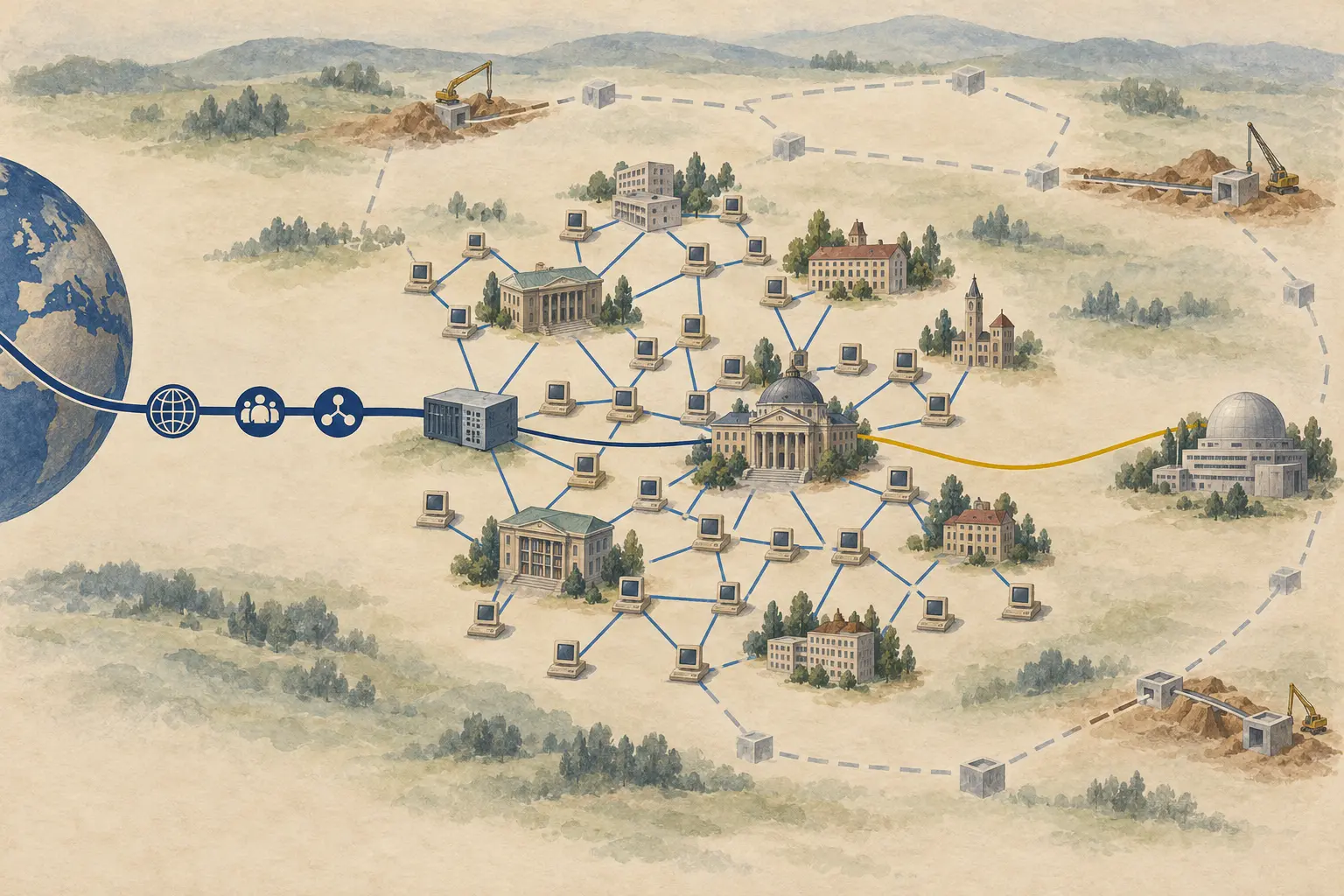
The practical point is not that X.25 was a failed substitute for the Internet. It served a different job in a transitional design. Its many access points widened the base on which organizations could network; shared international IP concentrated external reach; HBONE was meant to join domestic IP connectivity into a national system. The layers became visible at different times and carried different commitments.
Sources
Member Briefing
Deeper Profile Context
Sign in with the right membership level to unlock the full briefing and source notes.
Only for Strategic Circle
Strategic Circle
Open to all readers. Unlock profile briefings after joining and signing in.
Join Strategic CircleOnly for Leadership Alliance
Leadership Alliance
For qualified IP-asset owners and management; sign in to unlock alliance briefings.
Join Leadership Alliance