
Summary
- Two strong earthquakes struck offshore southwestern Taiwan eight minutes apart, but the cable damage developed as a sequence over roughly fourteen hours rather than as one instantaneous cut.
- Separate cable systems shared a concentrated south-of-Taiwan hazard corridor. BGP detours recovered some reachability, yet narrow alternate paths, congestion and longer routes showed why reachability is not the same as usable capacity.
- The defensible accountability test concerns route geography, activated spare capacity, peering and transit policy, fault reporting, localization and executable repair arrangements—not whether an operator could prevent an earthquake.
On 26 December 2006, the first visible fact was geological: two powerful earthquakes occurred offshore southwestern Taiwan. The more consequential infrastructure fact emerged afterward. Submarine cable faults appeared in a sequence across a corridor that carried a large share of the region's international connectivity. Network operators found alternate routes, changed traffic policy and worked through a demanding marine-repair schedule. Connectivity returned in stages, but the stages did not mean the same thing. A BGP route could exist while an application remained painfully slow.
Voice service could recover before peak-period Internet performance. A carrier could restore most capacity before every damaged wet-plant segment returned to normal.
That distinction turns the Hengchun event into a network-accountability case rather than a generic disaster narrative. The earthquake was a natural trigger. The central control question is what happened when multiple nominally separate routes encountered a common physical hazard and displaced traffic moved onto the remaining infrastructure. Counting cables on a topology diagram was not enough.
Continuity depended on where those cables ran, whether their alternatives avoided the same seabed exposure, how much spare bandwidth was actually available, whether peering and transit policies could use it, how quickly faults could be located, and whether vessels, equipment and coordinated repair plans could be executed.
The evidence does not support a verdict that one company caused a regional outage, nor does it establish that every operator behaved alike. Chunghwa Telecom can be bound to the event only through its own public filing and a later attributed regional account. Hong Kong's public records describe Hong Kong operators and users, not Chunghwa's private routing decisions. Peer-reviewed geology explains an inferred sequence of slides and turbidity currents, not an eyewitness record of every break.
Later resilience guidance helps identify the evidence a mature continuity programme should now produce, but it was not a retroactive legal duty in 2006.
The case is valuable precisely because these boundaries force a better form of scrutiny. Accountability here means testing claims about redundancy against running service, physical geography and repair evidence. It asks whether the network could carry displaced demand, not merely whether routers found any path. It asks whether independent-looking cables were independent of the relevant hazard, not merely whether they had different names. It asks whether recovery milestones were clearly defined, not merely whether a provider announced that service was improving.
1. The event began as a doublet, not one simplified shock
The earthquake record should be kept separate from the later cable mechanism. The USGS event page anchors the event, while the accompanying poster records a first shock at 12:26:21 UTC on 26 December 2006, with moment magnitude 7.1, at 21.825° N and 120.538° E, and a stated depth of 5 kilometres. It records a second shock at 12:34:14 UTC, eight minutes later, with moment magnitude 6.9, at 22.023° N and 120.539° E, also at a stated depth of 5 kilometres.[1][2] A USGS-linked paper describes the two earthquakes as the Pingtung doublet and documents the strong-motion data collected by Taiwan's instrumental network.[3]
A later peer-reviewed study of the cable failures rounds both shocks to magnitude 7.0.[4] The difference should not be “corrected” by inventing one harmonized value. Catalog values, scientific conventions and rounding can differ. In this account, the exact USGS poster values establish the event chronology, while the rounded values remain part of the geology paper's own description.
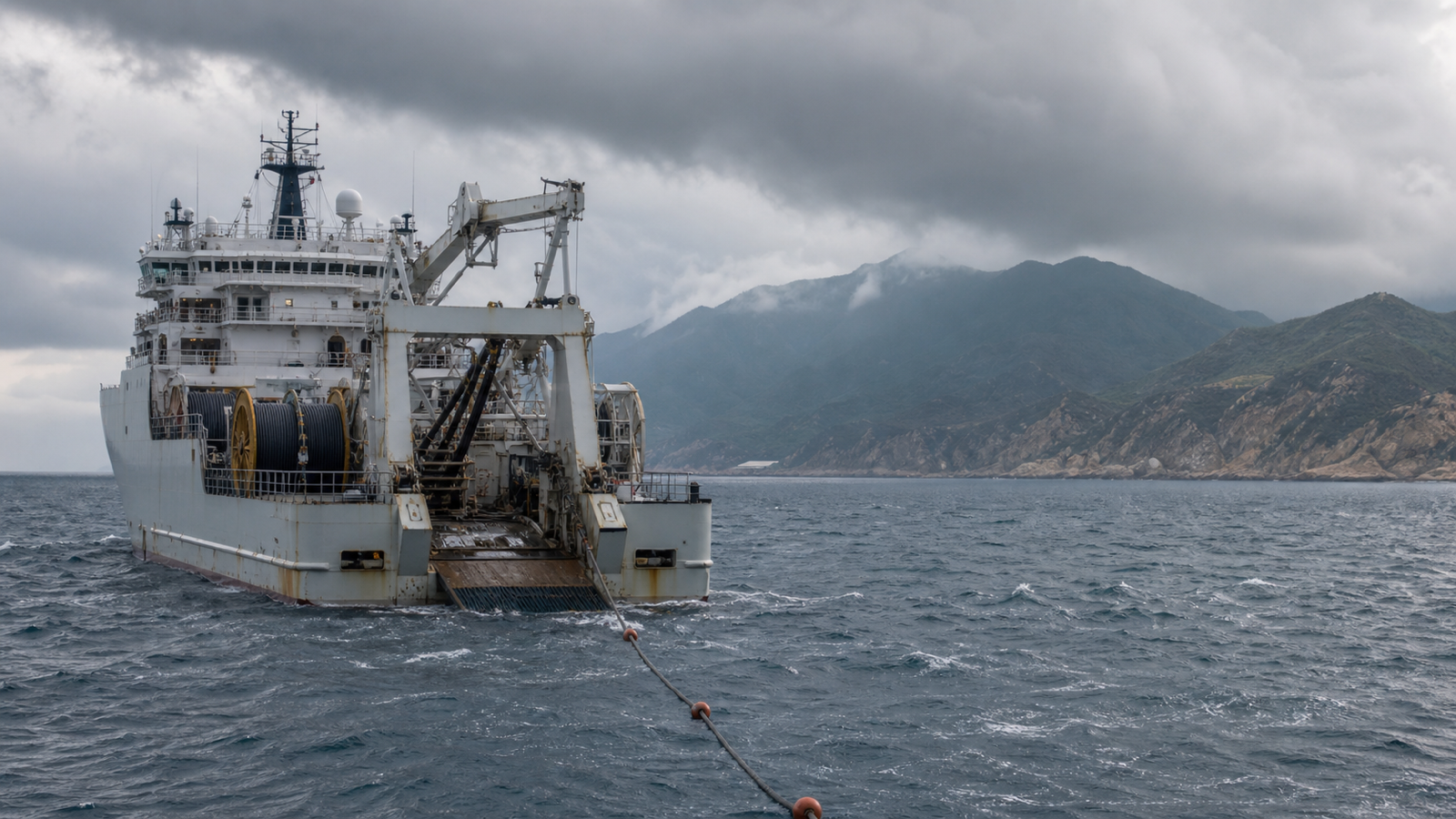
This matters because an oversimplified opening can distort the entire causal account. Saying that “the earthquake cut the cables” suggests one moment in which a fault rupture directly severed every affected line. The public research describes something more complex. The two shocks created or accompanied conditions for submarine slumps, sediment slides and turbidity currents. Cable breaks were then reported at different times and places. Some were close to the earthquake times; others followed as destructive sediment movement travelled through canyons and toward deeper water.[4][23]
The distinction is not semantic caution for its own sake. It separates five kinds of evidence that answer different questions:
- Earthquake evidence establishes when and where the two principal shocks occurred.
- Marine-geology evidence reconstructs the likely mechanism connecting seismic activity to cable damage.
- Network evidence describes what routing and service did after physical capacity disappeared.
- Operator and regulatory evidence records restoration actions and milestones within specific jurisdictions or companies.
- Later guidance supplies present-day control questions without proving a past breach of duty.
If these layers are collapsed, an article can easily turn inference into observation, regional conduct into company-specific conduct, or later good practice into an accusation about 2006. Keeping them separate produces a more demanding and more useful accountability test.
2. The cable failures developed through a shared hazard corridor
A concentrated band of nominally separate routes
The peer-reviewed reconstruction by Hsu and colleagues places at least sixteen modern telecommunications cables south of Taiwan within an approximately 150-kilometre-wide east-west band.[4] That is not a claim that every cable followed an identical line or had identical ownership. It is evidence that many routes used the same broad regional passage and crossed seabed features capable of transmitting a correlated hazard.
The study used break times and locations drawn from reports of cable repair operations. It associated the main sequence with the Fangliao and Kaoping submarine canyons and the Manila Trench. In that geography, a cable can be physically separate from another cable at the scale of a route drawing and still be exposed to the same canyon system, unstable sediment or travelling density flow. Route diversity is therefore a question of hazard separation, not only geometric separation at a convenient map scale.
This is the first point at which the accountability thesis becomes specifically about network infrastructure. A continuity plan can show several international systems and still have a common-mode weakness if those systems converge through one geologically exposed corridor. The relevant evidence is not the number of line items in a capacity inventory. It is a route study showing bathymetry, canyon crossings, sediment conditions, landing approaches, nearby historical failures and the degree to which each fallback path avoids the same physical mechanism.
What the break sequence supports—and what remains inferred
The study does not present a camera recording of a current striking each cable. It reconstructs a mechanism from the timing and location of faults, bathymetry and known sediment processes. That makes terms such as “inferred,” “interpreted” and “consistent with” essential.
Two early cable breaks were reported roughly one minute apart while being separated by about 30 kilometres. The researchers reasoned that one travelling current could not plausibly cover that distance in the available time, and interpreted the breaks as the result of separate slides.[4] Other faults progressed down-canyon in temporal order, supporting the inference that sediment-laden flows travelled along the seabed after being initiated by the earthquakes or aftershocks.
The paper estimated different flow velocities on different slopes, including about 20, 3.7 and 5.7 metres per second.[4] These are not universal speeds for one flow. They are source-specific estimates tied to different parts of the reconstructed sequence and bathymetric setting. The variation is itself instructive: a destructive seabed process does not have to behave uniformly to create a common failure corridor.
The study reports that most cables in its described set broke at least once during approximately the next fourteen hours.[4] A later Oceanography synthesis discusses the event as an example of submarine geohazards and reports twenty-two cable breaks.[23] The sequence extends the causal story beyond the initial shaking. It suggests that the risk window continued while mass movement progressed, so restoration and traffic decisions had to contend with an evolving failure state rather than a single, immediately stable inventory of damage.
That evolving state complicates operational judgment. A route still carrying traffic shortly after the first failures might later be lost. A contingency plan designed around one isolated break might become inadequate as additional systems failed. An operator could face repeated recalculation of what capacity remained, which customers or services to prioritize, and which alternate interconnections were still usable.
The available public evidence does not disclose those calculations for each operator. It does show why they matter. Correlated physical faults transform ordinary redundancy into a sequence-management problem: the network must continue operating while the set of available paths is changing.
Hazard diversity is not the same as route count
A useful route-diversity claim needs at least three layers of proof.
First, there is physical separation. Two cables should not share the same vulnerable trench, canyon head, landing approach or terrestrial choke point merely because they occupy different contractual systems.
Second, there is capacity independence. The alternate route needs activated or rapidly activatable bandwidth sufficient for the traffic expected to move onto it. A physically separate path with little available capacity may prevent total isolation while still failing the service objective.
Third, there is control independence. Routing policy, peering, transit agreements, monitoring and operational authority must allow traffic to use the path when the primary corridor fails. A cable that exists but cannot be reached under the applicable policies, commercial arrangements or technical configuration is not executable continuity.
The Hengchun sequence exposed all three as linked questions. The seabed evidence put physical separation in doubt for many regional routes. The routing and service record showed that available alternatives did not automatically supply normal performance. The repair record showed that recovery depended on shared specialist resources and coordination. Remove these network-specific facts and the thesis collapses into a general observation that earthquakes damage infrastructure. Keep them, and the case becomes a test of whether continuity claims were supported by real routes, real capacity and real recovery capability.
3. The numbers describe different systems, breaks and observation scopes
Large infrastructure incidents invite a single headline number. This event resists one. The available public record contains several counts, but their units and scopes differ:
| Source scope | Reported count | What the count means |
|---|---|---|
| Hong Kong-facing Pacific connectivity | Six of seven systems | Cable systems passing through the earthquake region and relevant to Hong Kong's easterly connectivity that failed one by one.[20] |
| Peer-reviewed Hsu study set | Eleven cables | Submarine cables described as broken in the study's sequence.[4] |
| Later APEC regional account | Nineteen breakpoints in seven systems | Breakpoint occurrences across a defined regional set, as attributed in the later presentation.[22] |
| Later APEC Chunghwa account | Nine breakpoints in four systems | Operator-specific breakpoints and systems attributed to Chunghwa Telecom.[22] |
| Later Oceanography synthesis | Twenty-two breaks | Cable-break occurrences in the synthesis, not necessarily twenty-two unique cable systems.[23] |
| Chunghwa's SEC filing | Four affected cables | Chunghwa undersea cables reported returned to normal by 2 February 2007.[19] |
These figures can coexist without contradiction. A system can suffer more than one breakpoint. One source can count physical break occurrences while another counts named cable systems. A jurisdiction can define a denominator around the systems relevant to its own external connectivity. An operator can report only the cables within its affected portfolio. A later scientific synthesis can use a broader or differently reconstructed event boundary than a contemporary company filing.
The disciplined conclusion is not “the true number was somewhere between four and twenty-two.” That would still merge unlike units. The correct approach is to preserve each count with its source, unit and scope. In particular:
- Six of seven is a ratio of relevant Hong Kong-facing systems, not a global failure rate.
- Eleven is the cable count in one peer-reviewed study's described sequence, not an operator inventory.
- Nineteen and nine are breakpoints, not unique cables.
- Twenty-two is a count of breaks, not proof that twenty-two separate systems failed.
- Four is Chunghwa's number of affected undersea cables returned to normal, not the regional total.
Count discipline is part of accountability because restoration claims depend on the denominator. “Ninety percent restored” may refer to capacity, while “four cables repaired” refers to physical assets. “Services restored” may mean customers regained a usable level of connectivity even though final marine work remained incomplete. Without a defined unit, a recovery percentage can appear more comprehensive than it is.
The same discipline should apply to future incident reporting. Operators and regulators should distinguish unique systems, physical fault locations, lit capacity lost, activated alternate capacity, customer-service impairment and completed repair segments. A count that mixes these objects cannot support a reliable continuity judgment.
4. BGP reachability was first aid, not replacement capacity
A route can exist while a service remains impaired
The routing response provides the clearest demonstration of the difference between logical redundancy and operational continuity. A peer-reviewed restoration study reports that BGP routers initially detoured traffic along redundant backup paths. That behavior recovered a degree of connectivity, but the resulting connections were poor. Operators then changed routing policy and engineered traffic so that narrow links would not be filled by the displaced demand.[5]
BGP answers a reachability question: which route, among those known and eligible under policy, should be used for a destination? It does not manufacture transmission capacity on the selected path. When several high-capacity submarine routes fail, a router may find a technically valid alternative through a longer or narrower connection. The routing table can therefore contain a path at the same time that users experience congestion, delay, loss or applications that no longer work acceptably.
This is why “the Internet routed around the damage” is an incomplete description. It captures the distributed system's ability to find alternatives, but not the quality or scale of those alternatives. Routing around a fault can prevent complete disconnection while still leaving a severe capacity deficit.
The study also describes single-link research and education networks that required temporary commodity connections, and it emphasizes collaboration among operators.[5] That evidence adds a topology dimension. Networks with only one meaningful international link could not rely on policy selection among several pre-existing paths. They needed another physical or commercial connection. For them, the problem was not merely choosing the best route; it was obtaining any usable substitute.
Peering and transit policy are continuity controls
When primary international paths disappear, displaced traffic does not move according to physical topology alone. It moves according to the routes operators announce and accept, the capacities attached to peering and transit relationships, and the traffic-engineering decisions made under stress.
An alternate cable path may be physically intact but operationally constrained in several ways:
- The relevant interconnection may have insufficient port or circuit capacity.
- The route may be much longer, increasing round-trip time for interactive services.
- Policy may prefer or reject paths in ways that are acceptable in normal conditions but counterproductive during a regional failure.
- Inbound and outbound traffic may follow different routes, producing asymmetric bottlenecks.
- One narrow fallback can attract more traffic than it can safely carry.
- A network that usually relies on settlement or capacity arrangements in one direction may need emergency capacity from different regions.
The available sources do not disclose these conditions for each autonomous system. They support the general observed pattern: BGP detours provided initial reachability, then operators had to adjust routing policy and traffic engineering because available paths were not adequate for the full displaced load.[5]
That is a central accountability point. A configured backup route should not be credited as a completed continuity control merely because it appears in a routing information base. The evidence should show how much traffic it can carry, how quickly it can be activated, which services it supports, which failure combinations it is designed for, and what happened in a test or real event.
Limits of the control-plane evidence
Historical routing archives exist. Route Views publishes BGP update data for December 2006, RIPE's Routing Information Service explains its measurement system, and CAIDA BGPStream offers tooling for analysis of historical routing data.[15][16][17] RFC 4271 defines BGP UPDATE messages, route information and core route-selection behavior.[18] Later research also shows methods for examining routing tables and updates across disaster time scales, while cautioning that different views reveal different parts of an event.[6][24]
The available evidence includes no event-specific AS-level replay. It would therefore be improper to state:
- a particular Chunghwa AS path before or after the cable breaks;
- an exact number of withdrawals caused by the event;
- a universal BGP convergence time;
- the forwarding route taken by a named user's packets;
- a complete inventory of operators that changed policy;
- or a control-plane measurement as proof of every user's service quality.
Collectors see selected peering vantage points. Their data can show announcements and withdrawals visible at those points, but not every private route, every forwarding decision or every congested link. Even a rigorous replay would need to separate temporal correlation from causation and control-plane reachability from data-plane performance.
The absence of that replay does not erase the published restoration evidence. It sets the level of precision. The IEICE study supports a general and consequential finding: redundant routing information helped restore connectivity, but available backup bandwidth and policy required further intervention.[5] That is the strongest conclusion supported by the available evidence; a per-AS narrative would require additional data.
Usable capacity is an end-to-end property
Capacity is often discussed as if it belongs to one cable. For a user, however, usable capacity is end to end. It depends on the narrowest relevant segment across access, backbone, international cable, landing, interconnection and destination-side transit. Moving traffic away from a damaged cable can reveal a constraint somewhere else.
Longer paths also change application behavior. An alternate route can have enough average throughput for bulk transfer while creating latency that damages real-time voice, interactive transactions or other delay-sensitive services. A continuity test should therefore distinguish:
- simple IP reachability;
- stable route availability;
- packet loss and latency;
- sustained and peak throughput;
- application-specific service quality;
- and the percentage of normal demand that can be carried.
The Hengchun record shows why a single “restored” flag is inadequate. Some voice and roaming functions recovered sooner than full Internet performance, while peak congestion and longer paths continued to matter.[21] The network was neither wholly down nor wholly normal. It moved through degraded states that should be described with explicit service and capacity measures.
5. Hong Kong's public record shows the operational gap
Hong Kong's government and telecommunications regulator supplied a public view of regional effects, alternate paths and repair. That record is valuable, but its jurisdiction must remain visible.
The government reported that six of seven Pacific Ocean cable systems passing through the earthquake region and relevant to Hong Kong's easterly connectivity failed one by one. It said the damaged systems represented about ninety percent of Hong Kong's external connectivity capacity.[20] This was not a statement that ninety percent of all regional cable assets had been destroyed, nor was it a Chunghwa capacity figure. It described Hong Kong's exposure to a particular set of systems and routes.
Operators used satellites and optical paths through Mainland China, Southeast Asia and Europe.[20] OFTA described efforts to maximize throughput and obtain capacity toward North America through Europe, Singapore, Australia and Mainland China.[21] These alternatives demonstrate the breadth of the response. They also reveal its cost in path length and constrained capacity.
Voice and roaming services recovered comparatively quickly, while Internet access remained slow during peak periods. Longer routes affected real-time applications.[21] By 5 January 2007, OFTA reported that major Hong Kong Internet service providers had recovered about eighty percent of their international connection capacity.[21] Again, this was a Hong Kong provider milestone. It should not be transferred to Chunghwa or treated as proof that every service had reached eighty percent of normal quality.
The sequence illustrates why continuity needs several dashboards rather than one status line. A regulator or operator might separately report:
- physical systems out of service;
- international capacity unavailable;
- alternate capacity activated;
- voice and roaming status;
- peak-period Internet throughput;
- latency-sensitive application performance;
- customers or services still materially impaired;
- and estimated physical repair completion.
Such separation would make public reporting more honest without requiring disclosure of sensitive route detail. It would also reduce the temptation to treat a partial restoration milestone as final recovery.
The Hong Kong account supports another important distinction: rerouting can change which infrastructure becomes critical. Paths through Europe, Singapore, Australia or Mainland China may have been peripheral to ordinary eastbound traffic but central during the failure. Continuity planning therefore has to assess dependencies that appear only under failover. An alternate path is not independent if its capacity, interconnection or operating authority becomes another single constraint once demand moves.
Nothing in this record proves that every Hong Kong operator made the same decision or had the same experience. Public summaries compress a heterogeneous response. They nonetheless establish that alternate routing, longer latency, congestion and staged capacity recovery were operational realities, not merely theoretical risks.[20][21]
6. Repair was a logistics and evidence problem
Locating faults before repairing them
Submarine cable repair begins with knowledge: where did the fault occur, what part of the system is affected, and what equipment and cable type will be required? The geology study's break times and locations came from reports associated with repair operations.[4] That provenance shows the relationship between operational fault localization and later scientific reconstruction, but the available record does not contain a complete set of operator alarm logs or optical time-domain measurements for every segment.
That limitation matters. An accountability assessment should distinguish the public reconstruction from the operational evidence that carriers and cable consortia held at the time. A strong recovery record would preserve alarm chronology, test results, estimated fault coordinates, updates as the estimate improved, vessel tasking, splice completion and post-repair validation. Without those records, outsiders can often see only the final milestone.
Vessels, spares, weather and sequencing
OFTA stated that an individual repair might normally require five to ten days, while also describing constraints that affected the multi-fault schedule. These included the availability of repair vessels, the need to load unusually large quantities of cable and equipment, stocks held at different depots, high-sea weather and a technical problem involving a repair ship.[21]
These are regional repair constraints in the Hong Kong public record. They should not be rewritten as a list of difficulties personally encountered by Chunghwa on every cable. Their importance is broader: repairability depends on a supply chain and operating system that starts long before a vessel reaches a fault.
A credible repair plan therefore needs evidence about:
- contracts or standing access to suitable cable ships;
- the location and compatibility of spare cable, repeaters and jointing equipment;
- mobilisation and loading time;
- permits and access arrangements;
- weather and sea-state operating limits;
- priority rules when several systems require the same specialist resources;
- availability of qualified crews;
- fault-location accuracy;
- and the process for confirming that the repaired segment can return to service.
In a correlated event, these resources cannot be assessed one cable at a time. Multiple owners may need vessels, depot stock and specialist teams at once. A five-to-ten-day norm for an individual repair does not imply that many repairs can all be completed within that window. Sequencing becomes a control decision.
The Hong Kong government expected systems to return progressively through late January or mid-February, subject to conditions.[20][21] The conditional language is important. Marine repair schedules are forecasts under uncertainty, not guaranteed deadlines. Accountability does not require pretending that weather or seabed conditions are controllable. It requires demonstrating that known constraints, priorities and dependencies are identified and managed.
Public reporting was itself a continuity control
OFTA's account noted that the existing reporting mechanism did not routinely require submarine-cable or Internet-access outage reports.[21] That limited the regulator's immediate picture. It is a reminder that detection at the operator level and situational awareness at the public level are different.
An operator may detect a cable fault immediately while a regulator lacks a consolidated view of how several faults interact. Customers may see severe congestion while a carrier reports that logical connectivity remains. A consortium may know the repair schedule for one system while no single public account connects that schedule to capacity restoration across all affected routes.
Reporting requirements cannot repair a cable, but they can improve coordinated decisions. Useful reporting would define the affected unit, service scope, remaining capacity, alternate paths at a safe level of abstraction, current repair stage, material constraints and the next verification milestone. It should also separate estimates from completed actions.
7. Chunghwa Telecom's role is narrow, direct and measurable
Chunghwa Telecom was a directly affected Taiwan operator. The most reliable basis for its role is the company's 2006 Form 20-F filed with the U.S. Securities and Exchange Commission.
The filing says the earthquake significantly damaged undersea cable networks connecting Taiwan with the United States, Japan, Hong Kong, China and Southeast Asia. Chunghwa states that it took one week to restore ninety percent of capacity. It reports that repairs were completed on 2 February 2007, when all four affected undersea cables returned to normal operations, and records approximately NT$10 million in repair costs.[19]
Those facts support several precise statements:
- Chunghwa had four affected undersea cables within the scope of its filing.
- It reported a capacity milestone of ninety percent after one week.
- It distinguished that milestone from final physical return to normal on 2 February.
- It disclosed a repair-cost figure.
They do not reveal every route used during the interim, the amount of unused capacity before the event, each peering-policy change, the ownership or lease structure of every circuit, or the priority assigned to each customer. The filing also does not make Chunghwa the owner of all regional failures.
A later APEC report, summarizing a Chinese Taipei presentation, gives a second operator-specific account. It attributes nine breakpoints in four cable systems to Chunghwa and says services were restored within eleven days.[22] This can be reported only as an attributed later summary. It uses a different unit and a different milestone from the filing.
The two accounts should not be forced into one timeline:
- Nine breakpoints in four systems describes an attributed fault count and asset scope.
- Ninety percent capacity after one week describes Chunghwa's reported capacity recovery.
- Services restored within eleven days describes the milestone in the later APEC account.
- Four affected cables normal by 2 February describes final return to normal in the SEC filing.
Capacity restoration can precede service normalization, and service restoration can precede completion of every marine repair. The record does not state that all four milestones were measured in the same way. Preserving their differences produces a stronger article than selecting the fastest or largest number.
The company-specific evidence also sets the proper accountability boundary. Chunghwa can be asked what route, capacity, fault and repair evidence underpinned its disclosed milestones. It cannot be assigned Hong Kong-specific actions merely because both places were affected by the same regional event. The public record supports a direct connection to the incident, not an unlimited inference about every response decision.
8. An evidence-based accountability test
The event does not support the proposition that operators should prevent earthquakes or guarantee uninterrupted service through every regional disaster. It supports a more practical test: what evidence showed that continuity controls were designed for correlated physical failures and remained usable under real demand?
Test one: route geography
A route-diversity claim should be supported by geospatial evidence at the scale of the hazard. For submarine cables south of Taiwan, that means more than different system names or a modest lateral separation. The evidence should show how routes relate to canyon heads, slopes, sediment pathways, trenches, landing approaches and previous faults.
The Hsu reconstruction indicates why. Cables spread across an approximately 150-kilometre band could still encounter connected or repeated sediment hazards.[4] Two paths can be diverse against an anchor strike at one coordinate yet correlated against an earthquake-triggered canyon flow. Diversity must be defined relative to the failure mechanism being managed.
The control question is not “Are there two cables?” It is “Which credible hazard can remove both, and what route remains if it does?”
Test two: usable spare capacity
Installed capacity, contracted capacity, lit capacity and immediately available capacity are different. A continuity plan should state how much traffic can move after each relevant failure combination, how quickly additional capacity can be activated, and which services receive priority when the total is insufficient.
The event showed that BGP could identify alternatives while connections remained poor and narrow paths required policy changes.[5] That means a route advertisement was necessary but not sufficient evidence. Capacity should be tested through sustained load, not inferred from configuration.
The test also has to include peak demand. A fallback that works during a quiet exercise may fail when an entire regional corridor displaces traffic. Evidence should show headroom, queuing behavior, packet loss, latency and application performance under the expected failover load.
Test three: peering, transit and traffic-engineering execution
Alternate capacity is useful only if traffic can reach it. Operators should know which policies need to change when primary paths disappear, who has authority to make those changes, what protections prevent the fallback from overloading, and how the effect will be measured.
This does not imply that every emergency change should be pre-scripted without judgment. It means the operating prerequisites should be known. Contact paths between carriers, emergency commercial arrangements, traffic-priority rules and rollback criteria are part of continuity.
The IEICE account's emphasis on operator collaboration is especially relevant.[5] Interdomain failures cross organizational boundaries. No operator controls all announcements, transit links, landing stations and destination networks. Continuity is partly the ability to coordinate without confusing shared action with shared responsibility.
Test four: service-level evidence
“Reachable” and “restored” should be broken into measurable service states. Hong Kong's record shows voice, roaming, general Internet and real-time applications recovering differently.[21] A serious continuity programme should define acceptable thresholds for each important service.
Evidence might include route stability, end-to-end latency, loss, throughput, successful transaction rates and customer-impact measures. The particular metrics will vary, but their definitions should be fixed before an incident. Otherwise a provider can unintentionally choose whichever indicator looks healthiest during recovery.
Test five: fault localization and reporting
Sequential faults require a continually updated damage picture. Operators and consortia need a timeline of alarms, localization evidence and confidence levels. Regulators and major customers need a public or contractual summary that distinguishes confirmed faults, suspected faults, service impact and expected repair stages.
The event's public record was assembled from different scientific, company and regulatory sources. That mosaic is informative, but it also reveals the absence of one immediate, normalized regional account. Better reporting would not eliminate uncertainty. It would make the uncertainty legible.
Test six: executable repair access
A paper commitment to repair is not the same as access to a vessel, compatible spares and a workable sequence. The OFTA record shows how availability, loading, depot location, weather and ship reliability can extend recovery.[21] These are operational dependencies that should have owners and evidence.
Repair readiness should be exercised at the level possible without unnecessary disruption. Contracts can be checked, spares inventoried, mobilisation assumptions tested, escalation contacts confirmed and decision rights documented. The aim is not to promise a calm sea. It is to avoid discovering an avoidable administrative or supply constraint after several cables are already down.
Test seven: recovery milestones that can be reconciled
The Chunghwa and Hong Kong records contain several legitimate but different milestones: voice recovery, percentage of capacity, services restored, cable systems returned to normal and physical repairs completed.[19][21][22] A continuity report should declare which one it is using.
Reconciliation should answer:
- What was the denominator?
- Was the measure capacity, traffic, customers, services or physical assets?
- Was it measured at peak or average demand?
- Did it cover one operator, one jurisdiction or the region?
- Did “normal” refer to routing, application quality or completed marine repair?
- What evidence confirmed the milestone?
This approach avoids both exaggeration and unfairness. It does not dismiss partial recovery because final repair took longer. It prevents partial recovery from being presented as complete restoration.
9. Later guidance is a control framework, not a retroactive verdict
Materials published after 2006 help organize these tests. They should be used prospectively and analytically.
The ICPC and UNEP material discusses submarine cables as critical infrastructure and addresses route planning, seabed conditions, hazards and repair.[8][9] Later disaster-risk research offers broader framing for infrastructure bottlenecks and correlated exposure.[7] Current ITU work emphasizes the importance and resilience of submarine cable systems, while later ITU-T publications provide design and system-feature guidance.[10][11][12][13] Taiwan's NCC-hosted APEC material and the later APEC report use the incident to discuss international cooperation, repair and resilience lessons.[14][22]
Together, these sources support a present-day control framework:
- survey routes against bathymetry, sediment and known geohazards;
- examine whether different systems share a failure corridor;
- plan access to specialist repair vessels and compatible spares;
- establish cooperative procedures across operators and jurisdictions;
- test capacity and routing under correlated failures;
- and report restoration in clearly defined stages.
They do not establish what Chunghwa or any other operator knew, funded, contracted or deployed in December 2006. They do not prove that a later recommendation was an applicable legal requirement at the time. They do not turn a natural disaster into evidence of negligence.
This temporal boundary matters for fair analysis. Good practice develops partly because incidents reveal previously underappreciated dependencies. A later standard can show how the industry now frames the risk without resolving what was reasonably foreseeable, technically feasible or contractually controlled two decades earlier.
The strongest use of later guidance is therefore evidentiary rather than accusatory. It helps specify what documents and test results an operator should be able to produce now: route-risk studies, diversity analysis, failover capacity tests, interconnection playbooks, repair-access records and post-incident reconciliation. If those records exist, they can demonstrate continuity preparation. If they do not, the gap is visible without inventing a historical breach.
10. A future BGP replay could add precision—but not omniscience
The existence of Route Views, RIPE RIS and BGPStream means a later researcher could perform a bounded historical replay using archived BGP updates.[15][16][17] RFC 4271 supplies the protocol baseline for interpreting announcements, withdrawals and routing information.[18] Research on disaster-related BGP analysis can help define windows and compare routing-table and update views.[6][24]
A defensible study would need to declare:
- the collectors and peers included;
- the prefixes or autonomous systems under examination;
- the baseline period;
- the event window;
- the method for separating ordinary churn from event-linked change;
- collector outages or visibility gaps;
- the difference between a visible control-plane change and a forwarding result;
- and the limits on generalizing from selected vantage points.
It could then ask whether selected networks showed unusual withdrawals, path-length changes, alternative upstreams or delayed route stability around the cable-failure sequence. It might compare the first shock, the second shock and later fault times rather than treating the event as one instant.
Even a careful replay would not directly measure spare bandwidth. BGP updates describe routing information, not the load carried by a path. They do not by themselves reveal congestion, packet loss or application quality. Those questions require traffic, performance or service evidence.
Nor would a replay automatically allocate responsibility. A path change visible at a collector may be the rational consequence of a physical failure, a protective policy action or a downstream response. The data can clarify behavior; organizational and technical context is still needed to interpret control.
On the evidence reviewed here, the correct conclusion is simply that such a replay is possible and has not been presented. That boundary preserves room for future evidence without turning the availability of archives into a claim about results.
11. The causal account has boundaries
The supported chain can be stated without collapsing its parts.
Triggering events: the two principal offshore Pingtung/Hengchun earthquakes and associated aftershocks.
Inferred proximate physical mechanism: earthquake-linked submarine slumps, sediment slides and turbidity currents that placed destructive force on cables and produced faults along canyon and trench routes.[4][23]
Contributing infrastructure conditions: multiple systems sharing a concentrated hazard corridor; limited usable alternate bandwidth; single-link dependencies; longer fallback paths; and repair resources constrained by vessels, spares, weather and coordination.[5][20][21]
Observed response: automatic routing detours, traffic-engineering changes, acquisition or use of alternative regional and intercontinental capacity, staged service recovery and progressive marine repair.[5][20][21]
Operator-specific evidence: Chunghwa's disclosed four-cable impact, one-week ninety-percent capacity milestone, 2 February return to normal and repair cost, plus the later attributed APEC account of nine breakpoints in four systems and service restoration within eleven days.[19][22]
This chain supports scrutiny of continuity controls. It does not establish:
- the exact contribution of each shock, aftershock, slide or flow to every fault;
- the complete ownership and lease topology;
- every operator's spare-capacity calculation;
- a particular Chunghwa routing-policy change;
- the service experience of every user;
- total regional economic loss;
- contractual liability for every interruption;
- or a legal conclusion about negligence.
These unknowns are not a reason to abandon analysis. They define what kind of conclusion the evidence can carry. The case supports a finding of correlated exposure and constrained usable continuity, not a universal allocation of blame.
12. Evidence that should change the conclusion
A sound accountability analysis should identify what could prove it wrong. The conclusion should be revised if stronger evidence materially changes any of its central links.
Detailed contemporaneous route surveys could show that affected systems were more geologically independent than the published corridor reconstruction suggests. Capacity and traffic-engineering records could show ample unused alternate bandwidth with no material congestion linked to the failures. Optical test records, marine surveys or repair logs could overturn the published break sequence or sediment-flow explanation. A reproducible routing replay could contradict the general detour and degradation narrative for the networks examined. Company records could materially conflict with Chunghwa's filing or the attributed APEC account.
Contracts and dispatch records could show that another party exclusively controlled a relevant repair or continuity decision.
Such evidence would not merely add detail; it could alter the thesis. The thesis depends on route geography, common hazard exposure, usable alternate capacity, peering and transit continuity, fault localization and executable repair. If those elements are removed or disproved, what remains is a natural-disaster chronology, not a network-accountability case.
This revision rule is important because infrastructure narratives can become fixed after a dramatic event. The numbers acquire a life of their own, and later guidance is read backward into earlier conduct. A transparent statement of disconfirming evidence keeps the analysis connected to reality.
Conclusion
The 2006 Hengchun event did not show that redundancy was useless. It showed that redundancy has several layers and that each layer needs evidence.
The earthquake doublet was followed by a sequence of cable faults associated in published research with slides and travelling sediment flows. Multiple systems occupied a common regional hazard corridor. BGP detours helped recover reachability, but they could not create capacity on narrow or longer alternate paths. Operators and regulators described congestion, differentiated service recovery and a repair schedule shaped by vessels, equipment, depots, weather and coordination.
Chunghwa's own filing documented a one-week capacity milestone and a later final return of four affected cables to normal, while a later APEC account recorded a different breakpoint and service-restoration measure.[4][5][19][20][21][22][23]
The resulting accountability test is concrete. Show that alternate routes are diverse against the relevant physical hazard. Show that they have usable capacity under displaced peak demand. Show that peering and transit policy can reach them without creating a new bottleneck. Show that faults can be located and reported. Show that repair access, spares and sequencing are executable. Define recovery milestones so that capacity, service and physical repair are not confused.
That is a demanding standard, but it is not an accusation that an operator should control the seabed. It is a request for evidence that continuity claims survive contact with geography, running networks and the practical work of recovery.
Sources
- https://earthquake.usgs.gov/earthquakes/eventpage/usp000f114
- https://earthquake.usgs.gov/product/poster/20061226/us/1461770326906/poster.pdf
- https://www.usgs.gov/publications/strong-motion-data-two-pingtung-taiwan-earthquakes-26-december-2006
- https://tecdc.earth.sinica.edu.tw/data/EQ2006Pingtung/full_article/18-PT022.pdf
- https://doi.org/10.1093/ietcom/e90-b.11.3095
- https://link.springer.com/chapter/10.1007/978-3-642-40588-4_18
- https://nhess.copernicus.org/articles/9/605/2009/
- https://www.iscpc.org/publications/icpc-unep_report.pdf
- https://resources.unep-wcmc.org/products/WCMC_RT059
- https://www.itu.int/en/ITU-T/Workshops-and-Seminars/qos/20240304/Documents/4-Alexandre%20Nheve.pdf
- https://www.itu.int/digital-resilience/submarine-cables/
- https://www.itu.int/epublications/publication/itu-t-g-suppl-41-2024-07-design-guidelines-for-optical-fibre-submarine-cable-systems
- https://www.itu.int/epublications/publication/itu-t-g-971-2024-12-general-features-of-optical-fibre-submarine-cable-systems
- https://www.ncc.gov.tw/english/files/08091/144_080915_1_C.PDF
- https://archive.routeviews.org/bgpdata/2006.12/UPDATES/
- https://www.ripe.net/analyse/internet-measurements/routing-information-service-ris/
- https://bgpstream.caida.org/
- https://www.rfc-editor.org/rfc/rfc4271
- https://www.sec.gov/Archives/edgar/data/1132924/000119312507087241/d20f.htm
- https://www.info.gov.hk/gia/general/200701/24/P200701240164.htm
- https://www.legco.gov.hk/yr06-07/english/panels/itb/papers/itb0115cb1-697-1-e.pdf
- https://www.apec.org/apecapi/publication/getfile?publicationId=6a8fa3a5-aaba-4cd8-8d33-3fd818572a88
- https://tos.org/oceanography/article/insights-into-submarine-geohazards-from-breaks-in-subsea-telecommunicationc
- https://www.ipccc.org/ipccc2015/Proceedings/data/polopoly_fs/1.2779312.1448299559%21/fileserver/file/572409/filename/Session06_01.pdf
Member Briefing
Deeper Profile Context
Sign in with the right membership level to unlock the full briefing and source notes.
Only for Strategic Circle
Strategic Circle
Open to all readers. Unlock profile briefings after joining and signing in.
Join Strategic CircleOnly for Leadership Alliance
Leadership Alliance
For qualified IP-asset owners and management; sign in to unlock alliance briefings.
Join Leadership Alliance