
Policy continuity, legitimacy, and accountability signals across internet governance institutions.
Governance
Governance
Internet governance intelligence tracks institutions, policy processes, standards activity, registry operations, accountability disputes, and implementation signals that affect internet infrastructure. BTW.
RIR WatchdogCase FileNumber Resource SocietyICANNIETFHistory of InternetNOGs

RIR Watchdog, Case File, NRS, ICANN, IETF, History of Internet, and NOG sessions.
Coverage prioritizes implementation evidence and institutional behavior over declarative positions.
Latest Coverage
Latest from Governance
7,602 articles

History
The Rule Had a Sunset Date. Its Evidence Report Was Optional: RFC 3933
RFC 3933 gave the IETF a clock for temporary process changes. The rule had to expire or be reconsidered, yet the problem statement, success criteria and written account of what happened could remain optional. A sunset constrained authority; it did not manufacture evidence.

IETF
The Call Completed. ENUM Had Not Supplied the Route.
The operations dashboard marked the call as successful. A SIP `200 OK` had arrived, the caller heard ringing, and the session moved into the billing system. Yet the route ledger told a different story: the ENUM query had failed, the softswitch had returned to its vendor-specific…

History
The Message Looked Like a Document. The Protocol Had Already Split It Apart: RFC 3930
RFC 3930 warned that a network message can look like one digital document to a person while the protocol treats it as many fields with different histories, destinations and security rules. The mistake was not aesthetic. It could make extensions fail, signatures brittle and…

History
The Filter Could Change One Entry—or All at Once.
RFC 3678 did not ask every multicast application to learn a new membership vocabulary. It left the old calls in place, then offered two different ways to change a source filter: adjust one source, or replace the complete filter in a single operation.

IETF
The Manager Learned the Engine ID. It Still Had No Permission to Change Anything.
The discovery reply looked like the missing credential. A management application had reached an SNMP endpoint, asked under a well-known local context, and received the identifier of the engine behind it. The value was stable enough to address later scoped requests. It might even…

IETF
The CSV Said the Poll Succeeded. The Trap Could No Longer Be Reconstructed.
One row looked complete: timestamp, source, destination, SNMP version, operation, request ID, zero error status and a list of variable bindings. It was compact enough to scan, join and graph. But when the question changed from “how many responses succeeded?” to “what did this…

History
The Output Stayed 128 Bits. The Key Rules Changed.
In 2004, RFC 3664 adapted AES-XCBC for IKE by keeping the full result that IPsec’s MAC had shortened to 96 bits. Two years later, its successor changed a different boundary: which key lengths the same PRF would accept, and for what IKEv2 purpose.

History
The Name Crossed Protocols. Its Parameters Did Not Move by Themselves: RFC 3555
RFC 3555 did not merely give RTP codecs names that could be printed in another protocol. It specified a custody chain: each piece of a media-type expression had a different destination in SDP, and the payload specification—not the registry—kept authority over what the pieces…

IETF
The Parameter Had an IANA Row. The Call Still Had No Route.
RFC 5341 gives `tel` URI extensions a controlled namespace and a durable reference. That is vital coordination. It is not a runtime receipt for the URI, the number, the network or the call.

History
The Directory Tree Grew Sixfold. The Client Still Needed a Map.
RFC 3663’s Referral LDAP experiment made domain-registration data easier to query in principle. Its own engineering record shows how much work moved into data layout, referrals and clients before a familiar protocol could feel like a usable service.

History
The Name Was Permanent Because It Refused to Name the Current Value: RFC 3553
A registry can move without forcing every protocol document and implementation to rename what it means. RFC 3553 achieved that continuity by giving the name less authority than people are tempted to read into it.

IETF
The Relay Lost One Capability. The Recipient Changed.
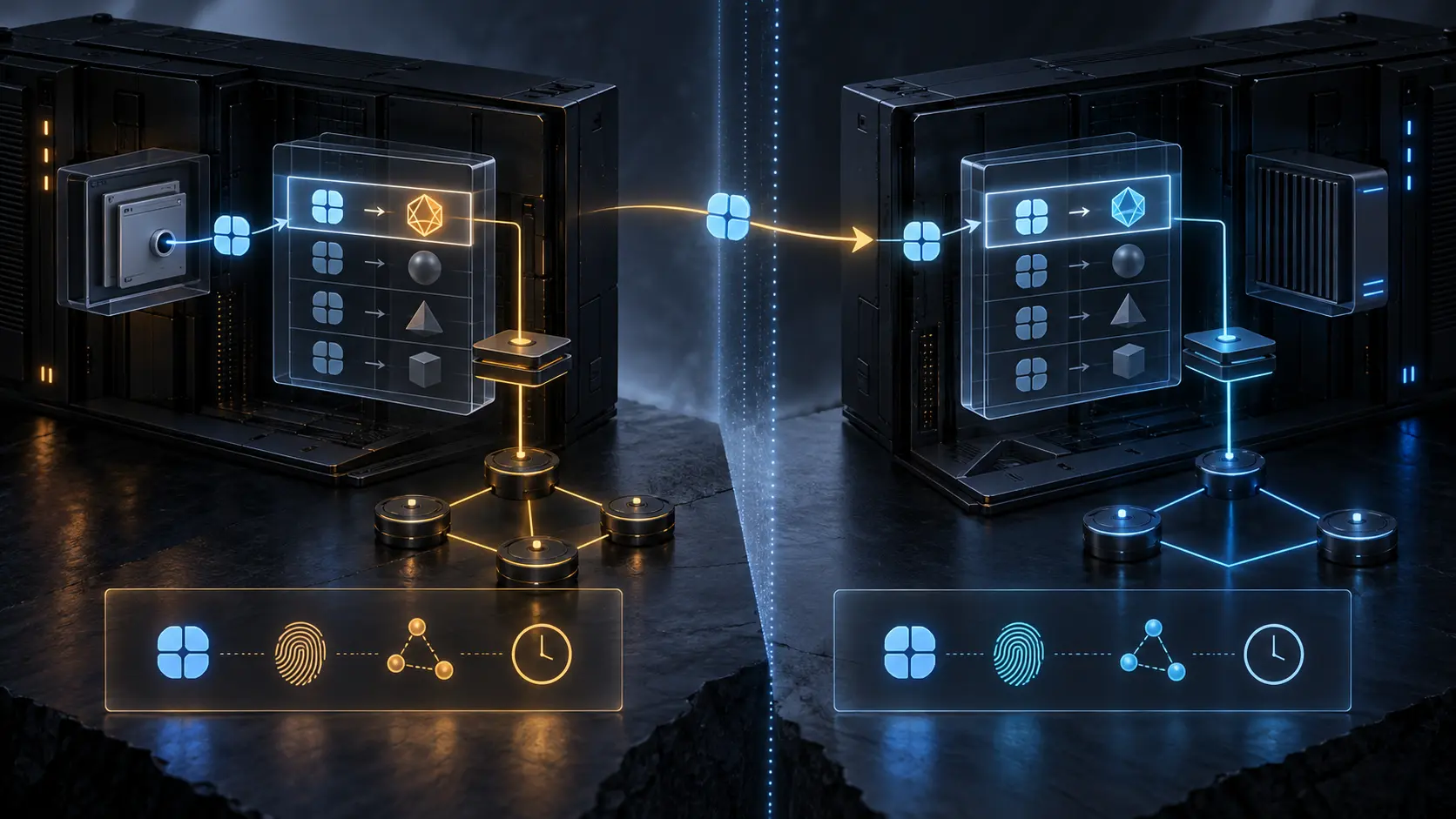
An internationalized address entered a mail transaction with an ASCII alternative attached. When a later relay could not carry the original, the experimental downgrade design selected the alternative. The message did not merely change encoding. It could arrive at another…
IETF
The Address Worked Here. On the Next Host, It Named Someone Else.
A legacy program saw an IPv4-shaped value and did what programs have done for decades: cached it, logged it, and handed it to a peer. The value was a HIP Local Scope Identifier. Its meaning ended at the machine that created it.

History
Same Cipher, Three Parameter Rules: Camellia in CMS
CMS does not identify encryption with a cipher name alone. RFC 3657 gave Camellia different algorithm identifiers for protecting content, wrapping a content key and announcing capability—and each context treats parameters differently.

IETF
A Phone Number Found Two Calendar Doors. It Scheduled Nothing.
One ENUM lookup can return an HTTPS calendar resource and a mail address for scheduling. Both are useful discoveries. Neither says that the caller may enter the calendar, that an invitation reached the intended person, or that a meeting now exists. RFC 5333 is valuable precisely…

History
A Name Was Reserved. The Mailbox Was Not Ready: RFC 3656
In a distributed mail service, preventing two servers from claiming one mailbox name is only half the job. RFC 3656 separated that namespace claim from the later state in which clients could actually use the mailbox.

IETF
The Multicast EtherType Stopped Meaning “Multicast”
A trace decoder sees Ethernet type `0x8848` and prints “MPLS multicast.” That label looks harmless because it repeats the old registry name. Under RFC 5332, however, the decisive fact is different: on the specified multicast Ethernet path, the top MPLS label was…

History
The TCP Counters Stayed Shared. The Connection Needed a Fifth Coordinate: RFC 2452
An IPv6 transition did not force the TCP management model to start over. RFC 2452 kept most transport counters common, then added one interface coordinate where an IPv6 connection row could otherwise be ambiguous.

IETF
The Header Said Audio. The Container Still Held More Than Sound.
A correct label can still be an incomplete inventory. RFC 5334 designed `audio/ogg`, `video/ogg`, and `application/ogg` around the container’s predominant use, while leaving every logical stream to be identified and processed separately.

IETF
The Count Fell. The LSPs Did Not.
Consider a migration in which one link's advertised unconstrained-TE-LSP count drops from 84 to 51 while every expected tunnel remains in service. Nothing has to be removed for that change to occur. A new originator can stop counting LSPs provisioned through the management…
Session Map
Governance Branch
RIR Watchdog
Five regional sessions tracking allocation policy, board legitimacy, and institutional continuity.
Open RIR WatchdogCase File
Long-cycle governance dossiers with legal, election, and institutional stress analysis.
Open Case FileNumber Resource Society
Membership, charter, and resource-governance intelligence from the NRS ecosystem.
Open NRS SessionICANN
DNS coordination, accountability frameworks, and global multi-stakeholder process dynamics.
Open ICANN SessionIETF
Protocol standardization trajectory and interoperability risk under fragmented policy conditions.
Open IETF SessionHistory of Internet
Long-cycle infrastructure history used for governance interpretation and structural forecasting.
Open History SessionNOGs
Operator-level implementation intelligence from APRICOT plus regional and national NOG ecosystems.
Open NOGs Session