
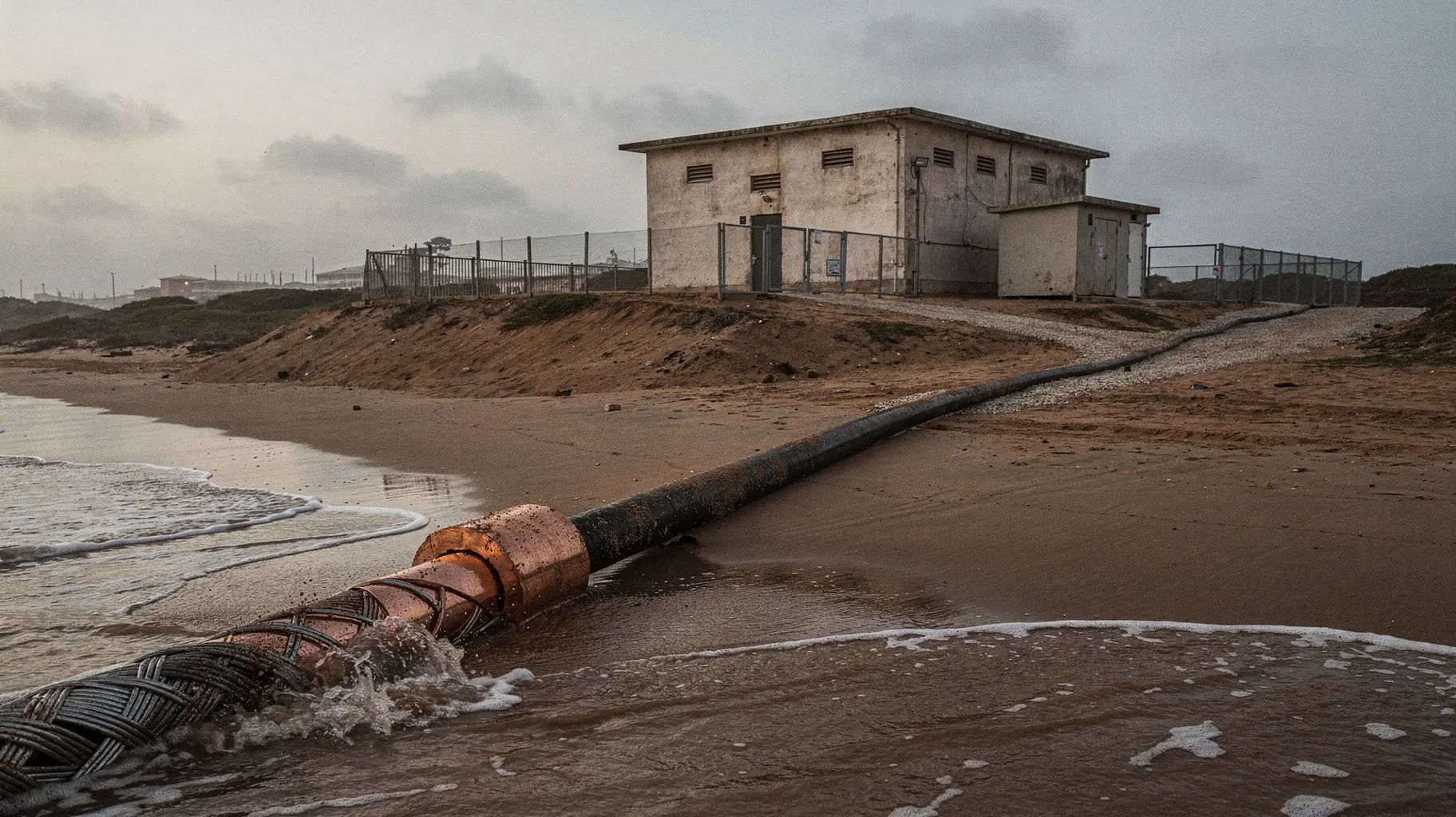
Summary
- BTW's card calls Gambia Submarine Cable Company an operator, and the same projection shows nothing a network buyer could connect to: zero autonomous systems, zero prefixes, zero IXP presences, zero facilities, no peering relationships of any kind, no country value and no control relationship. A classification is not evidence of a role.
- The card's three public-reference entries resolve to one document: two carry a URL, both carry the same cable record, and the third carries none. Three entries, one document.
- That record, as retained for this reading, places a landing point named "Banjul, Gambia" with country value "Gambia" and carries the company's name in its owners field. It names no licence, no landing-party agreement and no capacity figure with a unit. Five of six retrieval attempts in this window failed at provider level, which is a fact about the window and not about The Gambia.
What the record actually establishes
Start with what this record costs a reader. A buyer of Gambian capacity, or an analyst pricing that gateway, needs one thing from it: the name of a party that can commit capacity and answer for it. What follows supplies a landing place and a company name, then shows the record disagreeing with itself about what that company is.
A directory card does three jobs at once — it classifies, it cites, it measures — and on this company the three answers do not agree. The classification is "operator". The measurements are zero: zero autonomous systems, zero prefixes, zero IXP presences, zero facilities, no peering relationships of any kind, and among the card's seven materialisation gaps are "no network resources or relationships" and "no control relationships", alongside no country value, no people, no public contacts, no service claims and no events. The label is a word in a field.
The zeros are counts of what the record contains, and they describe an entity record with nothing behind the label.
The single relationship on the card points at a category rather than a party. It is a supplier edge whose stored target name is the literal string "ASN", with no target slug, eleven records, confidence 0.72 and an observation date of 12 July 2026. An ASN is a routing domain, and a routing domain is identified by a number; this card stores the word and no number. Nothing in the projection connects the entity to an address family, a facility or an exchange.
The two public facts come from the cable record. In the Africa Coast to Europe (ACE) cable record, the landing list carries an entry named "Banjul, Gambia" with country value "Gambia", and the owners field contains the string "Gambia Submarine Cable Company" (ACE cable record, as retained). The copy retained for this reading is elided, so anything outside that landing entry and that owners field is unread here rather than disproved. Neither a landing point nor a name in an owners field is an instrument: the first says where a cable comes ashore, the second says that a name appears on a list.
The distinction is the whole subject. A landing point answers a geographic question. A held landing answers a control question: which legal person may permit access, set terms and stand behind them. The first is satisfied by a place name; the second requires a document with a party, a counterparty and a date, and the retained copy supplies the place name only.
The owners field is weaker still for a specific reason: a list of that kind mixes landing parties, investors, capacity holders and parties recognised for other purposes depending on who maintains the record, it states no percentage and no voting right, and it carries no date, so it does not say whether the string refers to this exact legal person or when it entered the field.
The arithmetic inside the card
A second finding sits in the card rather than in the cable record, and it is arithmetic rather than interpretation. The card holds three public-reference entries. One is labelled "Network directory record" and carries no URL at all. The other two carry URLs, and they are the same URL: the ACE cable record. The import payload behind the card reduces to a single hash, and the card arrives with a completeness score of 0.5, missing exactly one field — country.
Three entries, two addresses, one distinct document. That is a fact about the card's structure, not an inference about the company, and it fixes the card's evidential weight: whatever the card says about this company is said by one document, and an entry count of three is a redundancy rather than a quorum. A reader who takes the count for corroboration is treating one source, cited twice and once unaddressed, as three.
The remaining fields keep the same shape. The region value is "Global", and the service-area note explains it in plain words: the company "is mapped to Global for other coverage". That is a mapping outcome, not a country determination, and it sits beside the missing country value rather than substituting for it. Confidence is 0.72 on the card and 0.72 on the single supplier edge. Localized cards exist in Spanish, French and Chinese, and there are no people, contacts, leadership roles, ASNs, prefixes, domains, facilities or events behind them.
The dates divide into two groups. The card's own measurements are older: the supplier edge was observed on 12 July 2026, the entity was first seen on 17 June 2026, and the projection was assembled on 27 August 2026, the day the card was last imported. The reading dates are this week: the record layer was retrieved on 21 October 2026 and the one public source was retrieved the same day. The citation, by contrast, carries no date in the retained copy, so the age of the underlying cable information is unknown here.
Where the evidence stops
Six retrieval attempts were made for this reading. One returned a usable excerpt. Three ended in a provider service error with the outcome unknown, one ended when provider capacity was unavailable after a bounded wait, and the single fallback that ran reported no retrieval or search tool available at all and returned nothing: five failures at provider level out of six. That is a record of this window, and it is not a finding about The Gambia, about its gateway or about this company. The boundary fits in a sentence.
Nothing here states capacity — design, lit or purchased — with a unit and a scope; nothing says this entity operates, holds or manages the Banjul landing station, or sells or has acquired capacity; no incorporation or licensing fact goes beyond the card's recorded "private_company" claim; and nothing addresses a second submarine path, a terrestrial international route, restoration arrangements or outage history. Their absence from this window is not their absence in the world.
Three instruments that would settle it
If you need an answer rather than a boundary, ask a counterparty for one of three documents. First, a national licensing or regulatory register entry naming the holder of the Banjul landing, with the role and the date stated. Second, a cable-consortium participant, shareholder or landing-party list issued by the consortium or by an operator inside it, naming the Gambian counterparty. Third, a filed capacity agreement or supply contract naming the seller, the buyer, the unit, the scope and the period.
Any one of the three would move this from a record-anatomy account to a control finding, and the first would do it most directly, because a licence names a party and a role in one act. Until one arrives, the honest description of Gambia Submarine Cable Company at The Gambia's gateway is narrower than its card suggests: one name in an owners field, one landing point in a country, an operator label with zero network resources behind it, and three references that resolve to a single document.
Member Briefing
Deeper Profile Context
Sign in with the right membership level to unlock the full briefing and source notes.
Only for Strategic Circle
Strategic Circle
Open to all readers. Unlock profile briefings after joining and signing in.
Join Strategic CircleOnly for Leadership Alliance
Leadership Alliance
For qualified IP-asset owners and management; sign in to unlock alliance briefings.
Join Leadership Alliance