
Summary
- The current BTW directory entry identifies the subject as Quantic Investments Pty Ltd as trustee for Ubuntu Trust T/A Function4. APNIC records connect the same legal and trading identity to Function4, the
function4.com.aucontact domain, AS153748, and the IPv4 prefix163.227.142.0/24. Those records support a company-specific network identity. They do not disclose Function4's private topology, customer list, staffing, equipment, utilisation, security architecture, or service performance. - Function4's website presents managed IT services, cyber security, communication and connectivity, business continuity, and an NBN connectivity offer. These are first-party capability statements. They establish what the company says it offers, not whether every component is available in every location, meets a particular service level, or has produced a measured customer result.
- APNIC records AS153748 as active, with a registration date of 31 March 2025. In a bounded public observation covering 18 July to 1 August 2026, RIPEstat showed
163.227.142.0/24as an announced prefix and showed AS134143 as the single observed neighbour or upstream. That snapshot gives evidence of running routing state, but it does not prove the commercial relationship, physical path, capacity, independence, availability, or end-to-end customer experience. - An exact RIPEstat route-origin validation query for AS153748 and
163.227.142.0/24returned an unknown result and no validating route-origin authorisation in the reviewed response. The finding is a narrow verification gap, not evidence that Function4 has no RPKI work anywhere or that the route is malicious. It does create a practical control question: what route-origin state is intended, who owns it, and how is a change independently verified? - A managed-service provider that combines connectivity, continuity, cyber security, and IT operations inherits a large reconciliation burden. Company authority, RIR credentials, route intent, DNS, circuit references, access policies, customer service records, backup scope, monitoring, support ownership, and supplier escalation must describe the same operating reality. Most expensive failures occur when those relationships drift rather than when a product feature is simply absent.
- Public evidence does not establish a Function4 outage, benchmark, customer deployment, restore-time result, security outcome, service-level achievement, or proprietary architecture. A defensible assessment therefore separates capability from reliability and both from customer production results, while analysing the supervision, integration, maintenance, handover, and exception-handling costs that any accountable operator must manage.
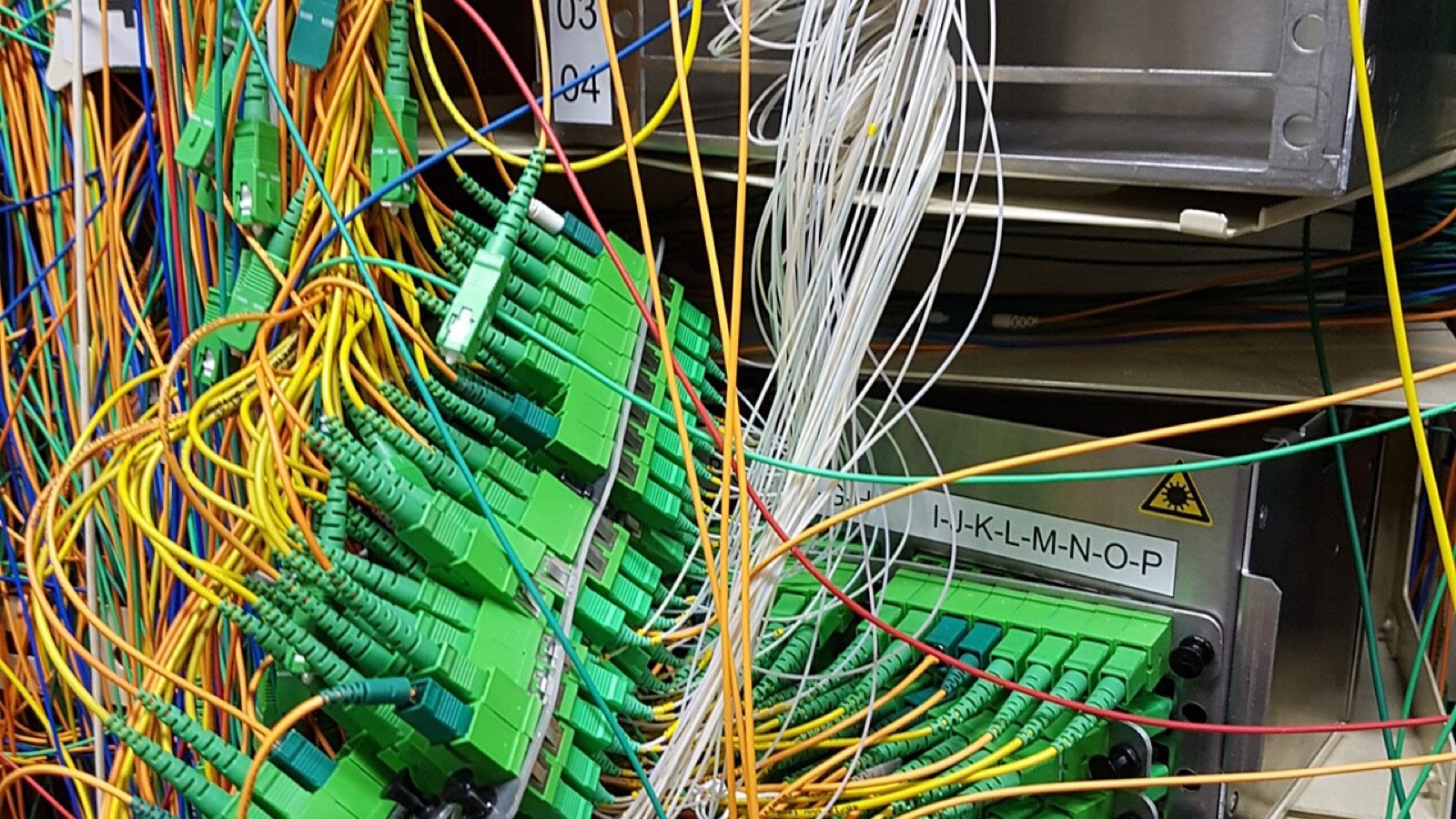
Featured-image context: the selected Wikimedia Commons photograph shows generic optical-fibre distribution equipment and the maintenance burden created by repeated connection work. It was made by InfosReseaux and is licensed under CC BY 4.0. The photograph does not depict Function4, its premises, equipment, staff, customers, architecture, capacity, availability, or performance.
Why this small routing footprint matters
Function4 is useful as a technology-company case because its public footprint joins two worlds that buyers often evaluate separately. One world is the managed-service catalogue: IT support, cyber security, communications, connectivity, and continuity. The other is Internet coordination: a registered autonomous system, a registered IPv4 prefix, observed BGP state, and route-origin security metadata. A service provider may describe these areas on different pages and assign them to different teams, yet a customer experiences them as one chain.
That chain begins before traffic moves. A legal or trading entity has authority to contract, hold accounts, appoint staff, and maintain registry records. A domain gives customers and suppliers a public contact surface. An ASN identifies a routing policy domain. An IP prefix gives the route an address resource. A BGP announcement makes the resource visible to other networks. DNS connects names to services. Access systems and security controls decide who may use them. Monitoring, support, and recovery determine whether an abnormal state is noticed and repaired.
Each element can be correct while the service still fails. A registry record may be accurate while the route is withdrawn. A route may be visible while packets fail beyond the edge. A backup may exist while restore credentials are inaccessible. A circuit may be physically healthy while a prefix filter rejects the intended announcement. A public offer may be clear while the provisioning profile has drifted. A support mailbox may accept mail while no current owner receives it.
The small observed footprint sharpens the analysis. One visible /24 and one observed neighbour are easier to enumerate than a large global network, but concentration makes each relationship consequential. A single prefix may carry multiple services. A single observed upstream can be a critical external handoff. A single RIR account may be the authority for a route-origin change. Public data cannot tell whether private redundancy exists, but it can show which continuity questions should be answered before capability is treated as dependable service.
This is also where cost is often understated. The purchase price of a connection or managed-service subscription is only one line. The operating cost includes integration, supervision, maintenance, evidence retention, account recovery, supplier coordination, security review, exception handling, and handover between people. These costs persist after installation. They rise when identities and dependencies are not mapped, because every incident becomes a new discovery exercise.
The exact company and registry identity boundary
The company object matters because network resources and service obligations must attach to an entity that can be identified without guesswork. The BTW directory uses the long form Quantic Investments Pty Ltd as trustee for Ubuntu Trust T/A Function4. Function4 is the public operating name. APNIC's administrative and organisation records connect Quantic Investments, the trust relationship, the Function4 trading identity, and contacts at function4.com.au.
The long form is not editorial clutter. Trust, corporate, and trading names can appear differently in contracts, invoices, RIR records, domain registrations, support portals, and supplier accounts. During ordinary service, staff may recognise the brand and work around mismatches. During an urgent route, account, or supplier change, a mismatch can block authority. A carrier or registry may need evidence from the legal account holder while a customer ticket names only Function4.
An accountable identity map should therefore preserve the legal name, trading name, directory identifier, ASN label, RIR organisation handle, administrative handles, domains, supplier account names, and current authorised roles. Historical aliases should remain searchable. Authority should not be inferred from an email address alone. The map should record who may request, approve, execute, and verify a high-impact change.
APNIC's records act as a public ledger for number-resource responsibility. They support uniqueness, attribution, contact, and change coordination. They are not sovereign over running traffic and do not prove service quality. A correct record cannot announce a prefix or restore a circuit. Conversely, a route visible in BGP does not make an inaccurate registrant record acceptable. Operational accountability requires recorded authority and running evidence to remain aligned.
Contact data creates a recurring maintenance duty. An abuse or administrative address has value only if messages reach an owned queue, the team can distinguish a valid request from social engineering, and the case reaches someone authorised to act. Staff departures, domain changes, mailbox rules, supplier migrations, and authentication changes can silently break that path. Testing a contact surface is therefore part of continuity, not merely a clerical task.
The directory object also limits the scope of this article. The subject is the Function4 company entity attached to AS153748 and the named prefix. It is not every business with a similar name, every service that uses the word function, or every network connected to an observed neighbour. Keeping that boundary explicit prevents routing evidence from being attached to the wrong company and prevents general managed-service claims from being treated as evidence about this operator.
AS153748 and 163.227.142.0/24 as control surfaces
APNIC records AS153748 under the name QIPLATFUT-AS-AP, with Australia as the country code and an active status. The reviewed record gives 31 March 2025 as the registration date. The corresponding APNIC address record associates 163.227.142.0/24 with the operator identity. These are concrete control surfaces: a routing identifier and an address resource for which authority, intent, and observed state can be compared.
An autonomous system number does not describe a complete network. It does not reveal routers, sites, circuits, providers, customers, software, staffing, or capacity. Its role is narrower and important: it identifies an administrative routing domain to other networks. The holder can express which prefixes it intends to originate and how routes should be exchanged, subject to the policies and filters of connected networks.
A /24 contains 256 IPv4 addresses mathematically. That number must not be converted into a customer count, server count, or usable-address inventory. Some addresses may be reserved, assigned to infrastructure, allocated to services, or unused. Network-address translation, virtualisation, and service design make a direct conversion especially misleading. Public records do not show Function4's assignment plan.
The prefix still creates lifecycle work. The operator needs an approved record of the aggregate, permitted origins, expected visibility, any customer or infrastructure assignments, reverse-DNS responsibility, security controls, abuse handling, and reclamation rules. It needs to know which systems generate route policy and which people can change the RIR and router state. A finite IPv4 resource also creates pressure to recover dormant assignments and document exceptions rather than allowing informal allocations to accumulate.
Route intent is the bridge between registration and running code. For 163.227.142.0/24, an intent record should state whether AS153748 is the only permitted origin, where the route may be announced, which upstream policies apply, whether any more-specifics are ever allowed, what RPKI state is expected, and how maintenance or emergency deviations expire. Without that record, an observed change is difficult to classify. It may be an incident, a planned migration, a collector artifact, or an old exception.
The running-code principle prevents a registry row from becoming a false assurance. The APNIC record says who is recorded for the resource. Public collectors show what some of the Internet observed. Router and upstream configurations determine actual announcements and forwarding. Customer probes show whether a useful service crosses the boundary. A mature control compares these layers instead of allowing one to stand in for all the others.
What the public routing observation can and cannot show
RIPEstat's announced-prefixes data showed 163.227.142.0/24 for AS153748 across the bounded review window from 18 July to 1 August 2026. Its routing-status view supported current public visibility in that snapshot. The ASN-neighbours response showed AS134143 as the single observed neighbour or upstream. These observations are useful because they come from running Internet data rather than only from a company description or registry field.
They remain observations. A route collector sees selected paths from selected vantage points. It can miss a route visible elsewhere. A route can remain visible while packets fail after the destination edge. A collector timestamp does not reveal the exact commissioning date of equipment or a commercial service. The data can change after retrieval. Every statement about visibility therefore needs its resource, vantage limitation, and time boundary.
The single observed neighbour deserves careful language. It is evidence that AS134143 appeared next to AS153748 in the reviewed public data. It is not proof of a contract, paid transit, capacity, physical diversity, or exclusive dependence. Function4 could have private, backup, or newly established connectivity that the public view did not expose. It could also depend operationally on the observed relationship. The evidence supports a concentration question, not a definitive topology claim.
Concentration has several dimensions. Two commercial products may share one physical duct, facility, power system, router, configuration platform, support team, or upstream backbone. Conversely, one observed ASN relationship may traverse more than one physical path. Counting visible neighbours is not a redundancy test. Independence has to be demonstrated across physical route, termination equipment, power, control plane, supplier organisation, credentials, monitoring, and escalation.
With one observed prefix, route withdrawal is a clear failure mode. If the /24 disappears from the relevant Internet views, externally addressed services may become unreachable even when internal systems are healthy. A mis-origin is another: a different ASN may originate the prefix accidentally or maliciously. A filter error can reject a legitimate route. A maximum-prefix setting can close a session after an unexpected change. A stale route can persist after a migration and direct traffic to the wrong boundary.
Monitoring should compare external observations with approved intent. It should alert on a missing expected prefix, an unexpected origin, an unapproved more-specific, a changed neighbour set, or an RPKI state that differs from policy. The alert should include the evidence time, affected resource, intended state, likely customer boundary, owner, and verification method. A generic message that BGP changed is insufficient during an incident.
False positives require an exception path. A planned upstream change, maintenance window, collector gap, or emergency traffic-engineering action may explain a difference. The operator should be able to attach the approved change, expected duration, risk, and expiry. If an emergency exception remains after recovery, it becomes configuration debt. Closing the alert without restoring intent or documenting a new approved state hides that debt.
External observation also protects against common-mode failure. A router can report that it exported a route while an upstream filtered it. An internal dashboard can show green because it relies on the same DNS or network path as the service. Independent collectors and probes give a different viewpoint. They do not replace internal telemetry, but they make it harder for one failed system to certify its own health.
The RPKI unknown result is a maintenance question
The exact RIPEstat validation query for origin AS153748 and prefix 163.227.142.0/24 returned an unknown result and no validating route-origin authorisation in the reviewed response. The correct conclusion is narrow. At that query time and for that exact origin-prefix pair, the returned data did not provide a valid or invalid result backed by a listed ROA.
Unknown is not the same as invalid. It does not prove hijacking, negligence, or universal absence of RPKI work. It may reflect that no covering ROA was available to the validator, a publication or cache condition, a query limitation, or a state that changed later. The public response alone cannot determine the reason. It does identify a gap that an operator should be able to reconcile against its intended policy.
Route-origin authorisation is security metadata attached to number-resource authority. It states which ASN may originate a prefix and, through maximum length, how specific an authorised announcement may be. That metadata has to remain aligned with route intent. An authorisation that is too narrow can make a legitimate operational change invalid. One that is too broad can authorise announcements the operator did not intend. An obsolete origin can remain authorised after a migration if no one owns retirement.
The maintenance process matters more than a one-time checkbox. Before a routing change, the operator should evaluate the intended origin and prefix against current ROAs and filters. After the change, it should verify the result from independent validators and route collectors. Emergency changes should carry an expiry. Credentials and approval paths should have deputies and tested recovery. A provider transition should include both creation of the new authorised state and retirement of the old state.
RPKI is also an integration surface. RIR accounts, certificate repositories, ROAs, route-policy systems, router filters, upstream validation behaviour, monitoring, and incident response may have different owners. A correct change in one system can fail to reach the others. Documentation should map each object to its authority, expected state, change path, and independent evidence.
The customer-facing impact depends on where validation is enforced and what route is affected. Public sources do not establish those details for Function4 or AS134143. It would therefore be speculative to claim a particular outage risk or mitigation result. The defensible operational question is whether Function4 can demonstrate the intended RPKI state for its prefix, detect divergence, and recover authority without relying on one unavailable person or account.
Capability claims are not reliability or customer outcomes
Function4's public site describes managed IT services, cyber security, communication and connectivity, and business continuity. A separate first-party page presents an NBN connectivity offer and local support positioning. These sources establish that the company represents those areas as current capabilities. They do not independently measure how the services perform.
Capability is the first evidence layer. It answers whether a service, process, or control is described and available to be evaluated. A connectivity offer can specify access options and support. A continuity service can include backup or recovery tasks. A cyber-security service can include monitoring or protective controls. Public copy may establish those descriptions, but the implementation boundary and prerequisites still need confirmation.
Reliability is the second layer. It requires a defined boundary, repeated observation, thresholds, and a time period. For connectivity, relevant measures can include route availability, packet loss, latency, jitter, DNS resolution, access authentication, congestion, change success, incident acknowledgement, restoration, and recurrence. For backup, they can include job success, data integrity, restore completion, recovery point, recovery time, and access to keys. The correct measures depend on the contracted service and what the provider controls.
Customer production results form a third layer. A result needs an attributable customer or bounded cohort, a baseline, a workload, a period, a measured change, and a credible account of other variables. Public sources reviewed for this article do not provide that evidence. There is no defensible basis to claim that Function4 reduced a named customer's downtime, improved application performance, prevented a security event, lowered a measured cost, or achieved a particular business outcome.
The absence of a public result is not evidence that the service failed. Managed-service engagements often involve confidential systems and contracts. The reporting discipline is simply to keep the gap visible. Capability can be attributed to Function4. Reliability needs current operational measurement. Customer outcomes need customer-specific evidence. A statement from one layer should not be promoted into the next without support.
This separation also improves operations. If capability exists but measurement is weak, the next investment is observability and recovery evidence. If reliability is demonstrated but business impact is unknown, marketing should avoid causal claims. If a customer result appears positive, teams should test attribution and durability before generalising. Clear boundaries reduce support disputes because buyer and provider know what has actually been promised and proven.
Artificial intelligence does not change the ladder. The reviewed Function4 sources do not document a particular AI model, benchmark, or autonomous operating architecture. A provider might use automation or AI internally, but that cannot be inferred from a generic managed-service category. Even a model demonstration would prove only a bounded capability. Production reliability would still depend on data quality, permissions, supervision, exception handling, rollback, and human accountability.
Managed-service integration and supervision costs
Managed services create value by taking responsibility across systems that a customer would otherwise coordinate. The same breadth creates integration cost. A customer name, service record, circuit, domain, public IP, firewall policy, backup job, monitoring target, support entitlement, supplier case, and invoice may sit in different systems. They must remain linked so that a change or incident can move from symptom to accountable owner.
Identity reconciliation is the first layer. The legal entity, Function4 brand, APNIC handles, ASN, prefix, domains, supplier accounts, customer accounts, and staff roles need a maintained crosswalk. A support request that names an IP address should resolve to the current service and authority. A carrier notice that names a circuit should resolve to affected routes and customers. A registry request should resolve to an authorised approver and an independent verifier.
Permissions create another layer. RIR, registrar, DNS, router, security, backup, cloud, monitoring, and supplier portals may all use different identity systems. Privilege should be sufficient for the role and no broader. Emergency access needs secure recovery. Service accounts need ownership, credential rotation, and retirement. A staff departure should not leave an invisible dependency or an active credential without a responsible owner.
Supervision means defining intended state and checking it. For AS153748, intended state includes the company authority, ASN, prefix, origin, RPKI status, external sessions, contacts, and route visibility. For a managed service, it can include device state, software support, configuration baseline, backup coverage, monitoring coverage, incident status, customer exceptions, and supplier dependencies. An inventory without comparison to current evidence is only a list.
Monitoring quality depends on independence and actionability. A probe should observe the boundary it is intended to protect. An alarm should identify what changed, why it matters, who owns the response, and what evidence will close it. A dashboard full of device counters may still miss customer impact. A single synthetic check may stay green while a subset of routes, identities, or services fail.
Handover is a recurring integration event. A new engineer, supplier, customer contact, or account owner must inherit not just documents but usable authority and context. The handover should cover normal operation, known exceptions, maintenance windows, credentials, dependencies, escalation, and evidence location. Access should be tested before the previous owner leaves. Otherwise the organisation discovers the gap during the first urgent change.
These duties are not proof that Function4 performs them in a particular way. Public sources do not disclose its internal systems or staffing. They are the cost surfaces implied by the capabilities the company advertises and by the public network resources attached to its identity. A buyer should ask how those duties are allocated and evidenced instead of assuming that a service label resolves them automatically.
Business continuity is a relationship-maintenance problem
Business continuity is often represented as a backup product or alternate connection. Those components can be necessary, but continuity depends on the relationships around them. Data has to be in scope. Backup jobs need credentials and storage. Restore procedures need compatible systems. Alternate connectivity needs independent paths and current routing. Staff need authority. Suppliers need reachable escalation. Customers need a communication path when normal systems are degraded.
Scope is the first control. A service inventory should identify which systems, data sets, identities, network dependencies, and business processes are covered. New services should not enter production without a recovery decision. Retired systems should leave monitoring and backup only after dependencies are removed. Shadow systems create risk because no one has accepted the cost of protecting or retiring them.
Backup success is not restore evidence. A completed job may contain incomplete data, unusable credentials, unsupported software, corrupt application state, or a dependency that was never included. Recovery tests should exercise representative workloads and record what was restored, where, by whom, under what conditions, and within which measured time. Public sources do not disclose Function4's methods or results, so no claim about them is warranted.
Connectivity continuity has similar layers. A second access service is not independent if it shares the same lead-in, exchange, facility, upstream, power, router, DNS, or operational team. An alternate path also needs tested route policy, addressing, firewall state, monitoring, and customer instructions. A failover that works in a design diagram can still fail because a credential expired or a route filter was never updated.
Communication is part of recovery. The provider needs a way to reach customers, suppliers, and internal owners when primary email, DNS, telephony, or identity systems are unavailable. Messages should distinguish known facts, uncertainty, impact, workaround, next update, and ownership. Overconfident early explanations create a second problem when evidence changes. Silence forces customers to make their own assumptions.
Continuity programmes accumulate exceptions. A backup may exclude a large data set temporarily. A device may run beyond support. An emergency route may remain active. A supplier contact may be stale. A recovery test may be deferred. Each exception needs an owner, impact, compensating control, expiry, and closure evidence. Accepting risk indefinitely without a date is not exception management.
The cost of continuity therefore appears as recurring labour and evidence, not only as spare hardware. Teams must maintain dependency maps, access, contracts, inventories, recovery instructions, tests, monitoring, and communication plans. They must review changes and retire obsolete state. A managed provider can absorb and standardise some of this work, but the customer still needs to understand shared responsibility and retain enough evidence to govern the service.
Cyber-security operations and provider dependencies
Cyber-security capability also has to be separated from security outcomes. A service can provide monitoring, policy, patching, identity controls, or response support. Whether it reduces risk depends on scope, configuration, coverage, detection quality, response authority, maintenance, and the customer's own systems. Public Function4 pages support capability categories but do not disclose a benchmark or measured customer security result.
Network identity is part of security. An unexpected origin for 163.227.142.0/24, a stale RIR contact, an over-broad credential, or an inaccurate DNS record can undermine service even when endpoint controls are healthy. Route-origin validation can reduce one class of routing error when correctly deployed, but it does not authenticate packets, prevent every leak, or repair a physical failure. Controls should be described by the threat and boundary they address.
Credential drift is a common failure mode across managed services. Staff change roles, suppliers change portals, applications introduce new tokens, and emergency accounts go untested. A credential can remain valid after ownership disappears, or recovery can depend on a person who is unavailable. Inventory, least privilege, rotation, deputies, and tested recovery reduce that risk. Logs should distinguish diagnosis, approval, execution, and verification for high-impact actions.
Software maintenance introduces lifecycle and lock-in costs. Security agents, backup clients, firewalls, routers, monitoring collectors, identity connectors, and management portals have versions, support windows, dependencies, and data formats. Delaying upgrades can accumulate exposure and compatibility debt. Upgrading without dependency testing can interrupt service. A provider transition becomes expensive when configuration, evidence, or export formats are proprietary or undocumented.
The first-party NBN offer illustrates an external dependency boundary. It establishes that Function4 markets a connectivity path using Australia's broadband ecosystem. It does not establish wholesale arrangements, access technology at a particular site, speed, contention, physical route, or service outcome. Provisioning and incident handling may cross customer premises, Function4 systems, access-network processes, carriers, DNS, and applications. Each handoff needs identifiers and ownership.
Supplier dependency is not inherently a flaw. Networks and managed services are assembled from specialist components. The risk arises when dependencies are invisible, authority is ambiguous, or recovery is untested. A supplier case should map to the affected customer service, circuit, route, device, or application. Contractual priority should map to technical impact. Maintenance notices should reach someone who can identify affected services before the change begins.
Exit and portability deserve early design. Customers should know which configurations, logs, credentials, domain records, backup sets, addressing records, and service histories can be exported; in what format; and under whose authority. Function4 similarly needs portability for its own external accounts and number-resource controls. A transition plan should preserve security and service while old and new responsibilities overlap, then retire residual access and exceptions.
Failure modes and the controls they require
1. The expected prefix is withdrawn
163.227.142.0/24 disappears from relevant public views while internal dashboards remain healthy. The control is an approved route-intent record, independent observation, customer-boundary probes, and an escalation path that joins router, upstream, service, and communication owners. Closure requires restored intended state or an approved replacement, not merely an alarm acknowledgement.
2. The prefix is originated by an unexpected ASN
A configuration mistake, stale migration state, or hostile event creates a different origin. The control is origin monitoring, precise filters, current RPKI intent, protected change authority, and a playbook for contacting RIR and upstream parties. Public observation should be treated as evidence to investigate, not as proof of motive.
3. The RPKI state remains unexplained
The validation result is unknown, but no owner can say whether that matches policy. The control is an explicit desired state for origin, prefix, maximum length, repository publication, validator observation, and upstream enforcement. The owner should be able to create, change, or retire the record and verify the result independently.
4. The observed upstream relationship changes without context
AS134143 disappears or another neighbour appears. The event may be planned, a collector difference, or a service issue. The control is an approved dependency and routing-policy inventory, maintenance correlation, physical and logical path mapping, and time-bounded exceptions. A neighbour count alone cannot establish redundancy or failure.
5. Registry authority and operating authority diverge
The APNIC account names the right organisation but current responders cannot authenticate or prove authority, or an old staff member retains access. The control is role-based accounts, deputies, secure recovery, periodic access review, and a company-identity crosswalk. Contact mailboxes should be tested rather than assumed.
6. A public service claim exceeds the implemented boundary
Connectivity or continuity copy is interpreted as a promise about availability, performance, recovery time, or coverage that the contract and monitoring do not support. The control is a claim register linking public language to scope, prerequisites, measures, owners, and review dates. Capability, reliability, and customer results should remain separate fields.
7. Monitoring certifies itself
The same DNS, identity, network path, power domain, or management system supports the service and its alarms. Both fail together, leaving a green dashboard. The control is independent probes, alternate communication, external route observation, and a degraded operating mode that does not depend on the failed surface.
8. A backup completes but recovery fails
Data was written, but keys, software, application consistency, network access, or dependent identities are missing. The control is representative restore testing with measured evidence, dependency inclusion, access recovery, and exception ownership. Job completion is one input, not the final result.
9. Customer, circuit, prefix, and support records do not join
An incident begins with an IP address or carrier identifier, but responders cannot identify the service, authority, or affected customers. The control is a maintained crosswalk across legal identity, customer record, circuit, device, port, ASN, prefix, DNS, supplier case, monitoring, and billing.
10. Emergency access is either unavailable or uncontrolled
Only one person can act, or a shared high-privilege credential is widely known. The control is least privilege, distinct emergency roles, secure recovery, deputies, time-bounded elevation, and independent verification. The process should work outside normal hours without erasing accountability.
11. An exception becomes permanent configuration
A temporary filter bypass, backup exclusion, manual IP assignment, unsupported device, or supplier workaround remains after the original event. The control is an exception register with reason, impact, owner, compensating control, expiry, and evidence-based closure. Age and recurrence should be reviewed as operational debt.
12. A provider transition loses evidence
The new owner receives devices or accounts but not route intent, recovery history, configuration rationale, customer mappings, or unresolved exceptions. The control is a tested handover package, data export, access transfer, overlap period, acceptance criteria, and retirement of old privileges after independent verification.
13. DNS and routing recover on different timelines
The prefix is reachable but public names still point to an old or unavailable service, or DNS is correct while the route is absent. The control is coordinated change planning, low-risk rollback, independent DNS and route probes, and an ownership model that joins registrar, authoritative DNS, network, application, and communication teams.
14. Supplier maintenance cannot be mapped to impact
A carrier, platform, or facility sends a notice, but commercial identifiers do not map to circuits, routes, customers, or applications. The control is dependency mapping and a maintenance intake process that translates supplier language into affected services, customer communications, test steps, and restoration evidence.
15. Customer outcome claims outpace evidence
A successful installation or isolated recovery becomes a general claim of reduced downtime or improved security. The control is an editorial and operational evidence ladder. Customer outcomes require an attributable baseline, workload, period, measured change, and limits. A capability description or testimonial cannot replace that evidence.
16. Public imagery creates a false representation
A generic photograph of fibre or equipment is interpreted as Function4's facility, architecture, or installed hardware. The control is explicit contextual attribution, a statement that the image is illustrative, and exclusion of readable credentials, customer identifiers, people, or third-party branding that could create endorsement or privacy risk.
Questions customers and maintainers should ask
The identity question comes first. Which legal or trading entity holds the service contract, AS153748, 163.227.142.0/24, the relevant domains, supplier accounts, and change authority? How do the long legal name and Function4 brand map across systems? Which roles can approve and execute a registry, DNS, route, security, or recovery change?
The route-intent question follows. Which prefixes should AS153748 originate now, from which boundaries, and through which approved relationships? What independent evidence confirms the state? What event triggers escalation for a withdrawal, unexpected origin, neighbour change, or invalid or unknown RPKI result? How are planned changes and collector gaps distinguished from incidents?
The path-independence question is more demanding than asking how many links exist. Which physical ducts, facilities, power domains, routers, access networks, upstreams, DNS services, management systems, credentials, and teams are shared? Has failover been exercised under realistic conditions, including loss of the primary communication and identity path?
The service-boundary question should be answered for every managed capability. What does Function4 control, what remains with the customer, and what belongs to an external provider? Which prerequisites and exclusions apply? Which measures define reliable performance? Who owns diagnosis, approval, execution, customer communication, and closure when evidence crosses those boundaries?
The continuity question is about recovery evidence. Which systems, data, identities, routes, and supplier relationships are in scope? When was a representative restore or failover last completed, what was measured, and what failed? Which exceptions remain open? Can authorised responders access instructions, credentials, tools, spares, and contacts if primary systems are unavailable?
The security question should distinguish control presence from outcome. Which threats does each control address? How are configurations, software support, credentials, logs, alerts, and response authority maintained? How are false positives and emergency exceptions handled? What independent evidence shows that the control remains effective at the intended boundary?
The transition question should be asked before service begins. What data, configuration, history, and evidence can be exported? How are domains, addresses, route authority, credentials, monitoring, backup sets, and supplier cases transferred? What overlap and acceptance tests apply? How are old access and stale authorisations retired?
The customer-result question prevents overclaiming. Which outcomes have actually been measured, for which workload and period, against what baseline? Which changes can be attributed to the service rather than other work? What limitations remain? If those details are unavailable, the statement should remain a capability or reliability claim rather than a business result.
The exception question often reveals the real workload. Which unsupported devices, manual assignments, temporary routes, backup exclusions, stale accounts, monitoring gaps, deferred tests, or supplier workarounds exist now? Who owns each one, how old is it, what can it affect, and when does accepted risk expire?
Finally, the public-record question joins the outside view to operations. Are the company identity, APNIC contacts, ASN, prefix, domains, service pages, and support routes current? What happens when an external observer finds a difference? A mature operator can explain the expected state, produce time-bounded evidence, and close the discrepancy without turning a public record into a substitute for running-service measurement.
What the evidence establishes and what remains unknown
The reviewed evidence establishes a coherent company and network-resource subject. The BTW directory identifies the exact Quantic Investments and Ubuntu Trust trading entity. Function4 operates a current public website. APNIC records connect the organisation and administrative roles to Function4 contacts, AS153748, and 163.227.142.0/24. RIPEstat observed the prefix and one neighbouring ASN in a bounded window. The exact RPKI query returned unknown with no validating ROA in the response.
The evidence also establishes first-party capability categories. Function4 presents managed IT, cyber security, communications and connectivity, business continuity, and an NBN offer. Those statements are attributable to the company and useful for defining the operational surfaces that require evidence.
Important facts remain unknown. Public sources do not disclose private network topology, circuits, facilities, capacity, hardware, software, cloud architecture, staffing, utilisation, customers, address assignments, support performance, incident history, recovery results, security-control effectiveness, service levels, financial performance, or supplier contracts. They do not prove that AS134143 is the only operational path or describe the commercial relationship.
The evidence does not establish a customer production outcome. It does not establish that Function4 met a target for uptime, latency, restore time, detection, response, or cost. It does not justify a claim about an AI model or automation architecture. Those limits are part of the result, not missing decoration.
Within those limits, the company remains a strong technology subject. It has an exact company identity, active number-resource records, observable routing, an RPKI verification gap, and public connectivity and continuity claims. Those surfaces support a practical analysis of how registry authority, running code, supplier dependencies, security metadata, service management, and recovery evidence must remain aligned.
Conclusion
Function4 and AS153748 show that managed connectivity is an accountability system before it is a product label. The company identity, APNIC handles, ASN, IPv4 prefix, observed route, RPKI state, domains, service catalogue, supplier relationships, customer records, access controls, monitoring, and recovery procedures all represent parts of the same operating reality. None can safely stand alone.
The registry is a ledger. It records authority and responsibility but does not operate the network. Public BGP data shows observed running state but not private design or customer impact. The company website establishes claimed capability but not reliability. Customer results require their own evidence. Preserving those boundaries prevents a current record, visible route, or service description from becoming an unsupported promise.
The recurring expense is maintenance of relationships. Legal and trading identities must map to current authority. Prefix registration must map to route intent. Route intent must map to BGP and security metadata. Circuits and supplier cases must map to services and customers. Backups must map to recoverable workloads. Alerts and exceptions must map to owners and closure evidence. Handover must preserve that map when people and providers change.
The public record does not support fictional architecture, tests, outages, benchmarks, or customer outcomes, and none are needed. It supports a more useful conclusion: dependable service emerges when recorded authority, observable running state, maintained dependencies, recoverable permissions, and disciplined exception handling stay coherent over time. For Function4, the visible ASN and prefix make that obligation concrete and testable, while the unknown RPKI result and concentrated public routing view identify questions that should remain open until stronger evidence closes them.
Sources
- BTW directory: Quantic Investments Pty Ltd as trustee for Ubuntu Trust T/A Function4
- Function4 home page
- Function4 services
- Function4 about page
- Function4 blog
- Function4 contact page
- Function4 NBN connectivity offer
- APNIC RDAP: AS153748
- APNIC RDAP: QIPL2-AP
- APNIC RDAP: ORG-FA61-AP
- APNIC RDAP: 163.227.142.0/24
- RIPEstat AS overview: AS153748
- RIPEstat announced prefixes: AS153748
- RIPEstat routing status: AS153748
- RIPEstat observed ASN neighbours: AS153748
- RIPEstat RPKI validation: AS153748 and 163.227.142.0/24
- Wikimedia Commons: optical fibre distribution panel
Member Briefing
Deeper Profile Context
Sign in with the right membership level to unlock the full briefing and source notes.
Only for Strategic Circle
Strategic Circle
Open to all readers. Unlock profile briefings after joining and signing in.
Join Strategic CircleOnly for Leadership Alliance
Leadership Alliance
For qualified IP-asset owners and management; sign in to unlock alliance briefings.
Join Leadership Alliance