
Summary
- FuelCell Energy says an unnamed Texas data-centre operator paid an upfront reservation amount for priority access to manufacturing capacity for a planned 75 MW installation. Definitive project agreements remain in progress.
- The reservation becomes consequential only as it moves through procurement, factory output, delivery and commissioning. FuelCell Energy’s latest filed quarter showed a 37.1 MW annualized manufacturing rate and product costs above Fit Energy’s contract pricing at that scale.
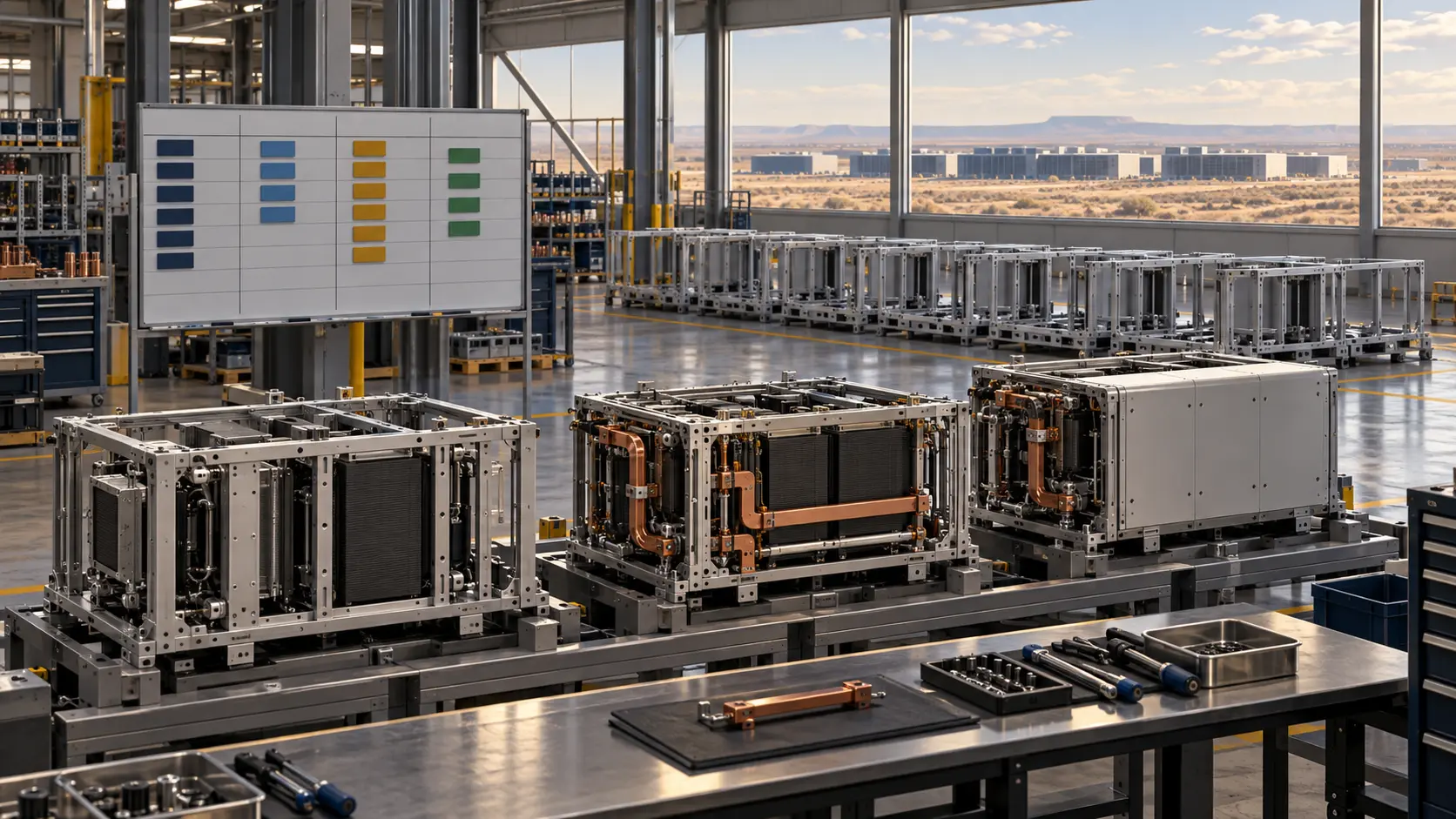
A reservation can be commercially meaningful without being a power plant. FuelCell Energy’s first capacity-reservation agreement gives an unnamed data-centre operator priority access to factory capacity for a planned 75 MW Texas project. The operator has paid an upfront amount, but the company has not disclosed the sum, named the customer or announced definitive project agreements. It says it will reserve manufacturing capacity and begin purchasing long-lead components while those agreements are completed.
That sequence puts the factory at the centre of the story. The company is no longer describing only a prospective customer conversation: it has a paid reservation and says procurement will start. Yet priority access is still one step in a chain. It does not establish a final construction scope, delivery timetable, completed equipment, site acceptance or electricity serving a data centre. The release describes six 12.5 MW FuelCell Energy Block systems, a modular plan rather than six delivered units.
The company’s filing draws a useful line between this kind of commercial signal and contracted work. As of 31 July, FuelCell Energy reported about $1.30 billion in Committed Backlog, which it defines as definitive, non-cancelable agreements. It separately presented $2.35 billion in Awarded Capacity Backlog tied to Fit Energy’s optional 350 MW Phases 1–3. The company says that category includes awards, capacity reservations and similar arrangements advancing toward definitive agreements; it is not firm-order or contracted backlog, nor a guarantee of revenue. The Texas reservation was signed after the quarter and was not part of those July figures. The 10-Q and the Q3 announcement describe different dates and different stages of commitment.
Fit Energy is a separate customer under a separate contract. Its agreement covers up to 380 MW across four phases: an initial 30 MW Phase 0 and three later phases of 100, 125 and 125 MW. Phase 0 is the committed segment. Fit can elect the rest at its sole option; no payment obligation for a later phase arises until Fit elects it and an initial deposit becomes due. Sites, permitting, financing and construction may still be outstanding. Treating that optional 350 MW as equivalent to the Texas reservation would blur both the parties and the obligations. The two arrangements instead show a supplier experimenting with different ways to secure manufacturing capacity before every project detail is settled. The company’s June agreement announcement and SEC-filed investor presentation set out the phased structure.
There is a harder operating test behind the commercial vocabulary. During the quarter ended 31 July, FuelCell Energy operated its Torrington facility at an annualized production rate of about 37.1 MW, up from 33.2 MW a year earlier. Management targeted 100 MW in October 2026. The 37.1 MW figure is a rate observed over a quarter, not the amount of capacity already delivered to customers. In the same filing, the company says product costs and absorbed manufacturing overhead at that rate exceeded the contract pricing established with Fit.
It recorded roughly $4 million of inventory charges and $13 million of losses on firm purchase commitments associated with Fit Phase 0. The filing says these charges concern identified Phase 0 items and do not represent management’s view of the overall agreement economics. They should not be projected onto the Texas reservation or every future order.
FuelCell Energy plans to expand Torrington to support at least 500 MW of annualized capacity in the relevant manufacturing process. The company expected a $200 million–$275 million investment and completion by June 2028. Capital committed to equipment is progress toward a larger factory; it is not a qualified line, sustained output or evidence that costs have fallen. The 12 October appointment of John Dansby as senior vice-president for scale-up manufacturing adds an executive accountable for that work, not an outcome. The filing records the scale-up plan; the appointment notice records the organizational change.
The test, then, is not whether data centres need electricity or whether FuelCell Energy has announced a large pipeline. It is whether the company can turn different forms of customer commitment into a repeatable delivery system: project-specific agreements, component procurement, production at higher volume, acceptable unit costs, shipment, installation and commissioning. The company reaffirmed a target for positive Adjusted EBITDA in the fourth quarter of fiscal 2027, conditional on production increases, backlog conversion, delivery schedules and cost reductions. That target links the factory ramp to economics, but it remains management’s goal rather than a recorded result. The 7 October update makes those dependencies explicit.
A capacity reservation buys a place in a manufacturing queue. Its value to the customer depends on the queue becoming a functioning installation; its value to the supplier depends on disciplined conversion rather than headline megawatts. Public evidence has reached the reservation and planned procurement stages. It has not yet reached a named customer, final project terms or an operating Texas site.
Sources: FuelCell Energy’s Q3 2026 Form 10-Q, Q3 release and Texas reservation, SEC-filed Q3 presentation, Fit Energy agreement, 7 October profitability-target update and 12 October manufacturing appointment.
Member Briefing
Deeper Profile Context
Sign in with the right membership level to unlock the full briefing and source notes.
Only for Strategic Circle
Strategic Circle
Open to all readers. Unlock profile briefings after joining and signing in.
Join Strategic CircleOnly for Leadership Alliance
Leadership Alliance
For qualified IP-asset owners and management; sign in to unlock alliance briefings.
Join Leadership Alliance