Summary
- LACNIC's own founding page names six organisations, prints one date and one place, and closes with the words that introduce a signature — then renders no name, no capacity and no signature date.
- LACNIC's later pages supply the names and put the same act on four different legal footings between 1999 and 2002. Two of those pages assign different people to CABASE's signing hand and to ENRED's.
- Florencio Utreras's bylined post of 31 July 2017 is the only reviewed page where he says, in the first person, that he represented ENRED and hosted the constitutive meeting. No reviewed institutional signatory list names him.
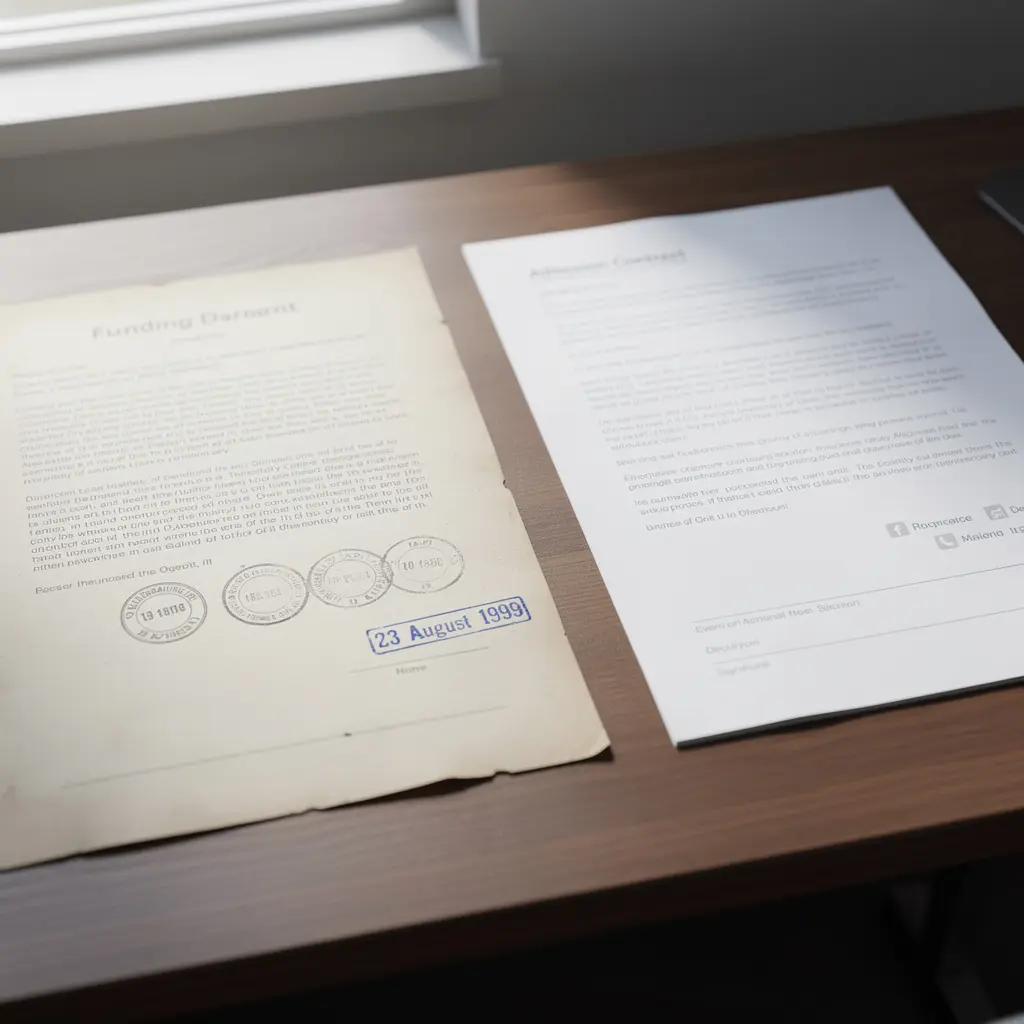
The page sits at a LACNIC address titled "RECOGNITION OF LACNIC". It carries the heading "23 de Agosto de 1999" and opens, in the text as retrieved, "En Santiago de Chile a los 23 días del mes de agosto de 1999, reunidas las siguientes organizaciones:" (LACNIC, recognition). It then lists six parties by acronym and full corporate name — AHCIET, CABASE, CGIBR, ECOMLAC, ENRED, NIC-Mx — and ends: "Todo lo cual se detalla en el documento anexo. De conformidad, se suscribe a continuación." Everything else is said in an annex this page does not carry. The words that close it promise a signature below. Nothing below them, in the text as retrieved, is a signature.
What the index promises and does not deliver
LACNIC's official-documents page lists an item called "LACNIC - Acuerdo de Creación", twice — apparently a Spanish and an English version — next to a letter of support from ARIN, a letter to ICANN's Stuart Lynn, and a cover letter (LACNIC, official documents). The index is labels only: no date, no name, no capacity. The creation agreement itself is listed, and in the review conducted for this piece it was not opened. That matters for what follows, because it means every statement here about who signed is a statement about the pages LACNIC publishes, not about the paper in its files. A scanned sheet with six handwritten signatures could sit behind that link tomorrow and change nothing said here — except this: that page is not the one the registry shows.
Four footings for one room
LACNIC's own materials do not put its beginning on one date. They put it on four.
The first chapter of the institution's own history places the signing on 23 August 1999 in Santiago and names one representative per organisation: Raimundo Beca for AHCIET, Jorge Plano for CABASE, José Luiz Ribeiro Filho for the Comité Gestor de Internet de Brasil, Fabio Marinho for eCOMLAC, Julián Dunayevich for ENRED, Germán Valdez for NIC México (LACNIC, community history, chapter 1). It gives no capacity for any of the six and no date per signature. It is a narrative, and it reads as one.
The second chapter of the same history dates the decisions to "aquel 22 de agosto de 1999 en la oficina de REUNA, donde operaba Florencio Utreras", where, it says, choices were being taken that would mark the registry for the future (LACNIC, community history, chapter 2). This is the sentence that matters most in the whole set, and it does not come from Utreras. The institution itself places the room in the office he ran.
A tenth-anniversary notice published on 28 August 2009 splits the difference and keeps the names out: the discussion concluded on the Sunday, and "Al día siguiente, el 23 de agosto de 1999, representantes del NIC Brasil, NIC México, eCOM-LAC, ENRED, CABASE y AHCIET, firmaron el acuerdo para su fundación." Representatives, plural, unnamed (LACNIC, 10th anniversary notice).
Then the legal form arrives years later, in two instalments. LACNIC's audited notes describe "a non-governmental and non-profit organisation, incorporated on July 27, 2001 in the city of Montevideo, Uruguay" which "started operations on April 1, 2002" (LACNIC, notes to the 2020 financial statements). The 2002 annual report recalls a board decision of 30 September 2000 completing the bylaws and establishing the organisation in Montevideo, records ICANN's recognition on 31 October 2002 during the Shanghai meeting, and notes that the board designated Oscar Messano as its president by unanimous vote (LACNIC, Memoria Anual 2002). And the executive director who followed, Raúl Echeberría, told a tenth-anniversary audience what that recognition meant to him: "Llegamos así al 31 de octubre de 2002, el día que oficialmente nació LACNIC." (Echeberría, 10 años de LACNIC).
My own arithmetic, and it is mine: the signing to the board decision is 404 days; to legal incorporation, 704; from incorporation to the start of operations, 248; from the signing to the Shanghai recognition, 1,165. The two dates LACNIC's own history gives for the same sequence sit one day apart.
Two lists, two different hands
Names exist on exactly two of the twelve documents reviewed, and they do not agree with each other.
The history gives CABASE to Jorge Plano. The tenth-anniversary honours page lists "Firmantes del Acta Constitutiva" — in the retrieved text, Julián Dunayevich of Argentina and José Luiz Ribeiro Filho of Brasil, with the text elided after the second name — and then a second group, "Firmantes del Acta Constitutiva que además fueron Directores": Germán Valdez Avilés, Raimundo Beca, Fábio Marinho and Oscar Messano (LACNIC, tenth-anniversary honours). Plano is not among the names the retrieved text labels a signatory. Messano is, though the history assigns CABASE at the signing to Plano. The two pages disagree, and neither prints a capacity or a signature date for anyone.
So: two of twelve documents name individuals at the signing; none of the twelve prints an office beside any name; none prints a date beside any name. Those counts are mine, over these twelve documents read on 25 November 2026.
The man who says he hosted it
On 31 July 2017 LACNIC's own blog published a piece under Florencio Utreras's name. In it he writes: "Participé en la creación de LACNIC en 1999, cuando en representación de ENRED y como Director Ejecutivo de REUNA fui el anfitrión de la reunión de constitución de LACNIC que se hiciera en agosto de 1999 en ocasión de la reunión de ICANN llevada a cabo en Santiago de Chile." And then, plainly: "Luego de su creación en 1999 no he participado más que como usuario." (LACNIC Blog, Florencio Utreras).
Three things are printed there that appear nowhere else in this set. He says he represented ENRED. He says his capacity was executive director of REUNA — not of LACNIC. And he says he was the host. The institution's own history gives ENRED's signing hand to Dunayevich. Both statements can be true: a representative can be named by the institution while the man who convened the room signs nothing, or signs an annex nobody has published. What cannot be done is to read either page as confirming the other. They are two documents, dated seventeen years apart, making overlapping claims about the same room.
The 6,552 days between the 1999 signing and that post are my arithmetic, not his.
What binds a member now
The instrument a member accepts today carries that same silence further. The English registration services agreement opens with a warning: "The Registration Service Agreement with LACNIC is a Adhesion Agreement and its contents must not be changed." It is concluded between "the LATIN AMERICAN AND CARIBBEAN REGISTRY FOR INTERNET NUMBERS, LTD." and "the Applicant Company", whose "addresses and representatives are set forth below" (LACNIC, registration services agreement, English). The execution clause runs: "IN WITNESS WHEREOF, the parties hereby have caused this Agreement to be executed by their duly authorized representatives at the places and on the dates set forth below." Below it: LACNIC, COMPANY NAME, "by:", "LACNIC Authorized Contracting Agent", "Authorized Contracting Agent", "Print Name", a Montevideo address, and "Date". Not one personal name. Not one capacity held by a person. Not one date.
The Spanish version is the same shape and says it out loud: "El Acuerdo de Servicios de Registro de LACNIC, es un Acuerdo de Adhesión y su contenido no puede ser modificado. Para acceder a los recursos que LACNIC le puede asignar, el mismo deberá ser firmado tal cual lo encontrará a continuación." The parties are LACNIC and "el Solicitante", whose "representación y domicilio se consignan al final", and the close reads "en el lugar y fecha indicados" (LACNIC, acuerdo de servicios de registro, Spanish). The Spanish text as retrieved stops before its signature area; the block's contents are read from the parallel English file.
Put the two ends side by side. The founding page names organisations and withholds people. The contract names an institution and an applicant and withholds both, leaving two fields — print name, date — for whoever turns up. In between, the people appear only on anniversary pages that disagree.
Why the host is the hinge
A registry's founding is not a document anyone consults when they need it. Members consult the agreement; auditors consult the accounts; historians consult the anniversary pages. The three surfaces do not share an author and do not share a date. LACNIC is legally a Montevideo company of 2001 that began operating in April 2002 and was recognised as a regional registry in Shanghai that October — four propositions, each printed, each true of a different thing.
Utreras matters here because he is the one participant the record places in the room without putting him on a list. Replace him with Dunayevich, Plano, Beca, Marinho, Ribeiro Filho, Valdez or Messano and the finding evaporates: each of those names is on an institutional roster, and rosters are the thing this piece is counting. He is the only one whose presence rests on his own sentence, published on the institution's own blog, describing an act — hosting — that leaves no trace in any instrument reviewed.
That is the shape of an institution built by people it does not name. The commitment is durable: the agreement survives every officer. The authorship is not: it lives on anniversary pages, in a blog post, in a history that gives two dates for the same Sunday and Monday. A member signing today inherits an obligation whose chain runs back to six organisations and a sentence saying a signature follows.
Limits
The creation agreement listed on LACNIC's official-documents index was not opened; its signature block is unreviewed here. The recognition page may carry a scanned or imaged signature area below the closing formula, which a text reading cannot show. The honours page text is elided between its first two names, so its roster is incomplete as retrieved. The Spanish agreement text was truncated before its signature area. Wikipedia was consulted only to cross-check the date and is not used as a source. Every absence asserted above is a count over these twelve documents read on 25 November 2026, not a claim about LACNIC's files.
Member Briefing
Read the full trend briefing
Members read the full briefing with the source notes behind every finding.
Strategic Circle
A daily briefing in your language, built from changes we have verified.
Join for USD 20/monthCancel anytime.
Members also get the full research library, a daily briefing on the networks they follow and the private forum.